
.svg)

.svg)


SP Persedex C-50 is a strong cation-exchange IEX chromatography resin built on a highly cross-linked dextran matrix. It combines a high flow rate with low back pressure, high dynamic capacity and good chemical stability. The resin is easy to scale up, shortening production time, improving production efficiency and reducing the cost of large-scale production. It is used for the separation of low molecular weight proteins, peptides, nucleotides and macromolecules.
Method of use
SP Persedex C-50 is supplied in granular form and must be swollen before use. The swelling ratio depends on the buffer used and differs considerably between solutions. Do not use magnetic stirring during swelling, as this easily breaks the gel.
Chromatography steps
- Pre-treatment. Weigh out the required amount of SP Persedex C-50, place it in 50–100 volumes of distilled water or loading equilibration solution and allow it to swell. Swelling usually takes 1–2 days at room temperature, or 2 hours in boiling water.
- Column packing. Pack the column according to standard operating procedure. Ensure that all materials are at working temperature and degas the gel before packing.
- Equilibration. Equilibrate the column with 2–5 column bed volumes (CV), making sure that the conductivity and pH of the eluent are exactly the same as those of the loading buffer.
- Sample loading. Determine the loading amount from the target product concentration and the loading capacity of the gel.
- Washing. After loading the sample, equilibrate the column with loading buffer to wash away unbound proteins and impurities, until the conductivity and pH of the eluent are exactly the same as those of the loading buffer.
- Elution. Use continuous or gradient elution, either by increasing the salt concentration of the buffer or by increasing the pH.
- Regeneration. Wash the impurity proteins off the column with 1–2M NaCl, then wash the salt out of the column with distilled water. Process the SP Persedex C-50 again according to the pre-treatment procedure.
Storage
Keep unopened resin in the original container at 4–30°C in a well-ventilated, dry and clean place. Do not freeze. Wash the used column with 2–3 CV of 20% ethanol solution and store at 2–8°C.
Destruction and recycling
Chromatography resin is difficult to degrade in nature, so incineration of waste resin is recommended to protect the environment. For resin that has been in contact with biologically active samples such as viruses and blood, follow local biosafety requirements before destroying or disposing of it.
Packing method
Detailed information on resin packaging is available on request. Please contact your local distributor.
Ordering information
- 268-00025 — 25 g
- 268-00100 — 100 g
- 268-00500 — 500 g
- 268-01000 — 1 kg
- 268-05000 — 5 kg
- 268-10000 — 10 kg


Corus 30-300 is a high-pressure chromatographic resin based on polystyrene-divinylbenzene. It has a large specific surface area, and excellent chemical and physical stability. Corus 30-300 has the advantages of high flow rate and high dynamic capacity, resistance to acid and alkali, and has a narrow pH operating range. The resin is used in reversed-phase chromatography (RPC) separation of small molecular compounds, peptides, low molecular weight proteins and other biomolecules.
Method of use
Column packing
Slurry concentration is the volume of the resting gel divided by the total volume after homogenisation. The best packing effect is obtained using a 0.5M NaCl slurry at a concentration of 70%.
- Calculate the column volume: V = Ac × L, where Ac = π × r². Ac is the cross-sectional area of the column, L is the height of the column, and r is the radius of the column.
- Agitate the medium to form a slurry and measure the required mass or volume. This should be about 1.2 CV to prevent shrinkage.
- Replace 20% ethanol with 0.5M NaCl solution and equilibrate overnight.
- Before packing, use 0.5M NaCl solution to adjust the slurry concentration to 65–70%. Pour the slurry into the column in a single pass, allow it to settle, and mark the height.
- Install the adapter and adjust the height so that the compression coefficient is 1.05–1.10. Start the pump and use a flow rate of 1.5–2 × the working flow rate to stabilise the column bed.
Cleaning
Packed columns should be cleaned with at least 5 CV of ultrapure or pure water.
Flow rate
After packing the column, equilibrate with the mobile phase for 3–4 CV. Control the flow rate at 1–5 cm/min until the conductivity and pH of the flow-through remain constant before loading the sample.
Sample loading
Solid samples can be prepared by dissolving them in equilibration buffer. Low-concentration sample solutions can be concentrated in advance; high-concentration sample solutions can be diluted with equilibration buffer. Filter the sample by centrifugation or membrane filtration to avoid clogging the column.
Estimate the sample load from the loading capacity of the resin and the concentration of the target molecule in the sample. Before loading, make the sample buffer as consistent as possible with the equilibration buffer. Reduce the sample load for the first run, then increase it according to the retention time and peak shape of the target molecules.
Elution
Use 2–10 CV of an aqueous solution such as methanol, ethanol, acetonitrile or acetone. Adjust the pH with acid, alkali or buffer, or both, to elute the target molecules.
Cleaning and regeneration
Contaminants such as lipids, endotoxins and proteins accumulate on the column as the number of uses increases. Regular cleaning-in-place (CIP) keeps the column in a stable working condition. Determine the frequency of CIP according to the degree of contamination. Where contamination is considerable, CIP after each use is recommended to ensure repeatability of results and to prolong the working life of the resin.
First wash with 3–4 CV of ethanol, acetone, alkali with ethanol or other solvents at the operating flow rate, then wash with 3–4 CV of equilibration buffer to re-equilibrate the column.
Storage
Keep unopened resin in the original container at 4–30°C in a well-ventilated, dry and clean place. Do not freeze. Wash the used column with 2–3 CV of 20–25% ethanol solution and store at 2–8°C.
Destruction and recycling
Chromatography resin is difficult to degrade in nature, so incineration of waste resin is recommended. For resin that has been in contact with biologically active samples such as viruses and blood, follow local biosafety requirements before destroying or disposing of it.
Packing method
Detailed information on resin packaging is available on request. Please contact your local distributor.
Ordering information
- 275-00025 — 25 ml
- 275-00100 — 100 ml
- 275-00500 — 500 ml
- 275-01000 — 1 L
- 275-05000 — 5 L
- 275-10000 — 10 L
Corus 30-100 is a high-pressure chromatographic resin based on polystyrene-divinylbenzene. It has a large specific surface area, and excellent chemical and physical stability. Corus 30-100 has the advantages of high flow rate and high dynamic capacity, resistance to acid and alkali, and has a narrow pH operating range. The resin is used in reversed-phase chromatography (RPC) separation of small molecular compounds, peptides, low molecular weight proteins and other biomolecules.
Method of use
Column packing
Slurry concentration is the volume of the resting gel divided by the total volume after homogenisation. The best packing effect is obtained using a 0.5M NaCl slurry at a concentration of 70%.
- Calculate the column volume: V = Ac × L, where Ac = π × r². Ac is the cross-sectional area of the column, L is the height of the column, and r is the radius of the column.
- Agitate the medium to form a slurry and measure the required mass or volume. This should be about 1.2 CV to prevent shrinkage.
- Replace 20% ethanol with 0.5M NaCl solution and equilibrate overnight.
- Before packing, use 0.5M NaCl solution to adjust the slurry concentration to 65–70%. Pour the slurry into the column in a single pass, allow it to settle, and mark the height.
- Install the adapter and adjust the height so that the compression coefficient is 1.05–1.10. Start the pump and use a flow rate of 1.5–2 × the working flow rate to stabilise the column bed.
Cleaning
Packed columns should be cleaned with at least 5 CV of ultrapure or pure water.
Flow rate
After packing the column, equilibrate with the mobile phase for 3–4 CV. Control the flow rate at 1–5 cm/min until the conductivity and pH of the flow-through remain constant before loading the sample.
Sample loading
Solid samples can be prepared by dissolving them in equilibration buffer. Low-concentration sample solutions can be concentrated in advance; high-concentration sample solutions can be diluted with equilibration buffer. Filter the sample by centrifugation or membrane filtration to avoid clogging the column.
Estimate the sample load from the loading capacity of the resin and the concentration of the target molecule in the sample. Before loading, make the sample buffer as consistent as possible with the equilibration buffer. Reduce the sample load for the first run, then increase it according to the retention time and peak shape of the target molecules.
Elution
Use 2–10 CV of an aqueous solution such as methanol, ethanol, acetonitrile or acetone. Adjust the pH with acid, alkali or buffer, or both, to elute the target molecules.
Cleaning and regeneration
Contaminants such as lipids, endotoxins and proteins accumulate on the column as the number of uses increases. Regular cleaning-in-place (CIP) keeps the column in a stable working condition. Determine the frequency of CIP according to the degree of contamination. Where contamination is considerable, CIP after each use is recommended to ensure repeatability of results and to prolong the working life of the resin.
First wash with 3–4 CV of ethanol, acetone, alkali with ethanol or other solvents at the operating flow rate, then wash with 3–4 CV of equilibration buffer to re-equilibrate the column.
Storage
Keep unopened resin in the original container at 4–30°C in a well-ventilated, dry and clean place. Do not freeze. Wash the used column with 2–3 CV of 20–25% ethanol solution and store at 2–8°C.
Destruction and recycling
Chromatography resin is difficult to degrade in nature, so incineration of waste resin is recommended. For resin that has been in contact with biologically active samples such as viruses and blood, follow local biosafety requirements before destroying or disposing of it.
Packing method
Detailed information on resin packaging is available on request. Please contact your local distributor.
Ordering information
- 274-00025 — 25 ml
- 274-00100 — 100 ml
- 274-00500 — 500 ml
- 274-01000 — 1 L
- 274-05000 — 5 L
- 274-10000 — 10 L
Corus 15-300 is a high-pressure chromatographic resin based on polystyrene-divinylbenzene. It has a large specific surface area, and excellent chemical and physical stability. Corus 15-300 has the advantages of high flow rate and high dynamic capacity, resistance to acid and alkali, and has a narrow pH operating range. The resin is used in reversed-phase chromatography (RPC) separation of small molecular compounds, peptides, low molecular weight proteins and other biomolecules.
Method of use
Column packing
Slurry concentration is the volume of the resting gel divided by the total volume after homogenisation. The best packing effect is obtained using a 0.5M NaCl slurry at a concentration of 70%.
- Calculate the column volume: V = Ac × L, where Ac = π × r². Ac is the cross-sectional area of the column, L is the height of the column, and r is the radius of the column.
- Agitate the medium to form a slurry and measure the required mass or volume. This should be about 1.2 CV to prevent shrinkage.
- Replace 20% ethanol with 0.5M NaCl solution and equilibrate overnight.
- Before packing, use 0.5M NaCl solution to adjust the slurry concentration to 65–70%. Pour the slurry into the column in a single pass, allow it to settle, and mark the height.
- Install the adapter and adjust the height so that the compression coefficient is 1.05–1.10. Start the pump and use a flow rate of 1.5–2 × the working flow rate to stabilise the column bed.
Cleaning
Packed columns should be cleaned with at least 5 CV of ultrapure or pure water.
Flow rate
After packing the column, equilibrate with the mobile phase for 3–4 CV. Control the flow rate at 1–5 cm/min until the conductivity and pH of the flow-through remain constant before loading the sample.
Sample loading
Solid samples can be prepared by dissolving them in equilibration buffer. Low-concentration sample solutions can be concentrated in advance; high-concentration sample solutions can be diluted with equilibration buffer. Filter the sample by centrifugation or membrane filtration to avoid clogging the column.
Estimate the sample load from the loading capacity of the resin and the concentration of the target molecule in the sample. Before loading, make the sample buffer as consistent as possible with the equilibration buffer. Reduce the sample load for the first run, then increase it according to the retention time and peak shape of the target molecules.
Elution
Use 2–10 CV of an aqueous solution such as methanol, ethanol, acetonitrile or acetone. Adjust the pH with acid, alkali or buffer, or both, to elute the target molecules.
Cleaning and regeneration
Contaminants such as lipids, endotoxins and proteins accumulate on the column as the number of uses increases. Regular cleaning-in-place (CIP) keeps the column in a stable working condition. Determine the frequency of CIP according to the degree of contamination. Where contamination is considerable, CIP after each use is recommended to ensure repeatability of results and to prolong the working life of the resin.
First wash with 3–4 CV of ethanol, acetone, alkali with ethanol or other solvents at the operating flow rate, then wash with 3–4 CV of equilibration buffer to re-equilibrate the column.
Storage
Keep unopened resin in the original container at 4–30°C in a well-ventilated, dry and clean place. Do not freeze. Wash the used column with 2–3 CV of 20–25% ethanol solution and store at 2–8°C.
Destruction and recycling
Chromatography resin is difficult to degrade in nature, so incineration of waste resin is recommended. For resin that has been in contact with biologically active samples such as viruses and blood, follow local biosafety requirements before destroying or disposing of it.
Packing method
Detailed information on resin packaging is available on request. Please contact your local distributor.
Ordering information
- 273-00025 — 25 ml
- 273-00100 — 100 ml
- 273-00500 — 500 ml
- 273-01000 — 1 L
- 273-05000 — 5 L
- 273-10000 — 10 L
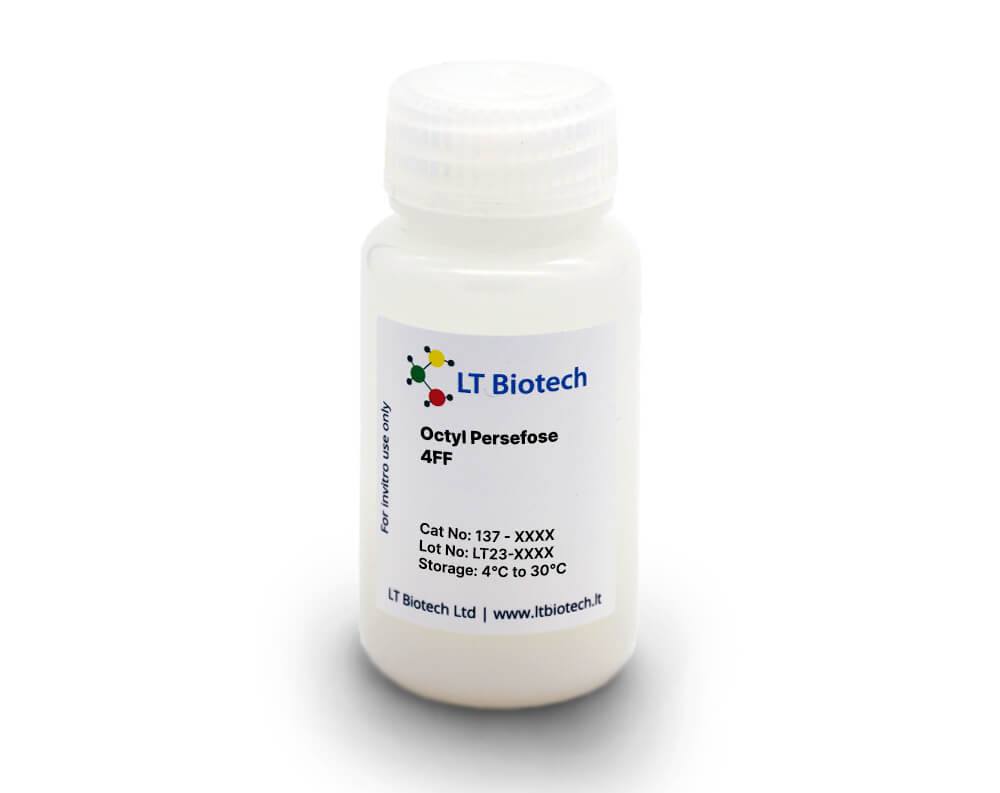
Octyl Persefose 4FF is a HIC resin prepared by coupling Octyl fat chains on a 4% agarose matrix. The high physical and chemical stability allows good pressure flow rate performance, making it ideal for large-scale purification processes especially in the capture or intermediate purification stages, where a high flow rate separation process is required. It is suitable for the fine separation and purification of recombinant proteins, antibodies, vaccines, virus-like particles and other highly hydrophobic biological molecules.
Method of use
Chromatographic conditions
Buffer selection. The binding buffer is usually a phosphate buffer containing a high concentration of salt, such as 20–50 mM PB with 1.5–2M (NH4)2SO4 at pH 7.0. The elution buffer is usually phosphate buffer without other salts, such as 50 mM PB at pH 7.0. Adjust the concentration and type of salt in the binding buffer based on the results obtained — whether the target precipitates, how strongly it binds, recovery rate, resolution. For substances that are difficult to elute, use pure water, or pure water with a low concentration of ethanol added.
Flow rate. Select a linear flow rate of 90–150 cm/h according to the column bed height.
Sample pretreatment. Filter the sample through a 0.45 µm microporous membrane before loading to prevent the column from clogging. Adjust the pH and conductivity of the sample to be consistent with the equilibration buffer, using dilution, ultrafiltration or desalting.
Chromatography steps
- Equilibration. Use equilibration buffer to fully equilibrate the column until the pH and conductivity are stable and consistent with the equilibration buffer. This step usually requires 3–5 column bed volumes (CV).
- Sample loading. Determine the loading volume and loading amount from the binding capacity measured in a small-scale test.
- Impurity washing. Use equilibration buffer or another suitable buffer to wash the column until the UV signal stabilises and returns to baseline.
- Elution. Elute by decreasing the concentration of salt ions in the elution buffer, applied as a linear or step gradient, to separate molecules of different binding strength. pH gradient elution or mixed elution can also be used.
- Regeneration. Rinse the column with a buffer containing low salt.
- Re-equilibration. Re-equilibrate the column with equilibration buffer.
In flow-through mode, collect during the sample loading step. Continue collecting through the washing step until all target molecules have passed through, then stop. Use low-salt buffer directly at the elution step to wash impurities away.
Cleaning and regeneration
Contaminants such as lipids, endotoxins and proteins accumulate on the column as the number of uses increases. Determine the frequency of cleaning-in-place (CIP) according to the degree of contamination. Where contamination is considerable, CIP after each use is recommended to ensure repeatability of results and to prolong the working life of the resin.
Recommended cleaning conditions by contaminant type:
- Strongly binding proteins: wash with 5 CV of ultrapure or pure water.
- Strongly hydrophobic and precipitated proteins: wash with 5 CV of 1M NaOH solution, then wash out the alkali with 5–10 CV of ultrapure or pure water.
- Lipoproteins and lipids: wash with 5 CV of 70% ethanol or 30% isopropanol, then rinse with 5–10 CV of ultrapure or pure water.
Degas 70% ethanol or 30% isopropanol before use. Use a flow rate of 30–60 cm/h during CIP. Use reverse cleaning where clogging is severe.
To reduce microbial load, treat the resin with 0.5–1M NaOH solution for 15–30 minutes.
Storage
Keep unopened resin in the original container at 4–30°C in a well-ventilated, dry and clean place. Do not freeze. Wash the used column with 2–3 CV of 20% ethanol solution and store at 2–8°C.
Destruction and recycling
Chromatography resin is difficult to degrade in nature, so incineration of waste resin is recommended. For resin that has been in contact with biologically active samples such as viruses and blood, follow local biosafety requirements before destroying or disposing of it.
Packing method
Detailed information on resin packaging is available on request. Please contact your local distributor.
Ordering information
- 137-00025 — 25 ml
- 137-00100 — 100 ml
- 137-00500 — 500 ml
- 137-01000 — 1 L
- 137-05000 — 5 L
- 137-10000 — 10 L
- 137-20000 — 20 L
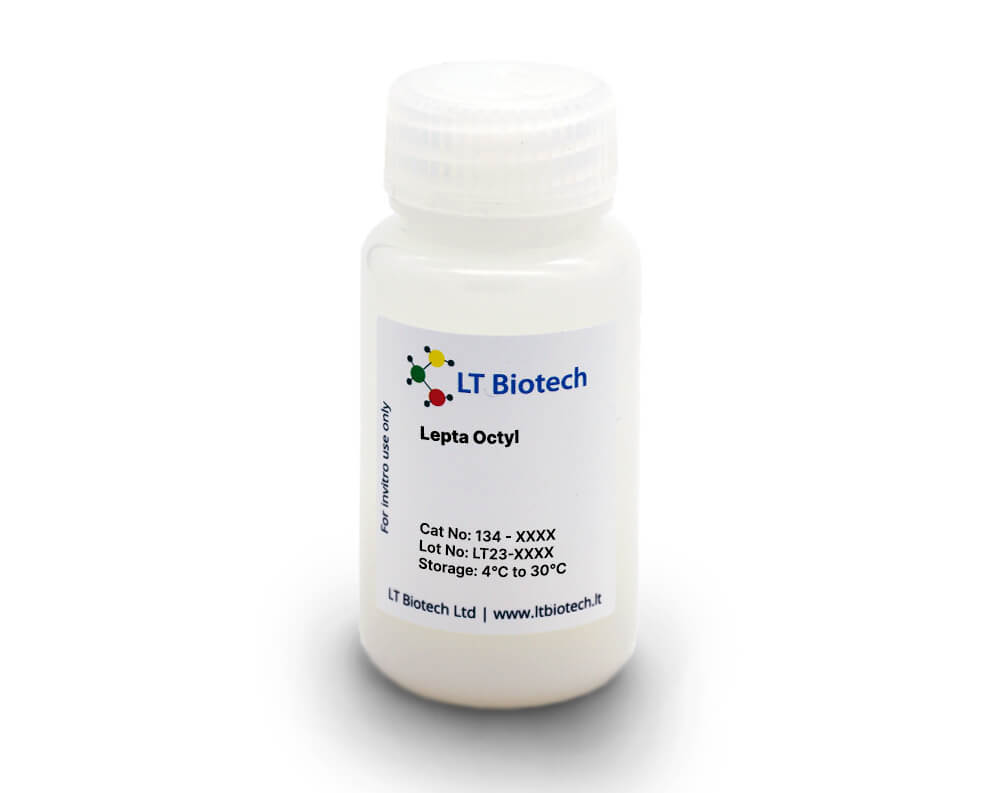
Lepta Octyl is a HIC resin based on high-rigidity agarose with a moderately hydrophobic aliphatic octyl group. It has low backpressure and fast flow rate, and is suitable for large-scale separation and purification of biomolecules. It is suitable for the fine separation and purification of recombinant proteins, antibodies, vaccines, virus-like particles and other highly hydrophobic biological molecules.
Method of use
Chromatographic conditions
Buffer selection. The binding buffer is usually a phosphate buffer containing a high concentration of salt, such as 20–50 mM PB with 1.5–2M (NH4)2SO4 at pH 7.0. The elution buffer is usually phosphate buffer without other salts, such as 20–50 mM PB at pH 7.0. Adjust the concentration and type of salt in the binding buffer based on the results obtained — whether the target precipitates, how strongly it binds, recovery rate, resolution. For substances that are difficult to elute, use pure water, or pure water with a low concentration of ethanol added.
Flow rate. Select a linear flow rate of 150–350 cm/h according to the column bed height.
Sample pretreatment. Filter the sample through a 0.45 µm microporous membrane before loading to prevent the column from clogging. Adjust the pH and conductivity of the sample to be consistent with the equilibration buffer, using dilution, ultrafiltration or desalting.
Chromatography steps
- Equilibration. Use equilibration buffer to fully equilibrate the column until the pH and conductivity are stable and consistent with the equilibration buffer. This step usually requires 3–5 column bed volumes (CV).
- Sample loading. Determine the loading volume and loading amount from the binding capacity measured in a small-scale test.
- Impurity washing. Use equilibration buffer or another suitable buffer to wash the column until the UV signal stabilises and returns to baseline.
- Elution. Elute by decreasing the concentration of salt ions in the elution buffer, applied as a linear or step gradient, to separate molecules of different binding strength. pH gradient elution or mixed elution can also be used.
- Regeneration. Rinse the column with a buffer containing low salt.
- Re-equilibration. Re-equilibrate the column with equilibration buffer.
In flow-through mode, collect during the sample loading step. Continue collecting through the washing step until all target molecules have passed through, then stop. Use low-salt buffer directly at the elution step to wash impurities away.
Cleaning and regeneration
Contaminants such as lipids, endotoxins and proteins accumulate on the column as the number of uses increases. Determine the frequency of cleaning-in-place (CIP) according to the degree of contamination. Where contamination is considerable, CIP after each use is recommended to ensure repeatability of results and to prolong the working life of the resin.
Recommended cleaning conditions by contaminant type:
- Strongly binding proteins: wash with 5 CV of ultrapure or pure water.
- Strongly hydrophobic and precipitated proteins: wash with 5 CV of 1M NaOH solution, then wash out the alkali with 5–10 CV of ultrapure or pure water.
- Lipoproteins and lipids: wash with 5 CV of 70% ethanol or 30% isopropanol, then rinse with 5–10 CV of ultrapure or pure water.
Degas 70% ethanol or 30% isopropanol before use. Use a flow rate of 30–60 cm/h during CIP. Use reverse cleaning where clogging is severe.
To reduce microbial load, treat the resin with 0.5–1M NaOH solution for 15–30 minutes.
Storage
Keep unopened resin in the original container at 4–30°C in a well-ventilated, dry and clean place. Do not freeze. Wash the used column with 2–3 CV of 20% ethanol solution and store at 2–8°C.
Destruction and recycling
Chromatography resin is difficult to degrade in nature, so incineration of waste resin is recommended. For resin that has been in contact with biologically active samples such as viruses and blood, follow local biosafety requirements before destroying or disposing of it.
Packing method
Detailed information on resin packaging is available on request. Please contact your local distributor.
Ordering information
- 134-00025 — 25 ml
- 134-00100 — 100 ml
- 134-00500 — 500 ml
- 134-01000 — 1 L
- 134-05000 — 5 L
- 134-10000 — 10 L
- 134-20000 — 20 L
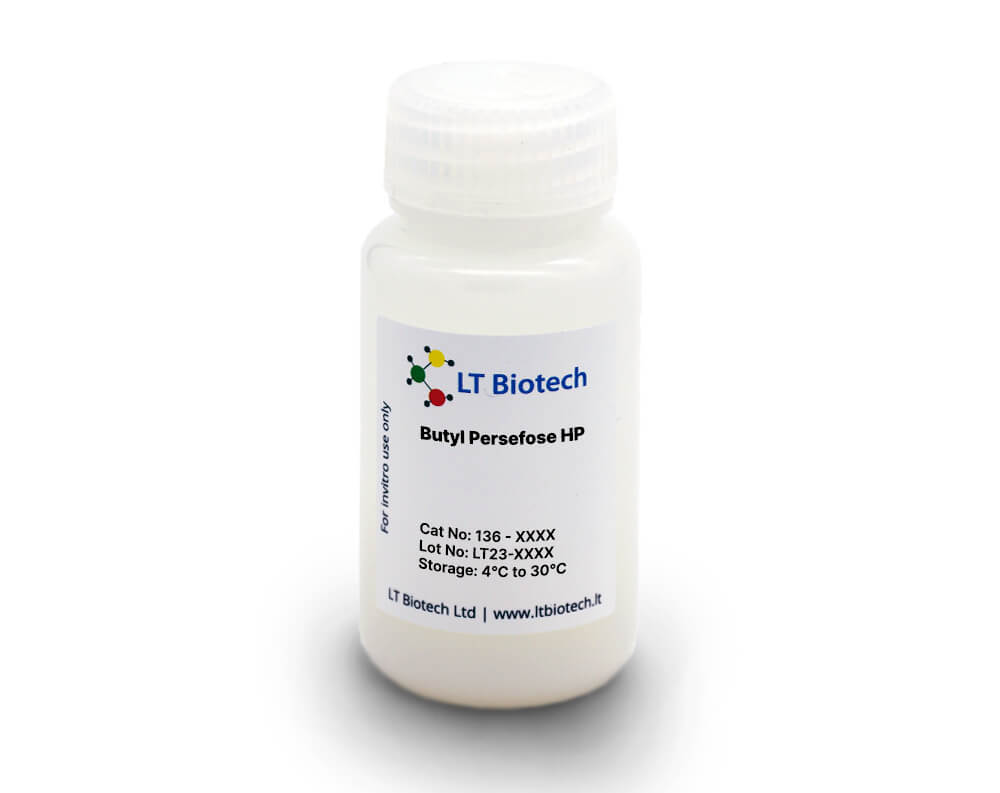
The framework of Butyl Persefose HP HIC resin is highly cross-linked agarose, which retains the excellent hydrophilicity and pore structure of natural polysaccharide compounds and has good compatibility with biological macromolecules. The average particle size of Butyl Persefose HP is 34 μm, which has a higher resolution efficiency than Butyl Persefose 4FF. The surface contains hydrophobic ligands; the ligand is butyl, which is particularly suitable for the fine separation and purification of recombinant proteins, antibodies, vaccines, virus-like particles and other highly hydrophobic biological molecules.
Method of use
Chromatographic conditions
Buffer selection. The binding buffer is usually a phosphate buffer containing a high concentration of salt, such as 20–50 mM PB with 1.5–2M (NH4)2SO4 at pH 7.0. The elution buffer is usually phosphate buffer without other salts, such as 20–50 mM PB at pH 7.0. Adjust the concentration and type of salt in the binding buffer based on the results obtained — whether the target precipitates, how strongly it binds, recovery rate, resolution. For substances that are difficult to elute, use pure water, or pure water with a low concentration of ethanol added.
Flow rate. Select a linear flow rate of 60–120 cm/h according to the column bed height.
Sample pretreatment. Filter the sample through a 0.45 µm microporous membrane before loading to prevent the column from clogging. Adjust the pH and conductivity of the sample to be consistent with the equilibration buffer, using dilution, ultrafiltration or desalting.
Chromatography steps
- Equilibration. Use equilibration buffer to fully equilibrate the column until the pH and conductivity are stable and consistent with the equilibration buffer. This step usually requires 3–5 column bed volumes (CV).
- Sample loading. Determine the loading volume and loading amount from the binding capacity measured in a small-scale test.
- Impurity washing. Use equilibration buffer or another suitable buffer to wash the column until the UV signal stabilises and returns to baseline.
- Elution. Elute by decreasing the concentration of salt ions in the elution buffer, applied as a linear or step gradient, to separate molecules of different binding strength. pH gradient elution or mixed elution can also be used.
- Regeneration. Rinse the column with a buffer containing low salt.
- Re-equilibration. Re-equilibrate the column with equilibration buffer.
In flow-through mode, collect during the sample loading step. Continue collecting through the washing step until all target molecules have passed through, then stop. Use low-salt buffer directly at the elution step to wash impurities away.
Cleaning and regeneration
Contaminants such as lipids, endotoxins and proteins accumulate on the column as the number of uses increases. Determine the frequency of cleaning-in-place (CIP) according to the degree of contamination. Where contamination is considerable, CIP after each use is recommended to ensure repeatability of results and to prolong the working life of the resin.
Recommended cleaning conditions by contaminant type:
- Strongly binding proteins: wash with 5 CV of ultrapure or pure water.
- Strongly hydrophobic and precipitated proteins: wash with 5 CV of 1M NaOH solution, then wash out the alkali with 5–10 CV of ultrapure or pure water.
- Lipoproteins and lipids: wash with 5 CV of 70% ethanol or 30% isopropanol, then rinse with 5–10 CV of ultrapure or pure water.
Degas 70% ethanol or 30% isopropanol before use. Use a flow rate of 30–60 cm/h during CIP. Use reverse cleaning where clogging is severe.
To reduce microbial load, treat the resin with 0.5–1M NaOH solution for 15–30 minutes.
Storage
Keep unopened resin in the original container at 4–30°C in a well-ventilated, dry and clean place. Do not freeze. Wash the used column with 2–3 CV of 20% ethanol solution and store at 2–8°C.
Destruction and recycling
Chromatography resin is difficult to degrade in nature, so incineration of waste resin is recommended. For resin that has been in contact with biologically active samples such as viruses and blood, follow local biosafety requirements before destroying or disposing of it.
Packing method
Detailed information on resin packaging is available on request. Please contact your local distributor.
Ordering information
- 136-00025 — 25 ml
- 136-00100 — 100 ml
- 136-00500 — 500 ml
- 136-01000 — 1 L
- 136-05000 — 5 L
- 136-10000 — 10 L
- 136-20000 — 20 L
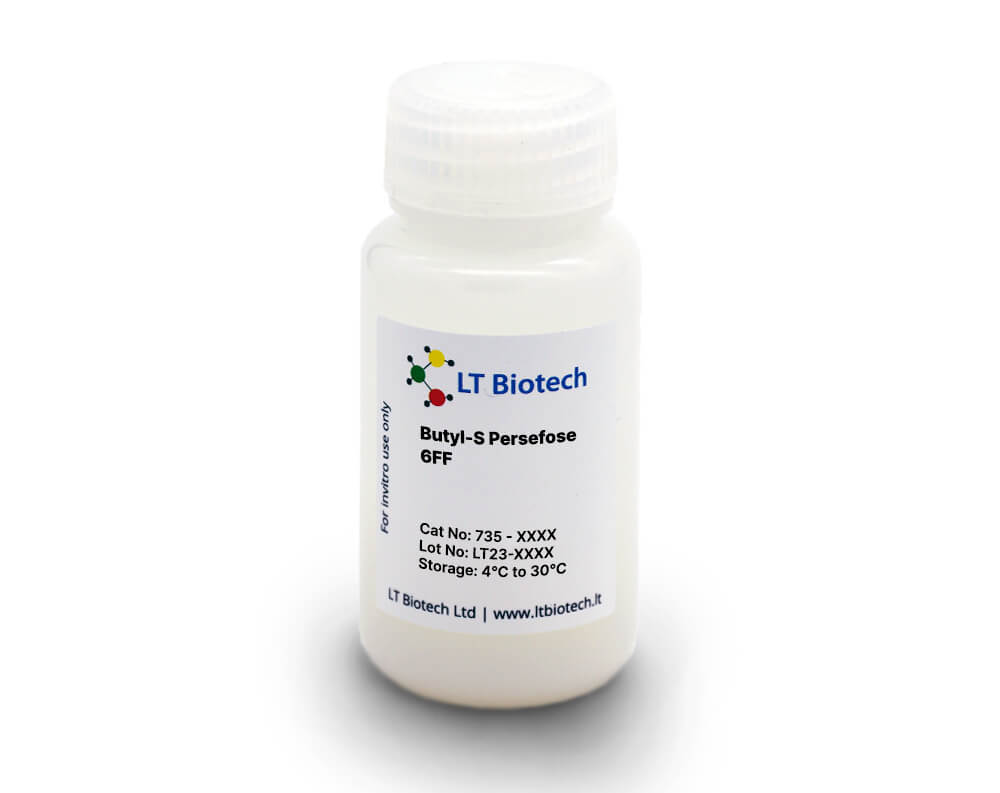
Butyl-S Persefose 6FF is a HIC resin with a median particle size of 90 µm. It separates molecules by differences in the nature and degree of their hydrophobicity under defined conditions. The resin is used for the separation and purification of recombinant proteins, antibodies, viruses and vaccines, and suits the removal of most impurities in the initial stages of a separation process.
Butyl-S Persefose 6FF scales up on three counts:
- The highly cross-linked agarose base frame is rigid, so it achieves a high process flow rate under low back pressure.
- The hydrophilic base frame minimises the influence of the base frame on the hydrophobic effect of the ligand.
- Chemical modification gives it chemical compatibility and resistance to cleaning-in-place (CIP) agents such as sodium hydroxide.
Method of use
Chromatographic conditions
Buffer selection. Select a buffer salt whose buffer group does not interact with the resin. In bind and elute mode, the equilibration buffer should be a high-salt buffer, such as one containing 1.5–2M ammonium sulfate, to support binding of the target molecule. Consider the stability of the sample in the buffer. The elution buffer is usually the equilibration buffer with the high salt removed.
- Equilibration, binding and washing buffer: 20–50 mM phosphate buffer containing 1.7–2M ammonium sulfate, pH 7.0.
- Elution buffer: 20–50 mM phosphate buffer, pH 7.0.
In flow-through mode, the equilibration buffer should use conditions that favour the binding of impurities. Once the target molecule has completely flowed through, wash directly with low-concentration salt.
Flow rate. Select a linear flow rate of 150–300 cm/h according to the column bed height.
Sample pretreatment. Filter the sample through a 0.45 µm microporous membrane before loading to prevent the column from clogging. Adjust the pH and conductivity of the sample to be consistent with the equilibration buffer, using dilution, ultrafiltration or desalting.
Chromatography steps
- Equilibration. Use equilibration buffer to fully equilibrate the column until the pH and conductivity are stable and consistent with the equilibration buffer. This step usually requires 3–5 column bed volumes (CV).
- Sample loading. Determine the loading volume and loading amount from the binding capacity measured in a small-scale test.
- Impurity washing. Use equilibration buffer or another suitable buffer to wash the column until the UV signal stabilises and returns to baseline.
- Elution. Elute by decreasing the concentration of salt ions in the elution buffer, applied as a linear or step gradient, to separate molecules of different binding strength. pH gradient elution or mixed elution can also be used.
- Regeneration. Rinse the column with a buffer containing low salt.
- Re-equilibration. Re-equilibrate the column with equilibration buffer.
In flow-through mode, collect during the sample loading step. Continue collecting through the washing step until all target molecules have passed through, then stop. Use low-salt buffer directly at the elution step to wash impurities away.
Cleaning and regeneration
Contaminants such as lipids, endotoxins and proteins accumulate on the column as the number of uses increases. Determine the frequency of cleaning-in-place (CIP) according to the degree of contamination. Where contamination is considerable, CIP after each use is recommended to ensure repeatability of results and to prolong the working life of the resin.
Recommended cleaning conditions by contaminant type:
- Strongly binding proteins: wash with 5 CV of ultrapure or pure water.
- Strongly hydrophobic and precipitated proteins: wash with 5 CV of 1M NaOH solution, then wash out the alkali with 5–10 CV of ultrapure or pure water.
- Lipoproteins and lipids: wash with 5 CV of 70% ethanol or 30% isopropanol, then rinse with 5–10 CV of ultrapure or pure water.
Degas 70% ethanol or 30% isopropanol before use. Use a flow rate of 30–60 cm/h during CIP. Use reverse cleaning where clogging is severe.
To reduce microbial load, treat the resin with 0.5–1M NaOH solution for 15–30 minutes.
Storage
Keep unopened resin in the original container at 4–30°C in a well-ventilated, dry and clean place. Do not freeze. Wash the used column with 2–3 CV of 20% ethanol solution and store at 2–8°C.
Destruction and recycling
Chromatography resin is difficult to degrade in nature, so incineration of waste resin is recommended. For resin that has been in contact with biologically active samples such as viruses and blood, follow local biosafety requirements before destroying or disposing of it.
Packing method
Detailed information on resin packaging is available on request. Please contact your local distributor.
Ordering information
- 735-00025 — 25 ml
- 735-00100 — 100 ml
- 735-00500 — 500 ml
- 735-01000 — 1 L
- 735-05000 — 5 L
- 735-10000 — 10 L
- 735-20000 — 20 L
Butyl Persefose 4FF is a HIC resin with a median particle size of 90 µm. It separates molecules by differences in the nature and degree of their hydrophobicity under defined conditions. The resin is used for the separation and purification of recombinant proteins, antibodies, viruses and vaccines.
Butyl Persefose 4FF scales up on three counts:
- The highly cross-linked agarose matrix is rigid, so it achieves a high process flow rate under low back pressure.
- The hydrophilic base frame minimises the influence of the base frame on the hydrophobicity of the ligand.
- Chemical modification gives it chemical compatibility and resistance to cleaning-in-place (CIP) agents such as sodium hydroxide.
Method of use
Chromatographic conditions
Buffer selection. Select a buffer salt whose buffer group does not interact with the resin. In bind and elute mode, the equilibration buffer should be a high-salt buffer, such as one containing 1.5–2M ammonium sulfate, to support binding of the target molecule. Consider the stability of the sample in the buffer. The elution buffer is usually the equilibration buffer with the high salt removed.
- Equilibration, binding and washing buffer: 50 mM phosphate buffer containing 1.5–2M ammonium sulfate, pH 7.0.
- Elution buffer: 50 mM phosphate buffer, pH 7.0.
In flow-through mode, the equilibration buffer should use conditions that favour the binding of impurities. Once the target molecule has completely flowed through, wash directly with low-concentration salt.
Flow rate. Select a linear flow rate of 150–250 cm/h according to the column bed height.
Sample pretreatment. Filter the sample through a 0.45 µm microporous membrane before loading to prevent the column from clogging. Adjust the pH and conductivity of the sample to be consistent with the equilibration buffer, using dilution, ultrafiltration or desalting.
Chromatography steps
- Equilibration. Use equilibration buffer to fully equilibrate the column until the pH and conductivity are stable and consistent with the equilibration buffer. This step usually requires 3–5 column bed volumes (CV).
- Sample loading. Determine the loading volume and loading amount from the binding capacity measured in a small-scale test.
- Impurity washing. Use equilibration buffer or another suitable buffer to wash the column until the UV signal stabilises and returns to baseline.
- Elution. Elute by decreasing the concentration of salt ions in the elution buffer, applied as a linear or step gradient, to separate molecules of different binding strength. pH gradient elution or mixed elution can also be used.
- Regeneration. Rinse the column with a buffer containing low salt.
- Re-equilibration. Re-equilibrate the column with equilibration buffer.
In flow-through mode, collect during the sample loading step. Continue collecting through the washing step until all target molecules have passed through, then stop. Use low-salt buffer directly at the elution step to wash impurities away.
Cleaning and regeneration
Contaminants such as lipids, endotoxins and proteins accumulate on the column as the number of uses increases. Determine the frequency of cleaning-in-place (CIP) according to the degree of contamination. Where contamination is considerable, CIP after each use is recommended to ensure repeatability of results and to prolong the working life of the resin.
Recommended cleaning conditions by contaminant type:
- Strongly binding proteins: wash with 5 CV of ultrapure or pure water.
- Strongly hydrophobic and precipitated proteins: wash with 5 CV of 1M NaOH solution, then wash out the alkali with 5–10 CV of ultrapure or pure water.
- Lipoproteins and lipids: wash with 5 CV of 70% ethanol or 30% isopropanol, then rinse with 5–10 CV of ultrapure or pure water.
Degas 70% ethanol or 30% isopropanol before use. Use a flow rate of 30–60 cm/h during CIP. Use reverse cleaning where clogging is severe.
To reduce microbial load, treat the resin with 0.5–1M NaOH solution for 15–30 minutes.
Storage
Keep unopened resin in the original container at 4–30°C in a well-ventilated, dry and clean place. Do not freeze. Wash the used column with 2–3 CV of 20% ethanol solution and store at 2–8°C.
Destruction and recycling
Chromatography resin is difficult to degrade in nature, so incineration of waste resin is recommended. For resin that has been in contact with biologically active samples such as viruses and blood, follow local biosafety requirements before destroying or disposing of it.
Packing method
Detailed information on resin packaging is available on request. Please contact your local distributor.
Ordering information
- 734-00025 — 25 ml
- 734-00100 — 100 ml
- 734-00500 — 500 ml
- 734-01000 — 1 L
- 734-05000 — 5 L
- 734-10000 — 10 L
- 734-20000 — 20 L
Lepta Butyl HR is a HIC resin with a median particle size of 40 µm. It separates molecules by differences in the nature and degree of their hydrophobicity under defined conditions. The resin is used for the separation and purification of recombinant proteins, plasmids, vaccines, viruses and virus-like particles.
Lepta Butyl HR scales up on four counts:
- The highly cross-linked agarose matrix is rigid, so it achieves a high process flow rate under low back pressure.
- The fine particle size gives high resolution.
- The hydrophilic base frame minimises the influence of the base frame on the hydrophobic effect of the ligand.
- Chemical modification gives it chemical compatibility and resistance to cleaning-in-place (CIP) agents such as sodium hydroxide.
Method of use
Chromatographic conditions
Buffer selection. Select a buffer salt whose buffer group does not interact with the resin. In bind and elute mode, the equilibration buffer should be a high-salt buffer, such as one containing 1.5–2M ammonium sulfate, to support binding of the target molecule. Consider the stability of the sample in the buffer. The elution buffer is usually a buffer with a low salt content.
In flow-through mode, the equilibration buffer should use conditions that favour the binding of impurities. Once the target molecule has completely flowed through, wash directly with low-concentration salt.
Flow rate. Select a linear flow rate of 90–500 cm/h according to the column bed height.
Sample pretreatment. Filter the sample through a 0.45 µm microporous membrane before loading to prevent the column from clogging. Adjust the pH and conductivity of the sample to be consistent with the equilibration buffer, using dilution, ultrafiltration or desalting.
Chromatography steps
- Equilibration. Use equilibration buffer to fully equilibrate the column until the pH and conductivity are stable and consistent with the equilibration buffer. This step usually requires 3–5 column bed volumes (CV).
- Sample loading. Determine the loading volume and loading amount from the binding capacity measured in a small-scale test.
- Impurity washing. Use equilibration buffer or another suitable buffer to wash the column until the UV signal stabilises and returns to baseline.
- Elution. Elute by decreasing the concentration of salt ions in the elution buffer, applied as a linear or step gradient, to separate molecules of different binding strength. pH gradient elution or mixed elution can also be used.
- Regeneration. Rinse the column with a buffer containing low salt.
- Re-equilibration. Re-equilibrate the column with equilibration buffer.
In flow-through mode, collect during the sample loading step. Continue collecting through the washing step until all target molecules have passed through, then stop. Use low-salt buffer directly at the elution step to wash impurities away.
Cleaning and regeneration
Contaminants such as lipids, endotoxins and proteins accumulate on the column as the number of uses increases. Determine the frequency of cleaning-in-place (CIP) according to the degree of contamination. Where contamination is considerable, CIP after each use is recommended to ensure repeatability of results and to prolong the working life of the resin.
Recommended cleaning conditions by contaminant type:
- Strongly binding proteins: wash with 5 CV of ultrapure or pure water.
- Strongly hydrophobic and precipitated proteins: wash with 5 CV of 1M NaOH solution, then wash out the alkali with 5–10 CV of ultrapure or pure water.
- Lipoproteins and lipids: wash with 5 CV of 70% ethanol or 30% isopropanol, then rinse with 5–10 CV of ultrapure or pure water.
Degas 70% ethanol or 30% isopropanol before use. Use a flow rate of 30–60 cm/h during CIP. Use reverse cleaning where clogging is severe.
To reduce microbial load, treat the resin with 0.5–1M NaOH solution for 15–30 minutes.
Storage
Keep unopened resin in the original container at 4–30°C in a well-ventilated, dry and clean place. Do not freeze. Wash the used column with 2–3 CV of 20% ethanol solution and store at 2–8°C.
Destruction and recycling
Chromatography resin is difficult to degrade in nature, so incineration of waste resin is recommended. For resin that has been in contact with biologically active samples such as viruses and blood, follow local biosafety requirements before destroying or disposing of it.
Packing method
Detailed information on resin packaging is available on request. Please contact your local distributor.
Ordering information
- 634-00025 — 25 ml
- 634-00100 — 100 ml
- 634-00500 — 500 ml
- 634-01000 — 1 L
- 634-05000 — 5 L
- 634-10000 — 10 L
- 634-20000 — 20 L
Lepta Butyl is a HIC resin based on high-rigidity agarose carrying weakly hydrophobic aliphatic butyl groups, with a median particle size of 80 µm. It has low back pressure and a fast flow rate, which suits large-scale separation and purification of highly hydrophobic biomolecules. The resin is used for the separation and purification of recombinant proteins, antibodies, viruses and vaccines.
Method of use
Chromatographic conditions
Buffer selection. The binding buffer is usually a phosphate buffer containing a high concentration of salt, such as 20 mM PB with 1.5–2M (NH4)2SO4 at pH 7.0. The elution buffer is usually phosphate buffer without other salts, such as 20–50 mM PB at pH 7.0. Adjust the concentration and type of salt in the binding buffer based on the results obtained — whether the target precipitates, how strongly it binds, recovery rate, resolution. For substances that are difficult to elute, use pure water, or pure water with a low concentration of ethanol added.
Flow rate. Select a linear flow rate of 150–350 cm/h according to the column bed height.
Sample pretreatment. Filter the sample through a 0.45 µm microporous membrane before loading to prevent the column from clogging. Adjust the pH and conductivity of the sample to be consistent with the equilibration buffer, using dilution, ultrafiltration or desalting.
Chromatography steps
- Equilibration. Use equilibration buffer to fully equilibrate the column until the pH and conductivity are stable and consistent with the equilibration buffer. This step usually requires 3–5 column bed volumes (CV).
- Sample loading. Determine the loading volume and loading amount from the binding capacity measured in a small-scale test.
- Impurity washing. Use equilibration buffer or another suitable buffer to wash the column until the UV signal stabilises and returns to baseline.
- Elution. Elute by decreasing the concentration of salt ions in the elution buffer, applied as a linear or step gradient, to separate molecules of different binding strength. Collect fractions from the eluted sample. pH gradient elution or mixed elution can also be used.
- Regeneration. Rinse the column with a buffer containing low salt.
- Re-equilibration. Re-equilibrate the column with equilibration buffer.
In flow-through mode, collect during the sample loading step. Continue collecting through the washing step until all target molecules have passed through, then stop. Use low-salt buffer directly at the elution step to wash impurities away.
Cleaning and regeneration
Contaminants such as lipids, endotoxins and proteins accumulate on the column as the number of uses increases. Determine the frequency of cleaning-in-place (CIP) according to the degree of contamination. Where contamination is considerable, CIP after each use is recommended to ensure repeatability of results and to prolong the working life of the resin.
Recommended cleaning conditions by contaminant type:
- Strongly binding proteins: wash with 5 CV of ultrapure or pure water.
- Strongly hydrophobic and precipitated proteins: wash with 5 CV of 1M NaOH solution, then wash out the alkali with 5–10 CV of ultrapure or pure water.
- Lipoproteins and lipids: wash with 5 CV of 70% ethanol or 30% isopropanol, then rinse with 5–10 CV of ultrapure or pure water.
Degas 70% ethanol or 30% isopropanol before use. Use a flow rate of 30–60 cm/h during CIP. Use reverse cleaning where clogging is severe.
To reduce microbial load, treat the resin with 0.5–1M NaOH solution for 15–30 minutes.
Storage
Keep unopened resin in the original container at 4–30°C in a well-ventilated, dry and clean place. Do not freeze. Wash the used column with 2–3 CV of 20% ethanol solution and store at 2–8°C.
Destruction and recycling
Chromatography resin is difficult to degrade in nature, so incineration of waste resin is recommended. For resin that has been in contact with biologically active samples such as viruses and blood, follow local biosafety requirements before destroying or disposing of it.
Packing method
Detailed information on resin packaging is available on request. Please contact your local distributor.
Ordering information
- 133-00025 — 25 ml
- 133-00100 — 100 ml
- 133-00500 — 500 ml
- 133-01000 — 1 L
- 133-05000 — 5 L
- 133-10000 — 10 L
- 133-20000 — 20 L
Phenyl Persefose HP is a HIC resin with a median particle size of 34 µm. It separates molecules by differences in the nature and degree of their hydrophobicity under defined conditions. The resin is used for the separation and purification of recombinant proteins, antibodies, viruses and vaccines.
Phenyl Persefose HP scales up on four counts:
- The highly cross-linked agarose matrix is rigid, so it achieves a high process flow rate under low back pressure.
- The fine particle size improves resolution.
- The hydrophilic base frame minimises the influence of the base frame on the hydrophobicity of the ligand.
- Chemical modification gives it chemical compatibility and resistance to cleaning-in-place (CIP) agents such as sodium hydroxide.
Method of use
Chromatographic conditions
Buffer selection. Select a buffer salt whose buffer group does not interact with the resin. In bind and elute mode, the equilibration buffer should be a high-salt buffer, such as one containing 1.5–2M ammonium sulfate, to support binding of the target molecule. Consider the stability of the sample in the buffer. The elution buffer is usually a buffer with a low salt content.
In flow-through mode, the equilibration buffer should use conditions that favour the binding of impurities. Once the target molecule has completely flowed through, wash directly with low-concentration salt.
Flow rate. Select a linear flow rate of 90–150 cm/h according to the column bed height.
Sample pretreatment. Filter the sample through a 0.45 µm microporous membrane before loading to prevent the column from clogging. Adjust the pH and conductivity of the sample to be consistent with the equilibration buffer, using dilution, ultrafiltration or desalting.
Chromatography steps
- Equilibration. Use equilibration buffer to fully equilibrate the column until the pH and conductivity are stable and consistent with the equilibration buffer. This step usually requires 3–5 column bed volumes (CV).
- Sample loading. Determine the loading volume and loading amount from the binding capacity measured in a small-scale test.
- Impurity washing. Use equilibration buffer or another suitable buffer to wash the column until the UV signal stabilises and returns to baseline.
- Elution. Elute by decreasing the concentration of salt ions in the elution buffer, applied as a linear or step gradient, to separate molecules of different binding strength. pH gradient elution or mixed elution can also be used.
- Regeneration. Rinse the column with a buffer containing low salt.
- Re-equilibration. Re-equilibrate the column with equilibration buffer.
In flow-through mode, collect during the sample loading step. Continue collecting through the washing step until all target molecules have passed through, then stop. Use low-salt buffer directly at the elution step to wash impurities away.
Cleaning and regeneration
Contaminants such as lipids, endotoxins and proteins accumulate on the column as the number of uses increases. Determine the frequency of cleaning-in-place (CIP) according to the degree of contamination. Where contamination is considerable, CIP after each use is recommended to ensure repeatability of results and to prolong the working life of the resin.
Recommended cleaning conditions by contaminant type:
- Strongly binding proteins: wash with 5 CV of ultrapure or pure water.
- Strongly hydrophobic and precipitated proteins: wash with 5 CV of 1M NaOH solution, then wash out the alkali with 5–10 CV of ultrapure or pure water.
- Lipoproteins and lipids: wash with 5 CV of 70% ethanol or 30% isopropanol, then rinse with 5–10 CV of ultrapure or pure water.
Degas 70% ethanol or 30% isopropanol before use. Use a flow rate of 30–60 cm/h during CIP. Use reverse cleaning where clogging is severe.
To reduce microbial load, treat the resin with 0.5–1M NaOH solution for 15–30 minutes.
Storage
Keep unopened resin in the original container at 4–30°C in a well-ventilated, dry and clean place. Do not freeze. Wash the used column with 2–3 CV of 20% ethanol solution and store at 2–8°C.
Destruction and recycling
Chromatography resin is difficult to degrade in nature, so incineration of waste resin is recommended. For resin that has been in contact with biologically active samples such as viruses and blood, follow local biosafety requirements before destroying or disposing of it.
Packing method
Detailed information on resin packaging is available on request. Please contact your local distributor.
Ordering information
- 730-00025 — 25 ml
- 730-00100 — 100 ml
- 730-00500 — 500 ml
- 730-01000 — 1 L
- 730-05000 — 5 L
- 730-10000 — 10 L
- 730-20000 — 20 L
Phenyl Persefose 6FF HS is a HIC resin with a median particle size of 90 µm. It separates molecules by differences in their hydrophobicity under defined conditions. The Phenyl Persefose 6FF series comes in two grades that differ by degree of ligand substitution: HS (high substitution) and LS (low substitution). This grade is high substitution, with a ligand density of ~45 µmol phenyl/ml. The resin is used for the separation and purification of recombinant proteins, antibodies, viruses and vaccines.
The Phenyl Persefose 6FF series scales up on three counts:
- The highly cross-linked agarose matrix is rigid, so it achieves a high process flow rate under low back pressure.
- The hydrophilic base frame minimises the influence of the base frame on the hydrophobicity of the ligand.
- Chemical modification gives it chemical compatibility and resistance to cleaning-in-place (CIP) agents such as sodium hydroxide.
Method of use
Chromatographic conditions
Buffer selection. Select a buffer salt whose buffer group does not interact with the resin. In bind and elute mode, the equilibration buffer should be a high-salt buffer, such as one containing 1.5–2M ammonium sulfate, to support binding of the target molecule. Consider the stability of the sample in the buffer. The elution buffer is usually a buffer with a low salt content.
In flow-through mode, the equilibration buffer should use conditions that favour the binding of impurities. Once the target molecule has completely flowed through, wash directly with low-concentration salt.
Flow rate. Select a linear flow rate of 150–300 cm/h according to the column bed height.
Sample pretreatment. Filter the sample through a 0.45 µm microporous membrane before loading to prevent the column from clogging. Adjust the pH and conductivity of the sample to be consistent with the equilibration buffer, using dilution, ultrafiltration or desalting.
Chromatography steps
- Equilibration. Use equilibration buffer to fully equilibrate the column until the pH and conductivity are stable and consistent with the equilibration buffer. This step usually requires 3–5 column bed volumes (CV).
- Sample loading. Determine the loading volume and loading amount from the binding capacity measured in a small-scale test.
- Impurity washing. Use equilibration buffer or another suitable buffer to wash the column until the UV signal stabilises and returns to baseline.
- Elution. Elute by decreasing the concentration of salt ions in the elution buffer, applied as a linear or step gradient, to separate molecules of different binding strength. pH gradient elution or mixed elution can also be used.
- Regeneration. Rinse the column with a buffer containing low salt.
- Re-equilibration. Re-equilibrate the column with equilibration buffer.
In flow-through mode, collect during the sample loading step. Continue collecting through the washing step until all target molecules have passed through, then stop. Use low-salt buffer directly at the elution step to wash impurities away.
Cleaning and regeneration
Contaminants such as lipids, endotoxins and proteins accumulate on the column as the number of uses increases. Determine the frequency of cleaning-in-place (CIP) according to the degree of contamination. Where contamination is considerable, CIP after each use is recommended to ensure repeatability of results and to prolong the working life of the resin.
Recommended cleaning conditions by contaminant type:
- Strongly binding proteins: wash with 5 CV of ultrapure or pure water.
- Strongly hydrophobic and precipitated proteins: wash with 5 CV of 1M NaOH solution, then wash out the alkali with 5–10 CV of ultrapure or pure water.
- Lipoproteins and lipids: wash with 5 CV of 70% ethanol or 30% isopropanol, then rinse with 5–10 CV of ultrapure or pure water.
Degas 70% ethanol or 30% isopropanol before use. Use a flow rate of 30–60 cm/h during CIP. Use reverse cleaning where clogging is severe.
To reduce microbial load, treat the resin with 0.5–1M NaOH solution for 15–30 minutes.
Storage
Keep unopened resin in the original container at 4–30°C in a well-ventilated, dry and clean place. Do not freeze. Wash the used column with 2–3 CV of 20% ethanol solution and store at 2–8°C.
Destruction and recycling
Chromatography resin is difficult to degrade in nature, so incineration of waste resin is recommended. For resin that has been in contact with biologically active samples such as viruses and blood, follow local biosafety requirements before destroying or disposing of it.
Packing method
Detailed information on resin packaging is available on request. Please contact your local distributor.
Ordering information
- 731-00025 — 25 ml
- 731-00100 — 100 ml
- 731-00500 — 500 ml
- 731-01000 — 1 L
- 731-05000 — 5 L
- 731-10000 — 10 L
- 731-20000 — 20 L
Phenyl Persefose 6FF HS is a HIC resin with a median particle size of 90 µm. It separates molecules by differences in their hydrophobicity under defined conditions. The Phenyl Persefose 6FF series comes in two grades that differ by degree of ligand substitution: HS (high substitution) and LS (low substitution). This grade is high substitution, with a ligand density of ~45 µmol phenyl/ml. The resin is used for the separation and purification of recombinant proteins, antibodies, viruses and vaccines.
The Phenyl Persefose 6FF series scales up on three counts:
- The highly cross-linked agarose matrix is rigid, so it achieves a high process flow rate under low back pressure.
- The hydrophilic base frame minimises the influence of the base frame on the hydrophobicity of the ligand.
- Chemical modification gives it chemical compatibility and resistance to cleaning-in-place (CIP) agents such as sodium hydroxide.
Method of use
Chromatographic conditions
Buffer selection. Select a buffer salt whose buffer group does not interact with the resin. In bind and elute mode, the equilibration buffer should be a high-salt buffer, such as one containing 1.5–2M ammonium sulfate, to support binding of the target molecule. Consider the stability of the sample in the buffer. The elution buffer is usually a buffer with a low salt content.
In flow-through mode, the equilibration buffer should use conditions that favour the binding of impurities. Once the target molecule has completely flowed through, wash directly with low-concentration salt.
Flow rate. Select a linear flow rate of 150–300 cm/h according to the column bed height.
Sample pretreatment. Filter the sample through a 0.45 µm microporous membrane before loading to prevent the column from clogging. Adjust the pH and conductivity of the sample to be consistent with the equilibration buffer, using dilution, ultrafiltration or desalting.
Chromatography steps
- Equilibration. Use equilibration buffer to fully equilibrate the column until the pH and conductivity are stable and consistent with the equilibration buffer. This step usually requires 3–5 column bed volumes (CV).
- Sample loading. Determine the loading volume and loading amount from the binding capacity measured in a small-scale test.
- Impurity washing. Use equilibration buffer or another suitable buffer to wash the column until the UV signal stabilises and returns to baseline.
- Elution. Elute by decreasing the concentration of salt ions in the elution buffer, applied as a linear or step gradient, to separate molecules of different binding strength. pH gradient elution or mixed elution can also be used.
- Regeneration. Rinse the column with a buffer containing low salt.
- Re-equilibration. Re-equilibrate the column with equilibration buffer.
In flow-through mode, collect during the sample loading step. Continue collecting through the washing step until all target molecules have passed through, then stop. Use low-salt buffer directly at the elution step to wash impurities away.
Cleaning and regeneration
Contaminants such as lipids, endotoxins and proteins accumulate on the column as the number of uses increases. Determine the frequency of cleaning-in-place (CIP) according to the degree of contamination. Where contamination is considerable, CIP after each use is recommended to ensure repeatability of results and to prolong the working life of the resin.
Recommended cleaning conditions by contaminant type:
- Strongly binding proteins: wash with 5 CV of ultrapure or pure water.
- Strongly hydrophobic and precipitated proteins: wash with 5 CV of 1M NaOH solution, then wash out the alkali with 5–10 CV of ultrapure or pure water.
- Lipoproteins and lipids: wash with 5 CV of 70% ethanol or 30% isopropanol, then rinse with 5–10 CV of ultrapure or pure water.
Degas 70% ethanol or 30% isopropanol before use. Use a flow rate of 30–60 cm/h during CIP. Use reverse cleaning where clogging is severe.
To reduce microbial load, treat the resin with 0.5–1M NaOH solution for 15–30 minutes.
Storage
Keep unopened resin in the original container at 4–30°C in a well-ventilated, dry and clean place. Do not freeze. Wash the used column with 2–3 CV of 20% ethanol solution and store at 2–8°C.
Destruction and recycling
Chromatography resin is difficult to degrade in nature, so incineration of waste resin is recommended. For resin that has been in contact with biologically active samples such as viruses and blood, follow local biosafety requirements before destroying or disposing of it.
Packing method
Detailed information on resin packaging is available on request. Please contact your local distributor.
Ordering information
- 731-00025 — 25 ml
- 731-00100 — 100 ml
- 731-00500 — 500 ml
- 731-01000 — 1 L
- 731-05000 — 5 L
- 731-10000 — 10 L
- 731-20000 — 20 L
Lepta Phenyl HR is a HIC resin with a median particle size of 40 µm. It separates molecules by differences in the nature and degree of their hydrophobicity under defined conditions. The resin is used for the separation and purification of recombinant proteins, antibodies, viruses and vaccines.
Lepta Phenyl HR scales up on three counts:
- A high-resolution modified agarose base frame.
- High resolution and high flow rate together.
- Tolerance to high salt, a wide pH range, resistance to organic solvents and chemical stability.
Method of use
Chromatographic conditions
Buffer selection. Select a buffer salt whose buffer group does not interact with the resin. In bind and elute mode, the equilibration buffer should be a high-salt buffer, such as one containing 1.5–2M ammonium sulfate, to support binding of the target molecule. Consider the stability of the sample in the buffer. The elution buffer is usually a buffer with a low salt content.
In flow-through mode, the equilibration buffer should use conditions that favour the binding of impurities. Once the target molecule has completely flowed through, wash directly with low-concentration salt.
Flow rate. Select a linear flow rate of 90–500 cm/h according to the column bed height.
Sample pretreatment. Filter the sample through a 0.45 µm microporous membrane before loading to prevent the column from clogging. Adjust the pH and conductivity of the sample to be consistent with the equilibration buffer, using dilution, ultrafiltration or desalting.
Chromatography steps
- Equilibration. Use equilibration buffer to fully equilibrate the column until the pH and conductivity are stable and consistent with the equilibration buffer. This step usually requires 3–5 column bed volumes (CV).
- Sample loading. Determine the loading volume and loading amount from the binding capacity measured in a small-scale test.
- Impurity washing. Use equilibration buffer or another suitable buffer to wash the column until the UV signal stabilises and returns to baseline.
- Elution. Elute by decreasing the concentration of salt ions in the elution buffer, applied as a linear or step gradient, to separate molecules of different binding strength. pH gradient elution or mixed elution can also be used.
- Regeneration. Rinse the column with a buffer containing low salt.
- Re-equilibration. Re-equilibrate the column with equilibration buffer.
In flow-through mode, collect during the sample loading step. Continue collecting through the washing step until all target molecules have passed through, then stop. Use low-salt buffer directly at the elution step to wash impurities away.
Cleaning and regeneration
Contaminants such as lipids, endotoxins and proteins accumulate on the column as the number of uses increases. Determine the frequency of cleaning-in-place (CIP) according to the degree of contamination. Where contamination is considerable, CIP after each use is recommended to ensure repeatability of results and to prolong the working life of the resin.
Recommended cleaning conditions by contaminant type:
- Strongly binding proteins: wash with 5 CV of ultrapure or pure water.
- Strongly hydrophobic and precipitated proteins: wash with 5 CV of 1M NaOH solution, then wash out the alkali with 5–10 CV of ultrapure or pure water.
- Lipoproteins and lipids: wash with 5 CV of 70% ethanol or 30% isopropanol, then rinse with 5–10 CV of ultrapure or pure water.
Degas 70% ethanol or 30% isopropanol before use. Use a flow rate of 30–60 cm/h during CIP. Use reverse cleaning where clogging is severe.
To reduce microbial load, treat the resin with 0.5–1M NaOH solution for 15–30 minutes.
Storage
Keep unopened resin in the original container at 4–30°C in a well-ventilated, dry and clean place. Do not freeze. Wash the used column with 2–3 CV of 20% ethanol solution and store at 2–8°C.
Destruction and recycling
Chromatography resin is difficult to degrade in nature, so incineration of waste resin is recommended. For resin that has been in contact with biologically active samples such as viruses and blood, follow local biosafety requirements before destroying or disposing of it.
Packing method
Detailed information on resin packaging is available on request. Please contact your local distributor.
Ordering information
- 632-00025 — 25 ml
- 632-00100 — 100 ml
- 632-00500 — 500 ml
- 632-01000 — 1 L
- 632-05000 — 5 L
- 632-10000 — 10 L
- 632-20000 — 20 L
Lepta Phenyl LS is a HIC resin with a median particle size of 75 µm. It separates molecules by differences in their hydrophobicity under defined conditions. The Lepta Phenyl series comes in two grades that differ by degree of ligand substitution: HS (high substitution) and LS (low substitution). This grade is low substitution, with a ligand density of ~15 µmol phenyl/ml. The resin is used for the separation and purification of recombinant proteins, antibodies, viruses and vaccines.
The Lepta Phenyl series scales up on three counts:
- The highly cross-linked agarose matrix is rigid, so it achieves a high process flow rate under low back pressure.
- The hydrophilic base frame minimises the influence of the base frame on the hydrophobicity of the ligand.
- Chemical modification gives it chemical compatibility and resistance to cleaning-in-place (CIP) agents such as sodium hydroxide.
Method of use
Chromatographic conditions
Buffer selection. Select a buffer salt whose buffer group does not interact with the resin. In bind and elute mode, the equilibration buffer should be a high-salt buffer, such as one containing 1.5–2M ammonium sulfate, to support binding of the target molecule. Consider the stability of the sample in the buffer. The elution buffer is usually a buffer with a low salt content.
In flow-through mode, the equilibration buffer should use conditions that favour the binding of impurities. Once the target molecule has completely flowed through, wash directly with low-concentration salt.
Flow rate. Select a linear flow rate of 150–500 cm/h according to the column bed height.
Sample pretreatment. Filter the sample through a 0.45 µm microporous membrane before loading to prevent the column from clogging. Adjust the pH and conductivity of the sample to be consistent with the equilibration buffer, using dilution, ultrafiltration or desalting.
Chromatography steps
- Equilibration. Use equilibration buffer to fully equilibrate the column until the pH and conductivity are stable and consistent with the equilibration buffer. This step usually requires 3–5 column bed volumes (CV).
- Sample loading. Determine the loading volume and loading amount from the binding capacity measured in a small-scale test.
- Impurity washing. Use equilibration buffer or another suitable buffer to wash the column until the UV signal stabilises and returns to baseline.
- Elution. Elute by decreasing the concentration of salt ions in the elution buffer, applied as a linear or step gradient, to separate molecules of different binding strength. pH gradient elution or mixed elution can also be used.
- Regeneration. Rinse the column with a buffer containing low salt.
- Re-equilibration. Re-equilibrate the column with equilibration buffer.
In flow-through mode, collect during the sample loading step. Continue collecting through the washing step until all target molecules have passed through, then stop. Use low-salt buffer directly at the elution step to wash impurities away.
Cleaning and regeneration
Contaminants such as lipids, endotoxins and proteins accumulate on the column as the number of uses increases. Determine the frequency of cleaning-in-place (CIP) according to the degree of contamination. Where contamination is considerable, CIP after each use is recommended to ensure repeatability of results and to prolong the working life of the resin.
Recommended cleaning conditions by contaminant type:
- Strongly binding proteins: wash with 5 CV of ultrapure or pure water.
- Strongly hydrophobic and precipitated proteins: wash with 5 CV of 1M NaOH solution, then wash out the alkali with 5–10 CV of ultrapure or pure water.
- Lipoproteins and lipids: wash with 5 CV of 70% ethanol or 30% isopropanol, then rinse with 5–10 CV of ultrapure or pure water.
Degas 70% ethanol or 30% isopropanol before use. Use a flow rate of 30–60 cm/h during CIP. Use reverse cleaning where clogging is severe.
To reduce microbial load, treat the resin with 0.5–1M NaOH solution for 15–30 minutes.
Storage
Keep unopened resin in the original container at 4–30°C in a well-ventilated, dry and clean place. Do not freeze. Wash the used column with 2–3 CV of 20% ethanol solution and store at 2–8°C.
Destruction and recycling
Chromatography resin is difficult to degrade in nature, so incineration of waste resin is recommended. For resin that has been in contact with biologically active samples such as viruses and blood, follow local biosafety requirements before destroying or disposing of it.
Packing method
Detailed information on resin packaging is available on request. Please contact your local distributor.
Ordering information
- 135-00025 — 25 ml
- 135-00100 — 100 ml
- 135-00500 — 500 ml
- 135-01000 — 1 L
- 135-05000 — 5 L
- 135-10000 — 10 L
- 135-20000 — 20 L
Lepta Phenyl HS is a HIC resin with a median particle size of 75 µm. It separates molecules by differences in their hydrophobicity under defined conditions. The Lepta Phenyl series comes in two grades that differ by degree of ligand substitution: HS (high substitution) and LS (low substitution). This grade is high substitution, with a ligand density of ~22 µmol phenyl/ml. The resin is used for the separation and purification of recombinant proteins, antibodies, viruses and vaccines.
The Lepta Phenyl series scales up on three counts:
- The highly cross-linked agarose matrix is rigid, so it achieves a high process flow rate under low back pressure.
- The hydrophilic base frame minimises the influence of the base frame on the hydrophobicity of the ligand.
- Chemical modification gives it chemical compatibility and resistance to cleaning-in-place (CIP) agents such as sodium hydroxide.
Method of use
Chromatographic conditions
Buffer selection. Select a buffer salt whose buffer group does not interact with the resin. In bind and elute mode, the equilibration buffer should be a high-salt buffer, such as one containing 1.5–2M ammonium sulfate, to support binding of the target molecule. Consider the stability of the sample in the buffer. The elution buffer is usually a buffer with a low salt content.
In flow-through mode, the equilibration buffer should use conditions that favour the binding of impurities. Once the target molecule has completely flowed through, wash directly with low-concentration salt.
Flow rate. Select a linear flow rate of 150–500 cm/h according to the column bed height.
Sample pretreatment. Filter the sample through a 0.45 µm microporous membrane before loading to prevent the column from clogging. Adjust the pH and conductivity of the sample to be consistent with the equilibration buffer, using dilution, ultrafiltration or desalting.
Chromatography steps
- Equilibration. Use equilibration buffer to fully equilibrate the column until the pH and conductivity are stable and consistent with the equilibration buffer. This step usually requires 3–5 column bed volumes (CV).
- Sample loading. Determine the loading volume and loading amount from the binding capacity measured in a small-scale test.
- Impurity washing. Use equilibration buffer or another suitable buffer to wash the column until the UV signal stabilises and returns to baseline.
- Elution. Elute by decreasing the concentration of salt ions in the elution buffer, applied as a linear or step gradient, to separate molecules of different binding strength. pH gradient elution or mixed elution can also be used.
- Regeneration. Rinse the column with a buffer containing low salt.
- Re-equilibration. Re-equilibrate the column with equilibration buffer.
In flow-through mode, collect during the sample loading step. Continue collecting through the washing step until all target molecules have passed through, then stop. Use low-salt buffer directly at the elution step to wash impurities away.
Cleaning and regeneration
Contaminants such as lipids, endotoxins and proteins accumulate on the column as the number of uses increases. Determine the frequency of cleaning-in-place (CIP) according to the degree of contamination. Where contamination is considerable, CIP after each use is recommended to ensure repeatability of results and to prolong the working life of the resin.
Recommended cleaning conditions by contaminant type:
- Strongly binding proteins: wash with 5 CV of ultrapure or pure water.
- Strongly hydrophobic and precipitated proteins: wash with 5 CV of 1M NaOH solution, then wash out the alkali with 5–10 CV of ultrapure or pure water.
- Lipoproteins and lipids: wash with 5 CV of 70% ethanol or 30% isopropanol, then rinse with 5–10 CV of ultrapure or pure water.
Degas 70% ethanol or 30% isopropanol before use. Use a flow rate of 30–60 cm/h during CIP. Use reverse cleaning where clogging is severe.
To reduce microbial load, treat the resin with 0.5–1M NaOH solution for 15–30 minutes.
Storage
Keep unopened resin in the original container at 4–30°C in a well-ventilated, dry and clean place. Do not freeze. Wash the used column with 2–3 CV of 20% ethanol solution and store at 2–8°C.
Destruction and recycling
Chromatography resin is difficult to degrade in nature, so incineration of waste resin is recommended. For resin that has been in contact with biologically active samples such as viruses and blood, follow local biosafety requirements before destroying or disposing of it.
Packing method
Detailed information on resin packaging is available on request. Please contact your local distributor.
Ordering information
- 631-00025 — 25 ml
- 631-00100 — 100 ml
- 631-00500 — 500 ml
- 631-01000 — 1 L
- 631-05000 — 5 L
- 631-10000 — 10 L
- 631-20000 — 20 L
Persecryl S-100 is a hydrophilic gel filtration SEC resin with a particle size of 25–75 µm and a separation range of 1–100 kDa. It gives a high flow rate in column operation, with high resolution and recovery. The resin is used in the separation and purification of biological macromolecules such as enzymes, polysaccharides, nucleic acids and proteins, and in the production of biological products including interferon-γ, interleukin 2, protein A and hepatitis B vaccine.
Method of use
Chromatographic conditions
Buffer selection. Consider the stability of the sample in the buffer. Use a salt-containing buffer rather than ultrapure or pure water, to avoid non-specific adsorption.
Flow rate. Select a linear flow rate no higher than 125 cm/h according to the column bed height.
Sample pretreatment. Filter the sample through a 0.45 µm microporous membrane before loading to prevent the column from clogging.
Chromatography steps
- Equilibration. Use the buffer to fully equilibrate the column until the pH and conductivity are stable and consistent with the equilibration buffer. This step usually requires 2–5 column bed volumes (CV).
- Sample loading. The usual loading volume is 1–2% of the column volume. Do not use too high a sample concentration, to avoid overpressure and loss of resolution.
- Elution. Elute with buffer and collect the peaks at different positions, usually over 1–1.5 CV.
- Regeneration. Rinse the column with a high-salt buffer, such as 1M NaCl.
- Re-equilibration. Re-equilibrate the column with buffer.
Cleaning and regeneration
Contaminants such as lipids, endotoxins and proteins accumulate on the column as the number of uses increases. Regular cleaning-in-place (CIP) keeps the column in a stable working condition. Determine the frequency of CIP according to the degree of contamination. Where contamination is considerable, CIP after each use is recommended to ensure repeatability of results and to prolong the working life of the resin.
Recommended cleaning conditions by contaminant type:
- Strongly binding proteins: wash with 1–2 CV of 2M NaCl solution.
- Strongly hydrophobic and precipitated proteins: wash with 1 CV of 0.1M NaOH solution, then wash out the alkali with 5–10 CV of ultrapure or pure water.
- Lipoproteins and lipids: wash with 5 CV of 70% ethanol or 30% isopropanol, then rinse with 5–10 CV of ultrapure or pure water.
Degas 70% ethanol or 30% isopropanol before use. Keep the flow rate at no more than 60 cm/h during CIP. Reverse cleaning can be used where clogging is severe.
After cleaning, equilibrate the column with at least 3 CV of equilibration buffer, until the pH and conductivity remain unchanged.
Storage
Keep unopened resin in the original container at 4–30°C in a well-ventilated, dry and clean place. Do not freeze. Wash the used column with 2–3 CV of 20% ethanol solution and store at 2–8°C.
Destruction and recycling
Chromatography resin is difficult to degrade in nature, so incineration of waste resin is recommended. For resin that has been in contact with biologically active samples such as viruses and blood, follow local biosafety requirements before destroying or disposing of it.
Packing method
Detailed information on resin packaging is available on request. Please contact your local distributor.
Ordering information
- 201-00025 — 25 ml
- 201-00100 — 100 ml
- 201-00500 — 500 ml
- 201-01000 — 1 L
- 201-05000 — 5 L
- 201-10000 — 10 L
Persecryl S-200 is a hydrophilic gel filtration SEC resin with a particle size of 25–75 µm and a separation range of 5–250 kDa. It gives a high flow rate in column operation, with high resolution and recovery. The resin is used in the separation and purification of biological macromolecules such as enzymes, polysaccharides, nucleic acids and proteins, and in the production of biological products including interferon-γ, interleukin 2, protein A and hepatitis B vaccine.
Method of use
Chromatographic conditions
Buffer selection. Consider the stability of the sample in the buffer. Use a salt-containing buffer rather than ultrapure or pure water, to avoid non-specific adsorption.
Flow rate. Select a linear flow rate according to the column bed height, so that the maximum working pressure is not exceeded.
Sample pretreatment. Filter the sample through a 0.45 µm microporous membrane before loading to prevent the column from clogging.
Chromatography steps
- Equilibration. Use the buffer to fully equilibrate the column until the pH and conductivity are stable and consistent with the equilibration buffer. This step usually requires 2–5 column bed volumes (CV).
- Sample loading. The usual loading volume is 1–2% of the column volume. Do not use too high a sample concentration, to avoid overpressure and loss of resolution.
- Elution. Elute with buffer and collect the peaks at different positions, usually over 1–1.5 CV.
- Regeneration. Rinse the column with a high-salt buffer, such as 1M NaCl.
- Re-equilibration. Re-equilibrate the column with buffer.
Cleaning and regeneration
Washing with buffer will usually restore equilibrium, after which the column can be used again. Some inactivated proteins and lipids cannot be washed out during regeneration and need to be removed by cleaning-in-place (CIP).
Clean lipids, inactivated proteins and precipitates with 0.2–0.5M NaOH or a non-ionic detergent at a flow rate of 15–20 cm/h, then wash with 2 CV of equilibration buffer. The whole cleaning process takes about 1–2 hours, depending on use.
Storage
Keep unopened resin in the original container at 4–30°C in a well-ventilated, dry and clean place. Do not freeze. Wash the used column with 2–3 CV of 20% ethanol solution and store at 2–8°C.
Destruction and recycling
Chromatography resin is difficult to degrade in nature, so incineration of waste resin is recommended. For resin that has been in contact with biologically active samples such as viruses and blood, follow local biosafety requirements before destroying or disposing of it.
Packing method
Detailed information on resin packaging is available on request. Please contact your local distributor.
Ordering information
- 200-00025 — 25 ml
- 200-00100 — 100 ml
- 200-00500 — 500 ml
- 200-01000 — 1 L
- 200-05000 — 5 L
- 200-10000 — 10 L
Persedex G-50SF is a cross-linked dextran gel filtration SEC resin with a particle size range of 10–40 µm and a separation range of 1.5–30 kDa. It separates molecules by differences in molecular weight. The Persedex G-50 series comes in three grades ordered by particle size, from the coarsest M through F to the finest SF; G-50SF is the finest. The resin is used for desalting biomolecules, buffer exchange, and the separation and purification of small molecular substances such as peptides.
Persedex G-50 scales up on two counts:
- A cross-linked dextran matrix with reliable rigidity.
- A range of pack sizes to suit different sample volumes, allowing linear scale-up.
Method of use
Chromatographic conditions
Buffer selection. Consider the stability of the sample in the buffer. Use a salt-containing buffer rather than ultrapure or pure water, to avoid non-specific adsorption.
Flow rate. Select a linear flow rate according to the column bed height, no higher than the recommended flow rate for this grade of 40 cm/h.
Sample pretreatment. Filter the sample through a 0.45 µm microporous membrane before loading to prevent the column from clogging.
Chromatography steps
- Equilibration. Use the buffer to fully equilibrate the column until the pH and conductivity are stable and consistent with the equilibration buffer. This step usually requires 1–2 column bed volumes (CV).
- Sample loading. The usual loading volume is 1–5% of the column volume. Do not use too high a sample concentration, to avoid overpressure and loss of resolution.
- Elution. Elute with buffer and collect the peaks at different positions, usually over 1–1.5 CV.
- Regeneration. Rinse the column with a high-salt buffer, such as 1M NaCl.
- Re-equilibration. Re-equilibrate the column with buffer.
Cleaning and regeneration
Contaminants such as lipids, endotoxins and proteins accumulate on the column as the number of uses increases. Regular cleaning-in-place (CIP) keeps the column in a stable working condition. Determine the frequency of CIP according to the degree of contamination. Where contamination is considerable, CIP after each use is recommended to ensure repeatability of results and to prolong the working life of the resin.
Recommended cleaning conditions by contaminant type:
- Strongly binding proteins: wash with 5 CV of 2M NaCl solution, or use a high-salt buffer at pH 3 or above, such as 1M NaAc solution.
- Strongly hydrophobic and precipitated proteins: wash with 5 CV of 0.2M NaOH solution, then wash out the alkali with 5–10 CV of ultrapure or pure water.
- Lipoproteins and lipids: wash with 5 CV of 70% ethanol or 30% isopropanol, then rinse with 5–10 CV of ultrapure or pure water.
Degas 70% ethanol or 30% isopropanol before use. Keep the flow rate at 30–60 cm/h during CIP. Reverse cleaning can be used where clogging is severe.
To reduce microbial load, treat the resin with 0.2M NaOH solution for 30–60 minutes.
Storage
Keep unopened resin in the original container at 4–30°C in a well-ventilated, dry and clean place. Do not freeze. Wash the used column with 2–3 CV of 20% ethanol solution and store at 2–8°C.
Destruction and recycling
Chromatography resin is difficult to degrade in nature, so incineration of waste resin is recommended. For resin that has been in contact with biologically active samples such as viruses and blood, follow local biosafety requirements before destroying or disposing of it.
Packing method
Detailed information on resin packaging is available on request. Please contact your local distributor.
Ordering information
- 579-00100 — 100 ml
- 579-00500 — 500 ml
- 579-01000 — 1 L
- 579-05000 — 5 L
Persedex LH-20 is a hydroxypropylated cross-linked dextran gel filtration SEC resin with a particle size range of 20–120 µm and a separation range of 4–5 kDa. It separates molecules by differences in molecular weight. The resin works in both aqueous and organic phases and has good chemical stability, which suits the separation of substances that differ only slightly from one another, such as natural products.
Persedex LH-20 scales up on two counts:
- A hydroxypropylated cross-linked dextran base frame with reliable rigidity.
- A range of pack sizes to suit different sample volumes, allowing linear scale-up.
Method of use
Chromatographic conditions
Buffer selection. Consider the stability of the sample in the buffer. Use a salt-containing buffer rather than ultrapure or pure water, to avoid non-specific adsorption.
Flow rate. Select a linear flow rate no higher than 700 cm/h according to the column bed height.
Sample pretreatment. Filter the sample through a 0.45 µm microporous membrane before loading to prevent the column from clogging.
Chromatography steps
- Equilibration. Use the buffer to fully equilibrate the column until the pH and conductivity are stable and consistent with the equilibration buffer. This step usually requires 1–2 column bed volumes (CV).
- Sample loading. The usual loading volume is 1–2% of the column volume. Do not use too high a sample concentration, to avoid overpressure and loss of resolution.
- Elution. Elute with buffer and collect the peaks at different positions, usually over 1–1.5 CV.
- Regeneration. Rinse the column with a high-salt buffer, such as 1M NaCl.
- Re-equilibration. Re-equilibrate the column with buffer.
Cleaning and regeneration
Contaminants such as lipids, endotoxins and proteins accumulate on the column as the number of uses increases. Regular cleaning-in-place (CIP) keeps the column in a stable working condition. Determine the frequency of CIP according to the degree of contamination. Where contamination is considerable, CIP after each use is recommended to ensure repeatability of results and to prolong the working life of the resin.
Recommended cleaning conditions by contaminant type:
- Strongly binding proteins: wash with 5 CV of 2M NaCl solution, or use a high-salt buffer at pH 3 or above, such as 1M NaAc solution.
- Strongly hydrophobic and precipitated proteins: wash with 5 CV of 0.2M NaOH solution, then wash out the alkali with 5–10 CV of ultrapure or pure water.
- Lipoproteins and lipids: wash with 5 CV of 70% ethanol or 30% isopropanol, then rinse with 5–10 CV of ultrapure or pure water.
Degas 70% ethanol or 30% isopropanol before use. Keep the flow rate at 30–60 cm/h during CIP. Reverse cleaning can be used where clogging is severe.
To reduce microbial load, treat the resin with 0.1M NaOH solution for 30–60 minutes.
Storage
Keep unopened resin in the original container at 4–30°C in a well-ventilated, dry and clean place. Do not freeze. Wash the used column with 2–3 CV of 20% ethanol solution and store at 2–8°C.
Destruction and recycling
Chromatography resin is difficult to degrade in nature, so incineration of waste resin is recommended. For resin that has been in contact with biologically active samples such as viruses and blood, follow local biosafety requirements before destroying or disposing of it.
Packing method
Detailed information on resin packaging is available on request. Please contact your local distributor.
Ordering information
- 578-00100 — 100 ml
- 578-00500 — 500 ml
- 578-01000 — 1 L
- 578-05000 — 5 L
Persedex G-50 is a series of cross-linked dextran-based gel filtration SEC resins that utilise molecular weight differences to separate molecules. This series consists of two types of chromatography resin with different particle sizes, arranged according to particle size from large to small, with suffixes of M and F respectively. This series of chromatographic resins can be used successfully for desalting of various biomolecules, buffer replacement, and separation and purification of small molecular substances such as peptides.
Persedex G-50 has excellent scale-up capabilities:
1. It has a cross-linked dextran with reliable rigidity.
2. A variety of packaging specifications are provided to meet the processing needs of samples of different volumes, and it is easy to scale up linearly.
Method of use
Chromatographic conditions
- Buffer selection: the stability of the sample in the buffer should be considered; to avoid possible non-specific adsorption, it is advisable to use a salt-containing buffer instead of ultra pure or pure water.
- Flow rate: according to the height of the column bed, a linear flow rate not higher than indicated in the table «Chromatography resin parameters» is generally selected.
- Sample pretreatment: to prevent the sample from clogging the column, it needs to be filtered with a 0.45 μm microporous membrane before loading.
Chromatography steps
- Equilibration: use the buffer to fully equilibrate the chromatography column until the pH and conductivity are stable and basically consistent with the equilibration buffer. This step usually requires 1–2 column bed volumes (CV).
- Sample loading: the usual sample volume is 1%–5% CV, and the sample concentration should not be too high, to avoid overpressure or affecting the resolution.
- Elution: use buffer to elute, and collect components that elute from different positions, usually requiring 1~1.5 CV.
- Regeneration: rinse the column with a high-salt buffer (such as 1M NaCl).
- Re-equilibration: re-equilibrate the column with buffer.
Cleaning and regeneration
Contaminants (e.g. lipids, endotoxins and proteins) accumulate on the column as the chromatographic resin is used more often. Regular cleaning-in-place (CIP) is essential to keep the column in a stable working condition. Determine the frequency of CIP according to the degree of contamination of the chromatography resin (if the contamination is considerable, CIP is recommended after each use to ensure repeatability of results and to prolong the working life of the chromatography resin). For different types of impurities and contaminants, the recommended cleaning conditions are as follows:
- Removal of proteins with strong binding force: wash with 5 CV of 2M NaCl solution, or use a high-salt buffer with a pH not lower than 2, such as 1M NaAc solution.
- Removal of strongly hydrophobic proteins and precipitated proteins: first wash with 5 CV of 0,2M NaOH solution, then wash the lye with 5–10 CV of ultra pure or pure water.
- Removal of lipoproteins and lipids: first wash with 5 CV of 70% ethanol or 30% isopropanol, then rinse with 5–10 CV of ultra pure or pure water.
Note: 70% ethanol or 30% isopropanol should be degassed before use; the flow rate should be 30–60 cm/h during CIP; reverse cleaning should be used when the clogging is severe. To reduce the microbial load, it is recommended that 0.5M NaOH solution is used to treat the chromatography resin; treatment time is 30–60 minutes.
Storage
Keep the unopened chromatography resin in the original container and store at 4~30°C in a well-ventilated, dry and clean place. Do not freeze. Wash the used column with 2–3 CV of 20% ethanol solution and store at 2~8°C.
Destruction and recycling
Since chromatography resin is difficult to degrade in nature, it is recommended that the waste chromatography resin is incinerated to protect the environment. For chromatography resin that has been in contact with biologically active samples such as viruses and blood, follow the local biosafety requirements before destroying or disposing of it.
Packing method
Detailed information on resin packaging is available on request. Please contact your local distributor.
Ordering details
- 293-00100 / 100ml
- 293-00500 / 500ml
- 293-01000 / 1L
- 293-05000 / 5L
Persedex G-50 is a series of cross-linked dextran-based gel filtration SEC resins that utilise molecular weight differences to separate molecules. This series consists of two types of chromatography resin with different particle sizes, arranged according to particle size from large to small, with suffixes of M and F respectively. This series of chromatographic resins can be used successfully for desalting of various biomolecules, buffer replacement, and separation and purification of small molecular substances such as peptides.
Persedex G-50 has excellent scale-up capabilities:
1. It has a cross-linked dextran with reliable rigidity.
2. A variety of packaging specifications are provided to meet the processing needs of samples of different volumes, and it is easy to scale up linearly.
Method of use
Chromatographic conditions
- Buffer selection: the stability of the sample in the buffer should be considered; to avoid possible non-specific adsorption, it is advisable to use a salt-containing buffer instead of ultra pure or pure water.
- Flow rate: according to the height of the column bed, a linear flow rate not higher than indicated in the table «Chromatography resin parameters» is generally selected.
- Sample pretreatment: to prevent the sample from clogging the column, it needs to be filtered with a 0.45 μm microporous membrane before loading.
Chromatography steps
- Equilibration: use the buffer to fully equilibrate the chromatography column until the pH and conductivity are stable and basically consistent with the equilibration buffer. This step usually requires 1–2 column bed volumes (CV).
- Sample loading: the usual sample volume is 1%–5% CV, and the sample concentration should not be too high, to avoid overpressure or affecting the resolution.
- Elution: use buffer to elute, and collect components that elute from different positions, usually requiring 1~1.5 CV.
- Regeneration: rinse the column with a high-salt buffer (such as 1M NaCl).
- Re-equilibration: re-equilibrate the column with buffer.
Cleaning and regeneration
Contaminants (e.g. lipids, endotoxins and proteins) accumulate on the column as the chromatographic resin is used more often. Regular cleaning-in-place (CIP) is essential to keep the column in a stable working condition. Determine the frequency of CIP according to the degree of contamination of the chromatography resin (if the contamination is considerable, CIP is recommended after each use to ensure repeatability of results and to prolong the working life of the chromatography resin). For different types of impurities and contaminants, the recommended cleaning conditions are as follows:
- Removal of proteins with strong binding force: wash with 5 CV of 2M NaCl solution, or use a high-salt buffer with a pH not lower than 2, such as 1M NaAc solution.
- Removal of strongly hydrophobic proteins and precipitated proteins: first wash with 5 CV of 0,2M NaOH solution, then wash the lye with 5–10 CV of ultra pure or pure water.
- Removal of lipoproteins and lipids: first wash with 5 CV of 70% ethanol or 30% isopropanol, then rinse with 5–10 CV of ultra pure or pure water.
Note: 70% ethanol or 30% isopropanol should be degassed before use; the flow rate should be 30–60 cm/h during CIP; reverse cleaning should be used when the clogging is severe. To reduce the microbial load, it is recommended that 0.5M NaOH solution is used to treat the chromatography resin; treatment time is 30–60 minutes.
Storage
Keep the unopened chromatography resin in the original container and store at 4~30°C in a well-ventilated, dry and clean place. Do not freeze. Wash the used column with 2–3 CV of 20% ethanol solution and store at 2~8°C.
Destruction and recycling
Since chromatography resin is difficult to degrade in nature, it is recommended that the waste chromatography resin is incinerated to protect the environment. For chromatography resin that has been in contact with biologically active samples such as viruses and blood, follow the local biosafety requirements before destroying or disposing of it.
Packing method
Detailed information on resin packaging is available on request. Please contact your local distributor.
Ordering details
- 576-00100 / 100ml
- 576-00500 / 500ml
- 576-01000 / 1L
- 576-05000 / 5L
Persedex G-25 is a series of cross-linked dextran-based gel filtration SEC resins that take advantage of molecular weight differences to separate molecules. This series consists of four types of chromatography resin with different particle sizes, arranged according to particle size from large to small, with suffixes of C, M, F and SF respectively.
This series of chromatographic resins can be used successfully for desalting various biomolecules, buffer replacement, and separation and purification of small molecular substances such as peptides.
Persedex G-25 has excellent scale-up capabilities:
1. It has a cross-linked dextran with reliable rigidity.
2. A variety of packaging specifications are provided to meet the processing needs of samples of different volumes, and it is easy to scale up linearly.
Method of use
Chromatographic conditions
- Buffer selection: the stability of the sample in the buffer should be considered; to avoid possible non-specific adsorption, it is advisable to use a salt-containing buffer instead of ultra pure or pure water.
- Flow rate: according to the height of the column bed, a linear flow rate not higher than indicated in the table «Chromatography resin parameters» is generally selected.
- Sample pretreatment: to prevent the sample from clogging the column, it needs to be filtered with a 0.45 μm microporous membrane before loading.
Chromatography steps
- Equilibration: use the buffer to fully equilibrate the chromatography column until the pH and conductivity are stable and basically consistent with the equilibration buffer. This step usually requires 1–2 column bed volumes (CV).
- Sample loading: the usual sample volume is 1%–5% CV, and the sample concentration should not be too high, to avoid overpressure or affecting the resolution.
- Elution: use buffer to elute, and collect components that elute from different positions, usually requiring 1~1.5 CV.
- Regeneration: rinse the column with a high-salt buffer (such as 1M NaCl).
- Re-equilibration: re-equilibrate the column with buffer.
(5) Re-equilibration: re-equilibrate the column with buffer.
Cleaning and regeneration
Contaminants (e.g. lipids, endotoxins and proteins) accumulate on the column as the chromatographic resin is used more often. Regular cleaning-in-place (CIP) is essential to keep the column in a stable working condition. Determine the frequency of CIP according to the degree of contamination of the chromatography resin (if the contamination is considerable, CIP is recommended after each use to ensure repeatability of results and to prolong the working life of the chromatography resin). For different types of impurities and contaminants, the recommended cleaning conditions are as follows:
- Removal of proteins with strong binding force: wash with 5 CV of 2M NaCl solution, or use a high-salt buffer with a pH not lower than 2, such as 1M NaAc solution.
- Removal of strongly hydrophobic proteins and precipitated proteins: first wash with 5 CV of 0,2M NaOH solution, then wash the lye with 5–10 CV of ultra pure or pure water.
- Removal of lipoproteins and lipids: first wash with 5 CV of 70% ethanol or 30% isopropanol, then rinse with 5–10 CV of ultra pure or pure water.
Note: 70% ethanol or 30% isopropanol should be degassed before use; the flow rate should be 30–60 cm/h during CIP; reverse cleaning should be used when the clogging is severe. To reduce the microbial load, it is recommended that 0.5M NaOH solution is used to treat the chromatography resin; treatment time is 30–60 minutes.
Storage
Keep the unopened chromatography resin in the original container and store at 4~30°C in a well-ventilated, dry and clean place. Do not freeze. Wash the used column with 2–3 CV of 20% ethanol solution and store at 2~8°C.
Destruction and recycling
Since chromatography resin is difficult to degrade in nature, it is recommended that the waste chromatography resin is incinerated to protect the environment. For chromatography resin that has been in contact with biologically active samples such as viruses and blood, follow the local biosafety requirements before destroying or disposing of it.
Packing method
Detailed information on resin packaging is available on request. Please contact your local distributor.
Ordering details
- 575-00100 / 100ml
- 575-00500 / 500ml
- 575-01000 / 1L
- 575-05000 / 5L
Persedex G-25F is the fine grade of the Persedex G-25 series, a range of cross-linked dextran-based gel filtration SEC resins that take advantage of molecular weight differences to separate molecules. The series comprises four grades that differ in particle size, designated C, M, F and SF from coarsest to finest. G-25F has a smaller particle size than the C and M grades, giving higher resolution at a lower flow rate. These resins are used successfully for desalting a wide range of biomolecules, for buffer exchange, and for the separation and purification of small molecular substances such as peptides.
Persedex G-25 has excellent scale-up capabilities:
- A cross-linked dextran matrix with reliable rigidity.
- A range of packaging specifications to meet the processing needs of different sample volumes, allowing straightforward linear scale-up.
Method of use
Chromatographic conditions
Buffer selection. Consider the stability of the sample in the buffer. To avoid possible non-specific adsorption, use a salt-containing buffer rather than ultrapure or pure water.
Flow rate. Generally select a linear flow rate no higher than the recommended 100 cm/h, according to the height of the column bed.
Sample pretreatment. Filter the sample through a 0.45 µm microporous membrane before loading to prevent the sample from clogging the column.
Chromatography steps
- Equilibration. Use the buffer to fully equilibrate the chromatography column until the pH and conductivity are stable and basically the same as the equilibration buffer. This step usually requires 1–2 column bed volumes (CV).
- Sample loading. The usual loading volume is 1%–5% of the column volume. The sample concentration should not be too high, to avoid overpressure or affecting the resolution.
- Elution. Use buffer elution to collect peaks at different positions, usually 1~1.5 CV.
- Regeneration. Rinse the column with a buffer containing high salt (such as 1M NaCl).
- Re-equilibration. Re-equilibrate the column with buffer.
Cleaning and regeneration
Contaminants (e.g. lipids, endotoxins and proteins) accumulate on the column as the number of uses of the chromatography resin increases. Regular cleaning-in-place (CIP) is essential to keep the column in a stable working condition. Determine the frequency of CIP according to the degree of contamination of the chromatography resin. Where contamination is considerable, CIP after each use is recommended to ensure repeatability of results and to prolong the working life of the chromatography resin.
For different types of impurities and contaminants, the recommended cleaning conditions are as follows:
- Strongly binding proteins: wash with 5 CV of 2M NaCl solution, or use a high salt buffer not lower than pH 2, such as 1M NaAc solution.
- Strongly hydrophobic proteins and precipitated proteins: first wash with 5 CV of 0.2M NaOH solution, then wash out the lye with 5–10 CV of ultrapure or pure water.
- Lipoproteins and lipids: first wash with 5 CV of 70% ethanol or 30% isopropanol, then rinse with 5–10 CV of ultrapure or pure water.
Degas 70% ethanol or 30% isopropanol before use. The flow rate should be no more than 30–60 cm/h during CIP. Use reverse cleaning where the clogging is severe. To reduce the microbial load, treat the chromatography resin with 0.2M NaOH solution for 30–60 minutes.
Storage
Keep the unopened chromatography resin in the original container and store at 4~30°C in a well-ventilated, dry and clean place. Do not freeze. Wash the used column with 2–3 CV of 20% ethanol solution and store at 2~8°C.
Destruction and recycling
Since chromatography resin is difficult to degrade in nature, it is recommended that the discarded chromatography resin is incinerated to protect the environment. For chromatography resin that has been in contact with biologically active samples such as viruses and blood, follow the local biosafety requirements before destroying or disposing of it.
Packing method
Detailed information on resin packaging is available on request. Please contact your local distributor.
Ordering information
- 574-00100 — 100 ml
- 574-00500 — 500 ml
- 574-01000 — 1 L
- 574-05000 — 5 L
Persedex G-25M is the medium grade of the Persedex G-25 series, a range of cross-linked dextran-based gel filtration SEC resins that take advantage of molecular weight differences to separate molecules. The series comprises four grades that differ in particle size, designated C, M, F and SF from coarsest to finest. G-25M sits between the coarse and fine grades in particle size. These resins are used successfully for desalting a wide range of biomolecules, for buffer exchange, and for the separation and purification of small molecular substances such as peptides.
Persedex G-25 has excellent scale-up capabilities:
- A cross-linked dextran matrix with reliable rigidity.
- A range of packaging specifications to meet the processing needs of different sample volumes, allowing straightforward linear scale-up.
Method of use
Chromatographic conditions
Buffer selection. Consider the stability of the sample in the buffer. To avoid possible non-specific adsorption, use a salt-containing buffer rather than ultrapure or pure water.
Flow rate. Generally select a linear flow rate no higher than the recommended 150 cm/h, according to the height of the column bed.
Sample pretreatment. Filter the sample through a 0.45 µm microporous membrane before loading to prevent the sample from clogging the column.
Chromatography steps
- Equilibration. Use the buffer to fully equilibrate the chromatography column until the pH and conductivity are stable and basically the same as the equilibration buffer. This step usually requires 1–2 column bed volumes (CV).
- Sample loading. The usual loading volume is 1%–5% of the column volume. The sample concentration should not be too high, to avoid overpressure or affecting the resolution.
- Elution. Use buffer elution to collect peaks at different positions, usually 1~1.5 CV.
- Regeneration. Rinse the column with a buffer containing high salt (such as 1M NaCl).
- Re-equilibration. Re-equilibrate the column with buffer.
Cleaning and regeneration
Contaminants (e.g. lipids, endotoxins and proteins) accumulate on the column as the number of uses of the chromatography resin increases. Regular cleaning-in-place (CIP) is essential to keep the column in a stable working condition. Determine the frequency of CIP according to the degree of contamination of the chromatography resin. Where contamination is considerable, CIP after each use is recommended to ensure repeatability of results and to prolong the working life of the chromatography resin.
For different types of impurities and contaminants, the recommended cleaning conditions are as follows:
- Strongly binding proteins: wash with 5 CV of 2M NaCl solution, or use a high salt buffer not lower than pH 2, such as 1M NaAc solution.
- Strongly hydrophobic proteins and precipitated proteins: first wash with 5 CV of 0.2M NaOH solution, then wash out the lye with 5–10 CV of ultrapure or pure water.
- Lipoproteins and lipids: first wash with 5 CV of 70% ethanol or 30% isopropanol, then rinse with 5–10 CV of ultrapure or pure water.
Degas 70% ethanol or 30% isopropanol before use. The flow rate should be no more than 30–60 cm/h during CIP. Use reverse cleaning where the clogging is severe. To reduce the microbial load, treat the chromatography resin with 0.2M NaOH solution for 30–60 minutes.
Storage
Keep the unopened chromatography resin in the original container and store at 4~30°C in a well-ventilated, dry and clean place. Do not freeze. Wash the used column with 2–3 CV of 20% ethanol solution and store at 2~8°C.
Destruction and recycling
Since chromatography resin is difficult to degrade in nature, it is recommended that the discarded chromatography resin is incinerated to protect the environment. For chromatography resin that has been in contact with biologically active samples such as viruses and blood, follow the local biosafety requirements before destroying or disposing of it.
Packing method
Detailed information on resin packaging is available on request. Please contact your local distributor.
Ordering information
- 573-00100 — 100 ml
- 573-00500 — 500 ml
- 573-01000 — 1 L
- 573-05000 — 5 L
Persedex G-25C is the coarse grade of the Persedex G-25 series, a range of cross-linked dextran-based gel filtration SEC resins that take advantage of molecular weight differences to separate molecules. The series comprises four grades that differ in particle size, designated C, M, F and SF from coarsest to finest. G-25C has the largest particle size and the highest recommended flow rate in the series. These resins are used successfully for desalting a wide range of biomolecules, for buffer exchange, and for the separation and purification of small molecular substances such as peptides.
Persedex G-25 has excellent scale-up capabilities:
- A cross-linked dextran matrix with reliable rigidity.
- A range of packaging specifications to meet the processing needs of different sample volumes, allowing straightforward linear scale-up.
Method of use
Chromatographic conditions
Buffer selection. Consider the stability of the sample in the buffer. To avoid possible non-specific adsorption, use a salt-containing buffer rather than ultrapure or pure water.
Flow rate. Generally select a linear flow rate no higher than the recommended 300 cm/h, according to the height of the column bed.
Sample pretreatment. Filter the sample through a 0.45 µm microporous membrane before loading to prevent the sample from clogging the column.
Chromatography steps
- Equilibration. Use the buffer to fully equilibrate the chromatography column until the pH and conductivity are stable and basically the same as the equilibration buffer. This step usually requires 1–2 column bed volumes (CV).
- Sample loading. The usual loading volume is 1%–5% of the column volume. The sample concentration should not be too high, to avoid overpressure or affecting the resolution.
- Elution. Use buffer elution to collect peaks at different positions, usually 1~1.5 CV.
- Regeneration. Rinse the column with a buffer containing high salt (such as 1M NaCl).
- Re-equilibration. Re-equilibrate the column with buffer.
Cleaning and regeneration
Contaminants (e.g. lipids, endotoxins and proteins) accumulate on the column as the number of uses of the chromatography resin increases. Regular cleaning-in-place (CIP) is essential to keep the column in a stable working condition. Determine the frequency of CIP according to the degree of contamination of the chromatography resin. Where contamination is considerable, CIP after each use is recommended to ensure repeatability of results and to prolong the working life of the chromatography resin.
For different types of impurities and contaminants, the recommended cleaning conditions are as follows:
- Strongly binding proteins: wash with 5 CV of 2M NaCl solution, or use a high salt buffer not lower than pH 2, such as 1M NaAc solution.
- Strongly hydrophobic proteins and precipitated proteins: first wash with 5 CV of 0.2M NaOH solution, then wash out the lye with 5–10 CV of ultrapure or pure water.
- Lipoproteins and lipids: first wash with 5 CV of 70% ethanol or 30% isopropanol, then rinse with 5–10 CV of ultrapure or pure water.
Degas 70% ethanol or 30% isopropanol before use. The flow rate should be no more than 30–60 cm/h during CIP. Use reverse cleaning where the clogging is severe. To reduce the microbial load, treat the chromatography resin with 0.2M NaOH solution for 30–60 minutes.
Storage
Keep the unopened chromatography resin in the original container and store at 4~30°C in a well-ventilated, dry and clean place. Do not freeze. Wash the used column with 2–3 CV of 20% ethanol solution and store at 2~8°C.
Destruction and recycling
Since chromatography resin is difficult to degrade in nature, it is recommended that the discarded chromatography resin is incinerated to protect the environment. For chromatography resin that has been in contact with biologically active samples such as viruses and blood, follow the local biosafety requirements before destroying or disposing of it.
Packing method
Detailed information on resin packaging is available on request. Please contact your local distributor.
Ordering information
- 572-00100 — 100 ml
- 572-00500 — 500 ml
- 572-01000 — 1 L
- 572-05000 — 5 L
SP-dex 200 PG belongs to the SP-dex PG series of gel filtration SEC resins built on a cross-linked agarose matrix, which separate molecules by their molecular weight differences. The series consists of three resins covering different separation ranges; SP-dex 200 PG covers the widest and highest of the three, 10~600 kDa, which suits it to large proteins, protein complexes and viral particles. These resins are used successfully for the separation and purification of biomolecules such as polypeptides, polysaccharides, recombinant proteins, nucleic acids and viruses.
SP-dex PG series chromatography resins have excellent scale-up production capacity:
- The improved SP-dex base matrix is more rigid, enabling higher process flow rates at lower back pressures and increasing process efficiency.
- The modified SP-dex base has better chemical resistance and is compatible with a wide range of buffer environments.
- A fine particle size design improves resolution.
Method of use
Chromatographic conditions
Buffer selection. Consider the stability of the sample in the buffer. To avoid possible non-specific adsorption, use a salt-containing buffer rather than ultrapure or pure water.
Flow rate. Generally select a linear flow rate no higher than 100 cm/h, according to the height of the column bed.
Sample pretreatment. Filter the sample through a 0.45 µm microporous membrane before loading to prevent the sample from clogging the column.
Chromatography steps
- Equilibration. Use the buffer to fully equilibrate the chromatography column until the pH and conductivity are stable and basically the same as the equilibration buffer. This step usually requires 1–2 column bed volumes (CV).
- Sample loading. The usual loading volume is 1%–5% of the column volume. The sample concentration should not be too high, to avoid overpressure or affecting the resolution.
- Elution. Use buffer elution to collect peaks at different positions, usually 1~1.5 CV.
- Regeneration. Rinse the column with a buffer containing high salt (such as 1M NaCl).
- Re-equilibration. Re-equilibrate the column with buffer.
Cleaning and regeneration
Contaminants (e.g. lipids, endotoxins and proteins) accumulate on the column as the number of uses of the chromatography resin increases. Regular cleaning-in-place (CIP) is essential to keep the column in a stable working condition. Determine the frequency of CIP according to the degree of contamination of the chromatography resin. Where contamination is considerable, CIP after each use is recommended to ensure repeatability of results and to prolong the working life of the chromatography resin.
For different types of impurities and contaminants, the recommended cleaning conditions are as follows:
- Strongly binding proteins: wash with 5 CV of 2M NaCl solution, or use a high salt buffer not lower than pH 2, such as 1M NaAc solution.
- Strongly hydrophobic proteins and precipitated proteins: first wash with 5 CV of 0.5M NaOH solution, then wash out the lye with 5–10 CV of ultrapure or pure water.
- Lipoproteins and lipids: first wash with 5 CV of 70% ethanol or 30% isopropanol, then rinse with 5–10 CV of ultrapure or pure water.
Degas 70% ethanol or 30% isopropanol before use. The flow rate should be no more than 30 cm/h during CIP. Use reverse cleaning where the clogging is severe. To reduce the microbial load, treat the chromatography resin with 0.5M NaOH solution for 30–60 minutes.
Storage
Keep the unopened chromatography resin in the original container and store at 4~30°C in a well-ventilated, dry and clean place. Do not freeze. Wash the used column with 2–3 CV of 20% ethanol solution and store at 2~8°C.
Destruction and recycling
Since chromatography resin is difficult to degrade in nature, it is recommended that the discarded chromatography resin is incinerated to protect the environment. For chromatography resin that has been in contact with biologically active samples such as viruses and blood, follow the local biosafety requirements before destroying or disposing of it.
Packing method
Detailed information on resin packaging is available on request. Please contact your local distributor.
Ordering information
- 793-00100 — 100 ml
- 793-00500 — 500 ml
- 793-01000 — 1 L
- 793-05000 — 5 L
- 793-10000 — 10 L
SP-dex 75 PG belongs to the SP-dex PG series of gel filtration SEC resins built on a cross-linked agarose matrix, which separate molecules by their molecular weight differences. The series consists of three resins covering different separation ranges; SP-dex 75 PG covers the middle of the three, 3~70 kDa, which suits it to most recombinant proteins. These resins are used successfully for the separation and purification of biomolecules such as polypeptides, polysaccharides, recombinant proteins, nucleic acids and viruses.
SP-dex PG series chromatography resins have excellent scale-up production capacity:
- The improved SP-dex base matrix is more rigid, enabling higher process flow rates at lower back pressures and increasing process efficiency.
- The modified SP-dex base has better chemical resistance and is compatible with a wide range of buffer environments.
- A fine particle size design improves resolution.
Method of use
Chromatographic conditions
Buffer selection. Consider the stability of the sample in the buffer. To avoid possible non-specific adsorption, use a salt-containing buffer rather than ultrapure or pure water.
Flow rate. Generally select a linear flow rate no higher than 100 cm/h, according to the height of the column bed.
Sample pretreatment. Filter the sample through a 0.45 µm microporous membrane before loading to prevent the sample from clogging the column.
Chromatography steps
- Equilibration. Use the buffer to fully equilibrate the chromatography column until the pH and conductivity are stable and basically the same as the equilibration buffer. This step usually requires 1–2 column bed volumes (CV).
- Sample loading. The usual loading volume is 1%–5% of the column volume. The sample concentration should not be too high, to avoid overpressure or affecting the resolution.
- Elution. Use buffer elution to collect peaks at different positions, usually 1~1.5 CV.
- Regeneration. Rinse the column with a buffer containing high salt (such as 1M NaCl).
- Re-equilibration. Re-equilibrate the column with buffer.
Cleaning and regeneration
Contaminants (e.g. lipids, endotoxins and proteins) accumulate on the column as the number of uses of the chromatography resin increases. Regular cleaning-in-place (CIP) is essential to keep the column in a stable working condition. Determine the frequency of CIP according to the degree of contamination of the chromatography resin. Where contamination is considerable, CIP after each use is recommended to ensure repeatability of results and to prolong the working life of the chromatography resin.
For different types of impurities and contaminants, the recommended cleaning conditions are as follows:
- Strongly binding proteins: wash with 5 CV of 2M NaCl solution, or use a high salt buffer not lower than pH 2, such as 1M NaAc solution.
- Strongly hydrophobic proteins and precipitated proteins: first wash with 5 CV of 0.5M NaOH solution, then wash out the lye with 5–10 CV of ultrapure or pure water.
- Lipoproteins and lipids: first wash with 5 CV of 70% ethanol or 30% isopropanol, then rinse with 5–10 CV of ultrapure or pure water.
Degas 70% ethanol or 30% isopropanol before use. The flow rate should be no more than 30 cm/h during CIP. Use reverse cleaning where the clogging is severe. To reduce the microbial load, treat the chromatography resin with 0.5M NaOH solution for 30–60 minutes.
Storage
Keep the unopened chromatography resin in the original container and store at 4~30°C in a well-ventilated, dry and clean place. Do not freeze. Wash the used column with 2–3 CV of 20% ethanol solution and store at 2~8°C.
Destruction and recycling
Since chromatography resin is difficult to degrade in nature, it is recommended that the discarded chromatography resin is incinerated to protect the environment. For chromatography resin that has been in contact with biologically active samples such as viruses and blood, follow the local biosafety requirements before destroying or disposing of it.
Packing method
Detailed information on resin packaging is available on request. Please contact your local distributor.
Ordering information
- 792-00100 — 100 ml
- 792-00500 — 500 ml
- 792-01000 — 1 L
- 792-05000 — 5 L
- 792-10000 — 10 L
SP-dex 30 PG belongs to the SP-dex PG series of gel filtration SEC resins built on a cross-linked agarose matrix, which separate molecules by their molecular weight differences. The series consists of three resins covering different separation ranges; SP-dex 30 PG covers the lowest of the three, 1~10 kDa, which suits it to peptides and other small biomolecules. These resins are used successfully for the separation and purification of biomolecules such as polypeptides, polysaccharides, recombinant proteins, nucleic acids and viruses.
SP-dex PG series chromatography resins have excellent scale-up production capacity:
- The improved SP-dex base matrix is more rigid, enabling higher process flow rates at lower back pressures and increasing process efficiency.
- The modified SP-dex base has better chemical resistance and is compatible with a wide range of buffer environments.
- A fine particle size design improves resolution.
Method of use
Chromatographic conditions
Buffer selection. Consider the stability of the sample in the buffer. To avoid possible non-specific adsorption, use a salt-containing buffer rather than ultrapure or pure water.
Flow rate. Generally select a linear flow rate no higher than 100 cm/h, according to the height of the column bed.
Sample pretreatment. Filter the sample through a 0.45 µm microporous membrane before loading to prevent the sample from clogging the column.
Chromatography steps
- Equilibration. Use the buffer to fully equilibrate the chromatography column until the pH and conductivity are stable and basically the same as the equilibration buffer. This step usually requires 1–2 column bed volumes (CV).
- Sample loading. The usual loading volume is 1%–5% of the column volume. The sample concentration should not be too high, to avoid overpressure or affecting the resolution.
- Elution. Use buffer elution to collect peaks at different positions, usually 1~1.5 CV.
- Regeneration. Rinse the column with a buffer containing high salt (such as 1M NaCl).
- Re-equilibration. Re-equilibrate the column with buffer.
Cleaning and regeneration
Contaminants (e.g. lipids, endotoxins and proteins) accumulate on the column as the number of uses of the chromatography resin increases. Regular cleaning-in-place (CIP) is essential to keep the column in a stable working condition. Determine the frequency of CIP according to the degree of contamination of the chromatography resin. Where contamination is considerable, CIP after each use is recommended to ensure repeatability of results and to prolong the working life of the chromatography resin.
For different types of impurities and contaminants, the recommended cleaning conditions are as follows:
- Strongly binding proteins: wash with 5 CV of 2M NaCl solution, or use a high salt buffer not lower than pH 2, such as 1M NaAc solution.
- Strongly hydrophobic proteins and precipitated proteins: first wash with 5 CV of 0.5M NaOH solution, then wash out the lye with 5–10 CV of ultrapure or pure water.
- Lipoproteins and lipids: first wash with 5 CV of 70% ethanol or 30% isopropanol, then rinse with 5–10 CV of ultrapure or pure water.
Degas 70% ethanol or 30% isopropanol before use. The flow rate should be no more than 30 cm/h during CIP. Use reverse cleaning where the clogging is severe. To reduce the microbial load, treat the chromatography resin with 0.5M NaOH solution for 30–60 minutes.
Storage
Keep the unopened chromatography resin in the original container and store at 4~30°C in a well-ventilated, dry and clean place. Do not freeze. Wash the used column with 2–3 CV of 20% ethanol solution and store at 2~8°C.
Destruction and recycling
Since chromatography resin is difficult to degrade in nature, it is recommended that the discarded chromatography resin is incinerated to protect the environment. For chromatography resin that has been in contact with biologically active samples such as viruses and blood, follow the local biosafety requirements before destroying or disposing of it.
Packing method
Detailed information on resin packaging is available on request. Please contact your local distributor.
Ordering information
- 791-00100 — 100 ml
- 791-00500 — 500 ml
- 791-01000 — 1 L
- 791-05000 — 5 L
- 791-10000 — 10 L
Persefose 6B is a modified highly cross-linked (cross-linking ratio 6%) agarose-based gel filtration SEC resin, which separates different molecules by using their molecular weight and conformation differences. This chromatography medium can be used successfully for the separation and purification of various biological molecules such as recombinant proteins, antibodies, nucleic acids, viruses and virus-like particles, and polysaccharides, as well as QC molecular weight determination. It is especially suitable for molecules that cannot be dissolved in aqueous solution.
Method of use
Chromatographic conditions
Buffer selection. Consider the stability of the sample in the buffer. To avoid possible non-specific adsorption, use a salt-containing buffer rather than ultrapure or pure water.
Flow rate. Generally select a linear flow rate no higher than 15 cm/h according to the height of the column bed.
Sample pretreatment. Filter the sample through a 0.45 µm microporous membrane before loading to prevent the sample from clogging the column.
Chromatography steps
- Equilibration. Use the buffer to fully equilibrate the chromatography column until the pH and conductivity are stable and basically the same as the equilibration buffer. This step usually requires 1–2 column bed volumes (CV).
- Sample loading. The usual loading volume is 1%–5% of the column volume. The sample concentration should not be too high, to avoid overpressure or affecting the resolution.
- Elution. Use buffer elution to collect peaks at different positions, usually 1~1.5 CV.
- Regeneration. Rinse the column with a buffer containing high salt (such as 1M NaCl).
- Re-equilibration. Re-equilibrate the column with buffer.
Cleaning and regeneration
Contaminants (e.g. lipids, endotoxins and proteins) accumulate on the column as the number of uses of the chromatography resin increases. Regular cleaning-in-place (CIP) is essential to keep the column in a stable working condition. Determine the frequency of CIP according to the degree of contamination of the chromatography resin. Where contamination is considerable, CIP after each use is recommended to ensure repeatability of results and to prolong the working life of the chromatography resin.
For different types of impurities and contaminants, the recommended cleaning conditions are as follows:
- Strongly binding proteins: wash with 5 CV of 2M NaCl solution, or use a high salt buffer not lower than pH 2, such as 1M NaAc solution.
- Strongly hydrophobic proteins and precipitated proteins: first wash with 5 CV of 0.5M NaOH solution, then wash out the lye with 5–10 CV of ultrapure or pure water.
- Lipoproteins and lipids: first wash with 5 CV of 70% ethanol or 30% isopropanol, then rinse with 5–10 CV of ultrapure or pure water.
Degas 70% ethanol or 30% isopropanol before use. The flow rate should be no more than 15 cm/h during CIP. Use reverse cleaning where the clogging is severe.
To reduce the microbial load, treat the chromatographic resin with 0.5–1M NaOH solution for 15–30 minutes.
Storage
Keep the unopened chromatography resin in the original container and store at 4~30°C in a well-ventilated, dry and clean place. Do not freeze. Wash the used column with 2–3 CV of 20% ethanol solution and store at 2~8°C.
Destruction and recycling
Since chromatography resin is difficult to degrade in nature, it is recommended that the discarded chromatography resin is incinerated to protect the environment. For chromatography resin that has been in contact with biologically active samples such as viruses and blood, follow the local biosafety requirements before destroying or disposing of it.
Packing method
Detailed information on resin packaging is available on request. Please contact your local distributor.
Ordering information
- 706-00025 — 25 ml
- 706-00100 — 100 ml
- 706-00500 — 500 ml
- 706-01000 — 1 L
- 706-05000 — 5 L
- 706-10000 — 10 L
- 706-20000 — 20 L
Persefose 4B is a highly cross-linked (cross-linking ratio 4%) agarose-based gel filtration SEC resin, which separates different molecules by their molecular weight and conformation differences. This chromatography resin can be used successfully for the separation and purification of various large biomolecules, such as recombinant proteins, antibodies, nucleic acids, viruses and virus-like particles, and polysaccharides.
Method of use
Chromatographic conditions
Buffer selection. Consider the stability of the sample in the buffer. To avoid possible non-specific adsorption, use a salt-containing buffer rather than ultrapure or pure water.
Flow rate. Generally select a linear flow rate of 70~140 cm/h according to the height of the column bed.
Sample pretreatment. Filter the sample through a 0.45 µm microporous membrane before loading to prevent the sample from clogging the column.
Chromatography steps
- Equilibration. Use the buffer to fully equilibrate the chromatography column until the pH and conductivity are stable and basically the same as the equilibration buffer. This step usually requires 1–2 column bed volumes (CV).
- Sample loading. The usual loading volume is 1%–2% of the column volume. The sample concentration should not be too high, to avoid overpressure or affecting the resolution.
- Elution. Use buffer elution to collect peaks at different positions, usually 1~1.5 CV.
- Regeneration. Rinse the column with a buffer containing high salt (such as 1M NaCl).
- Re-equilibration. Re-equilibrate the column with buffer.
Cleaning and regeneration
Contaminants (e.g. lipids, endotoxins and proteins) accumulate on the column as the number of uses of the chromatography resin increases. Regular cleaning-in-place (CIP) is essential to keep the column in a stable working condition. Determine the frequency of CIP according to the degree of contamination of the chromatography resin. Where contamination is considerable, CIP after each use is recommended to ensure repeatability of results and to prolong the working life of the chromatography resin.
For different types of impurities and contaminants, the recommended cleaning conditions are as follows:
- Strongly binding proteins: wash with 5 CV of 2M NaCl solution, or use a high salt buffer not lower than pH 2, such as 1M NaAc solution.
- Strongly hydrophobic proteins and precipitated proteins: first wash with 5 CV of 0.5M NaOH solution, then wash out the lye with 5–10 CV of ultrapure or pure water.
- Lipoproteins and lipids: first wash with 5 CV of 70% ethanol or 30% isopropanol, then rinse with 5–10 CV of ultrapure or pure water.
Degas 70% ethanol or 30% isopropanol before use. The flow rate should be no more than 30 cm/h during CIP. Use reverse cleaning where the clogging is severe.
Storage
Keep the unopened chromatography resin in the original container and store at 4~30°C in a well-ventilated, dry and clean place. Do not freeze. Wash the used column with 2–3 CV of 20% ethanol solution and store at 2~8°C.
Destruction and recycling
Since chromatography resin is difficult to degrade in nature, it is recommended that the discarded chromatography resin is incinerated to protect the environment. For chromatography resin that has been in contact with biologically active samples such as viruses and blood, follow the local biosafety requirements before destroying or disposing of it.
Packing method
Detailed information on resin packaging is available on request. Please contact your local distributor.
Ordering information
- 705-00025 — 25 ml
- 705-00100 — 100 ml
- 705-00500 — 500 ml
- 705-01000 — 1 L
- 705-05000 — 5 L
- 705-10000 — 10 L
- 705-20000 — 20 L
Persefose CL-6B is a highly cross-linked agarose-based gel filtration SEC resin (cross-linking ratio 6%), which separates different molecules by their molecular weight and conformation differences. It can be used successfully for the separation and purification of a wide range of biomolecules, such as recombinant proteins, antibodies, nucleic acids, viruses and virus-like particles, and polysaccharides.
Persefose CL-6B has excellent scale-up performance:
- A highly cross-linked agarose matrix with excellent rigidity. This reduces the restriction on column bed height and allows a high process flow rate under low back pressure, improving process efficiency.
- An improved bead-making process achieves smaller diffusion effects and provides better resolution.
Method of use
Chromatographic conditions
Buffer selection. Consider the stability of the sample in the buffer. To avoid possible non-specific adsorption, use a salt-containing buffer rather than ultrapure or pure water.
Flow rate. Generally select a linear flow rate no higher than 30 cm/h, according to the height of the column bed.
Sample pretreatment. Filter the sample through a 0.45 µm microporous membrane before loading to prevent the sample from clogging the column.
Chromatography steps
- Equilibration. Use the buffer to fully equilibrate the chromatography column until the pH and conductivity are stable and basically the same as the equilibration buffer. This step usually requires 1–2 column bed volumes (CV).
- Sample loading. The usual loading volume is 1%–5% of the column volume. The sample concentration should not be too high, to avoid overpressure or affecting the resolution.
- Elution. Use buffer elution to collect peaks at different positions, usually 1~1.5 CV.
- Regeneration. Rinse the column with a buffer containing high salt (such as 1M NaCl).
- Re-equilibration. Re-equilibrate the column with buffer.
Cleaning and regeneration
Contaminants (e.g. lipids, endotoxins and proteins) accumulate on the column as the number of uses of the chromatography resin increases. Regular cleaning-in-place (CIP) is essential to keep the column in a stable working condition. Determine the frequency of CIP according to the degree of contamination of the chromatography resin. Where contamination is considerable, CIP after each use is recommended to ensure repeatability of results and to prolong the working life of the chromatography resin.
For different types of impurities and contaminants, the recommended cleaning conditions are as follows:
- Strongly binding proteins: wash with 5 CV of 2M NaCl solution, or use a high salt buffer not lower than pH 2, such as 1M NaAc solution.
- Strongly hydrophobic proteins and precipitated proteins: first wash with 5 CV of 1M NaOH solution, then wash out the lye with 5–10 CV of ultrapure or pure water.
- Lipoproteins and lipids: first wash with 5 CV of 70% ethanol or 30% isopropanol, then rinse with 5–10 CV of ultrapure or pure water.
Degas 70% ethanol or 30% isopropanol before use. The flow rate should be no more than 30 cm/h during CIP. Use reverse cleaning where the clogging is severe. To reduce the microbial load, treat the chromatography resin with 0.5~1M NaOH solution for 15–30 minutes.
Storage
Keep the unopened chromatography resin in the original container and store at 4~30°C in a well-ventilated, dry and clean place. Do not freeze. Wash the used column with 2–3 CV of 20% ethanol solution and store at 2~8°C.
Destruction and recycling
Since chromatography resin is difficult to degrade in nature, it is recommended that the discarded chromatography resin is incinerated to protect the environment. For chromatography resin that has been in contact with biologically active samples such as viruses and blood, follow the local biosafety requirements before destroying or disposing of it.
Packing method
Detailed information on resin packaging is available on request. Please contact your local distributor.
Ordering information
- 704-00025 — 25 ml
- 704-00100 — 100 ml
- 704-00500 — 500 ml
- 704-01000 — 1 L
- 704-05000 — 5 L
- 704-10000 — 10 L
- 704-20000 — 20 L
Persefose CL-4B is a modified cross-linked agarose-based gel filtration SEC resin (cross-linking ratio 4%), which separates different molecules by their molecular weight and conformation differences. It can be used successfully for the separation and purification of a wide range of biological molecules, such as recombinant proteins, antibodies, nucleic acids, viruses and virus-like particles, and polysaccharides, as well as for QC molecular weight determination. It is particularly suitable for molecules that are not readily soluble in aqueous solution.
Method of use
Chromatographic conditions
Buffer selection. Consider the stability of the sample in the buffer. To avoid possible non-specific adsorption, use a salt-containing buffer rather than ultrapure or pure water.
Flow rate. Generally select a linear flow rate no higher than 30 cm/h, according to the height of the column bed.
Sample pretreatment. Filter the sample through a 0.45 µm microporous membrane before loading to prevent the sample from clogging the column.
Chromatography steps
- Equilibration. Use the buffer to fully equilibrate the chromatography column until the pH and conductivity are stable and basically consistent with the equilibration buffer. This step usually requires 1–2 column bed volumes (CV).
- Sample loading. The usual loading volume is 2%–5% of the column volume. The sample concentration should not be too high, to avoid overpressure or affecting the resolution.
- Elution. Use buffer to elute, collecting the components that elute at different positions, usually over 1~1.5 CV.
- Regeneration. Rinse the column with a high-salt buffer (such as 1M NaCl).
- Re-equilibration. Re-equilibrate the column with buffer.
Cleaning and regeneration
Contaminants (e.g. lipids, endotoxins and proteins) accumulate on the column as the number of uses of the chromatography resin increases. Regular cleaning-in-place (CIP) is essential to keep the column in a stable working condition. Determine the frequency of CIP according to the degree of contamination of the chromatography resin. Where contamination is considerable, CIP after each use is recommended to ensure repeatability of results and to prolong the working life of the chromatography resin.
For different types of impurities and contaminants, the recommended cleaning conditions are as follows:
- Strongly binding proteins: wash with 5 CV of 2M NaCl solution, or use a high salt buffer not lower than pH 3, such as 1M NaAc solution.
- Strongly hydrophobic proteins and precipitated proteins: first wash with 5 CV of 1M NaOH solution, then wash out the lye with 5–10 CV of ultrapure or pure water.
- Lipoproteins and lipids: first wash with 5 CV of 70% ethanol or 30% isopropanol, then rinse with 5–10 CV of ultrapure or pure water.
Degas 70% ethanol or 30% isopropanol before use. The flow rate should be no more than 30 cm/h during CIP. Use reverse cleaning where the clogging is severe. To reduce the microbial load, treat the chromatography resin with 0.5~1M NaOH solution for 15–30 minutes.
Storage
Keep the unopened chromatography resin in the original container and store at 4~30°C in a well-ventilated, dry and clean place. Do not freeze. Wash the used column with 2–3 CV of 20% ethanol solution and store at 2~8°C.
Destruction and recycling
Since chromatography resin is difficult to degrade in nature, it is recommended that the waste chromatography resin is incinerated to protect the environment. For chromatography resin that has been in contact with biologically active samples such as viruses and blood, follow the local biosafety requirements before destroying or disposing of it.
Packing method
Detailed information on resin packaging is available on request. Please contact your local distributor.
Ordering information
- 703-00025 — 25 ml
- 703-00100 — 100 ml
- 703-00500 — 500 ml
- 703-01000 — 1 L
- 703-05000 — 5 L
- 703-10000 — 10 L
- 703-20000 — 20 L
Persefose 6FF is a gel filtration SEC resin built on a highly cross-linked agarose matrix, with a cross-linking ratio of 6% and a median particle size of 45–165 µm. It separates molecules by differences in molecular weight and conformation. The resin is used for the separation and purification of recombinant proteins, antibodies, nucleic acids, viruses, virus-like particles and polysaccharides.
Persefose 6FF scales up on two counts:
- The highly cross-linked agarose matrix is rigid. This reduces the restriction on column bed height, and allows a high process flow rate under low back pressure.
- An improved bead-making process reduces the diffusion effect and gives better resolution.
Method of use
Chromatographic conditions
Buffer selection. Consider the stability of the sample in the buffer. Use a salt-containing buffer rather than ultrapure or pure water, to avoid non-specific adsorption.
Flow rate. Select a linear flow rate of 90–200 cm/h according to the column bed height. Where the column bed height is 60 cm or more, reduce the flow rate to 45–60 cm/h.
Sample pretreatment. Filter the sample through a 0.45 µm microporous membrane before loading to prevent the column from clogging.
Chromatography steps
- Equilibration. Use the buffer to fully equilibrate the column until the pH and conductivity are stable and consistent with the equilibration buffer. This step usually requires 1–2 column bed volumes (CV).
- Sample loading. The usual loading volume is 1–5% of the column volume. Do not use too high a sample concentration, to avoid overpressure and loss of resolution.
- Elution. Elute with buffer and collect the peaks at different positions, usually over 1–1.5 CV.
- Regeneration. Rinse the column with a high-salt buffer, such as 1M NaCl.
- Re-equilibration. Re-equilibrate the column with buffer.
Cleaning and regeneration
Contaminants such as lipids, endotoxins and proteins accumulate on the column as the number of uses increases. Regular cleaning-in-place (CIP) keeps the column in a stable working condition. Determine the frequency of CIP according to the degree of contamination. Where contamination is considerable, CIP after each use is recommended to ensure repeatability of results and to prolong the working life of the resin.
Recommended cleaning conditions by contaminant type:
- Strongly binding proteins: wash with 5 CV of 2M NaCl solution, or use a high-salt buffer at pH 2 or above, such as 1M NaAc solution.
- Strongly hydrophobic and precipitated proteins: wash with 5 CV of 1M NaOH solution, then wash out the alkali with 5–10 CV of ultrapure or pure water.
- Lipoproteins and lipids: wash with 5 CV of 70% ethanol or 30% isopropanol, then rinse with 5–10 CV of ultrapure or pure water.
Degas 70% ethanol or 30% isopropanol before use. Keep the flow rate at 30–60 cm/h during CIP. Use reverse cleaning where clogging is severe.
To reduce microbial load, treat the resin with 0.5–1M NaOH solution for 15–30 minutes.
Storage
Keep unopened resin in the original container at 4–30°C in a well-ventilated, dry and clean place. Do not freeze. Wash the used column with 2–3 CV of 20% ethanol solution and store at 2–8°C.
Destruction and recycling
Chromatography resin is difficult to degrade in nature, so incineration of waste resin is recommended. For resin that has been in contact with biologically active samples such as viruses and blood, follow local biosafety requirements before destroying or disposing of it.
Packing method
Detailed information on resin packaging is available on request. Please contact your local distributor.
Ordering information
- 702-00025 — 25 ml
- 702-00100 — 100 ml
- 702-00500 — 500 ml
- 702-01000 — 1 L
- 702-05000 — 5 L
- 702-10000 — 10 L
- 702-20000 — 20 L
Aether CM-650 IEX resin is based on polyacrylate; the surface is hydrophilically modified then bonded with weakly acidic ion-exchange groups. It has high loading capacity, good chemical stability, high mechanical strength and small non-specific adsorption. It features excellent biocompatibility and column bed stability, and can provide faster flow rate. It is especially suitable for large-scale preparation applications, significantly improving the production efficiency of downstream purification processes, reducing costs and creating better economic benefits. It is widely used in capture, intermediate purification and final polishing of antibodies, proteins, peptides, nucleic acids (oligonucleotides), viruses, insulins and other biomolecules.
Method of use
Chromatography steps
- Equilibration. Equilibrate the column with 5–10 CV of a suitable buffer until the conductivity and pH of the eluent are stable and consistent with the equilibration buffer. For example, the equilibration buffer could be 20 mM PBS, pH 7.0. Screen and optimise according to the stability and isoelectric point of the target protein and the type of ion-exchange resin.
- Sample loading. Prepare solid samples by dissolving them in equilibration buffer. Dialyse low-concentration sample solutions against equilibration buffer; dilute high-concentration sample solutions with equilibration buffer. To avoid column clogging, centrifuge or membrane filter the sample (preferably 0.45 or 0.22 µm). Calculate the amount of feed from the loading capacity of the resin and the content of the target protein in the feed solution. Before loading, make the sample buffer as consistent as possible with the equilibration buffer.
- Elution. After loading, continue to rinse with equilibration buffer until the baseline is stable. Depending on the separation, elute the adsorbed samples in sequence by increasing the salt concentration or changing the pH of the mobile phase.
- Regeneration. After each chromatography run, wash the column with 0.5–2M NaCl to remove proteins strongly bound to the resin.
Cleaning and regeneration
Contaminants such as lipids, endotoxins and proteins accumulate on the column as the number of uses increases. Determine the frequency of cleaning-in-place (CIP) according to the degree of contamination. Where contamination is considerable, CIP after each use is recommended to ensure repeatability of results and to prolong the working life of the resin.
Recommended cleaning conditions by contaminant type:
- Strongly binding proteins: wash with 5 CV of 2M NaCl solution, or use a high-salt buffer not lower than pH 2, such as 1M NaAc solution.
- Strongly hydrophobic and precipitated proteins: wash with 5 CV of 0.2–0.5M NaOH solution (contact time 1–2 hours), then wash out the alkali with 5–10 CV of ultrapure or pure water.
- Lipoproteins and lipids: wash with 5 CV of 50% ethanol or 30% isopropanol (contact time 0.5–1 hour), then rinse with 5–10 CV of ultrapure or pure water. Alternatively, clean with an alkaline or acidic solution containing a non-ionic surfactant, such as 0.1–0.5% Triton X-100 + 0.1M acetic acid for 12 hours, then rinse with more than 5 CV of 50% ethanol to remove the detergent, followed by 5 CV of ultrapure or pure water. When using high-concentration organic solvents, increase the solvent concentration gradually to avoid air bubbles.
Degas 50% ethanol or 30% isopropanol before use. Use a flow rate of 30–60 cm/h during CIP. Use reverse cleaning where clogging is severe.
To reduce microbial load, treat the resin with 0.5–1M NaOH solution.
Storage
Keep unopened resin in the original container at 4–30°C in a well-ventilated, dry and clean place. Do not freeze. Wash the used column with 2–3 CV of 20% ethanol solution and store at 2–8°C.
Destruction and recycling
Chromatography resin is difficult to degrade in nature, so incineration of waste resin is recommended. For resin that has been in contact with biologically active samples such as viruses and blood, follow local biosafety requirements before destroying or disposing of it.
Packing method
Detailed information on resin packaging is available on request. Please contact your local distributor.
Ordering information
- 227-00025 — 25 ml
- 227-00100 — 100 ml
- 227-00500 — 500 ml
- 227-01000 — 1 L
- 227-05000 — 5 L
- 227-10000 — 10 L
Aether SP-650 IEX resin is based on polyacrylate; the surface is hydrophilically modified then bonded with strong acidic ion-exchange groups. It has high loading capacity, good chemical stability, high mechanical strength and small non-specific adsorption. It features excellent biocompatibility and column bed stability, and can provide faster flow rate. It is especially suitable for large-scale preparation applications, significantly improving the production efficiency of downstream purification process, reducing costs and creating better economic benefits. It is widely used in capture, intermediate purification and final polishing of antibodies, proteins, peptides, nucleic acids (oligonucleotides), viruses, insulins and other biomolecules.
Method of use
Chromatography steps
- Equilibration. Equilibrate the column with 5–10 CV of a suitable buffer until the conductivity and pH of the eluent are stable and consistent with the equilibration buffer. For example, the equilibration buffer could be 20 mM PBS, pH 7.0. Screen and optimise according to the stability and isoelectric point of the target protein and the type of ion-exchange resin.
- Sample loading. Prepare solid samples by dissolving them in equilibration buffer. Dialyse low-concentration sample solutions against equilibration buffer; dilute high-concentration sample solutions with equilibration buffer. To avoid column clogging, centrifuge or membrane filter the sample (preferably 0.45 or 0.22 µm). Calculate the amount of feed from the loading capacity of the resin and the content of the target protein in the feed solution. Before loading, make the sample buffer as consistent as possible with the equilibration buffer.
- Elution. After loading, continue to rinse with equilibration buffer until the baseline is stable. Depending on the separation, elute the adsorbed samples in sequence by increasing the salt concentration or changing the pH of the mobile phase.
- Regeneration. After each chromatography run, wash the column with 0.5–2M NaCl to remove proteins strongly bound to the resin.
Cleaning and regeneration
Contaminants such as lipids, endotoxins and proteins accumulate on the column as the number of uses increases. Determine the frequency of cleaning-in-place (CIP) according to the degree of contamination. Where contamination is considerable, CIP after each use is recommended to ensure repeatability of results and to prolong the working life of the resin.
Recommended cleaning conditions by contaminant type:
- Strongly binding proteins: wash with 5 CV of 2M NaCl solution, or use a high-salt buffer not lower than pH 2, such as 1M NaAc solution.
- Strongly hydrophobic and precipitated proteins: wash with 5 CV of 0.2–0.5M NaOH solution (contact time 1–2 hours), then wash out the alkali with 5–10 CV of ultrapure or pure water.
- Lipoproteins and lipids: wash with 5 CV of 50% ethanol or 30% isopropanol (contact time 0.5–1 hour), then rinse with 5–10 CV of ultrapure or pure water. Alternatively, clean with an alkaline or acidic solution containing a non-ionic surfactant, such as 0.1–0.5% Triton X-100 + 0.1M acetic acid for 12 hours, then rinse with more than 5 CV of 50% ethanol to remove the detergent, followed by 5 CV of ultrapure or pure water. When using high-concentration organic solvents, increase the solvent concentration gradually to avoid air bubbles.
Degas 50% ethanol or 30% isopropanol before use. Use a flow rate of 30–60 cm/h during CIP. Use reverse cleaning where clogging is severe.
To reduce microbial load, treat the resin with 0.5–1M NaOH solution.
Storage
Keep unopened resin in the original container at 4–30°C in a well-ventilated, dry and clean place. Do not freeze. Wash the used column with 2–3 CV of 20% ethanol solution and store at 2–8°C.
Destruction and recycling
Chromatography resin is difficult to degrade in nature, so incineration of waste resin is recommended. For resin that has been in contact with biologically active samples such as viruses and blood, follow local biosafety requirements before destroying or disposing of it.
Packing method
Detailed information on resin packaging is available on request. Please contact your local distributor.
Ordering information
- 228-00025 — 25 ml
- 228-00100 — 100 ml
- 228-00500 — 500 ml
- 228-01000 — 1 L
- 228-05000 — 5 L
- 228-10000 — 10 L
Aether DEAE-650 IEX resin is based on polyacrylate; the surface has been hydrophilically modified then bonded with weak basic ion-exchange groups. It has high loading capacity, good chemical stability and strong mechanical strength. With small non-specific adsorption, excellent biocompatibility and column bed stability, it can provide a faster flow rate and is especially suitable for large-scale preparation applications. It significantly improves the production efficiency of downstream purification processes, and can reduce costs thus create better economic benefits. It is widely used in capture, intermediate purification and final polishing of antibodies, proteins, peptides, nucleic acids (oligonucleotides), viruses, insulins and other biomolecules.
Method of use
Chromatography steps
- Equilibration. Equilibrate the column with 5–10 CV of a suitable buffer until the conductivity and pH of the eluent are stable and consistent with the equilibration buffer. For example, the equilibration buffer could be 20 mM PBS, pH 7.0. Screen and optimise according to the stability and isoelectric point of the target protein and the type of ion-exchange resin.
- Sample loading. Prepare solid samples by dissolving them in equilibration buffer. Concentrate and dialyse low-concentration sample solutions against equilibration buffer; dilute high-concentration sample solutions with equilibration buffer. To avoid column clogging, centrifuge or membrane filter the sample (preferably 0.45 or 0.22 µm). Calculate the amount of feed from the loading capacity of the resin and the content of the target protein in the feed solution. Before loading, make the sample buffer as consistent as possible with the equilibration buffer.
- Elution. After loading, continue to rinse with equilibration buffer until the baseline is stable. Depending on the separation, elute the adsorbed samples in sequence by increasing the salt concentration or changing the pH of the mobile phase.
- Regeneration. After each chromatography run, wash the column with 0.5–2M NaCl to remove proteins strongly bound to the resin.
Cleaning and regeneration
Contaminants such as lipids, endotoxins and proteins accumulate on the column as the number of uses increases. Determine the frequency of cleaning-in-place (CIP) according to the degree of contamination. Where contamination is considerable, CIP after each use is recommended to ensure repeatability of results and to prolong the working life of the resin.
Recommended cleaning conditions by contaminant type:
- Strongly binding proteins: wash with 5 CV of 2M NaCl solution, or use a high-salt buffer not lower than pH 2, such as 1M NaAc solution.
- Strongly hydrophobic and precipitated proteins: wash with 5 CV of 0.2–0.5M NaOH solution (contact time 1–2 hours), then wash out the alkali with 5–10 CV of ultrapure or pure water.
- Lipoproteins and lipids: wash with 5 CV of 50% ethanol or 30% isopropanol (contact time 0.5–1 hour), then rinse with 5–10 CV of ultrapure or pure water. Alternatively, clean with an alkaline or acidic solution containing a non-ionic surfactant, such as 0.1–0.5% Triton X-100 + 0.1M acetic acid for 12 hours, then rinse with more than 5 CV of 50% ethanol to remove the detergent, followed by 5 CV of ultrapure or pure water. When using high-concentration organic solvents, increase the solvent concentration gradually to avoid air bubbles.
Degas 50% ethanol or 30% isopropanol before use. Use a flow rate of 30–60 cm/h during CIP. Use reverse cleaning where clogging is severe.
To reduce microbial load, treat the resin with 0.5–1M NaOH solution.
Storage
Keep unopened resin in the original container at 4–30°C in a well-ventilated, dry and clean place. Do not freeze. Wash the used column with 2–3 CV of 20% ethanol solution and store at 2–8°C.
Destruction and recycling
Chromatography resin is difficult to degrade in nature, so incineration of waste resin is recommended. For resin that has been in contact with biologically active samples such as viruses and blood, follow local biosafety requirements before destroying or disposing of it.
Packing method
Detailed information on resin packaging is available on request. Please contact your local distributor.
Ordering information
- 225-00025 — 25 ml
- 225-00100 — 100 ml
- 225-00500 — 500 ml
- 225-01000 — 1 L
- 225-05000 — 5 L
- 225-10000 — 10 L
Aether Q-650 IEX resin is based on polyacrylate; the surface has been modified by hydrophilicity then bonded with strong basic ion-exchange groups. It has high loading capacity, good chemical stability and high mechanical strength, small non-specific adsorption. It features excellent biocompatibility and column bed stability, and can provide faster flow rate. It is especially suitable for large-scale preparation applications, significantly improving the production efficiency of downstream purification process, reducing costs and creating better economic benefits. It is widely used in capture, intermediate purification and final polishing of antibodies, proteins, peptides, nucleic acids (oligonucleotides), viruses, insulins and other biomolecules.
Method of use
Chromatography steps
- Equilibration. Equilibrate the column with 5–10 CV of a suitable buffer until the conductivity and pH of the eluent are stable and consistent with the equilibration buffer. For example, the equilibration buffer could be 20 mM PBS, pH 7.0. Screen and optimise according to the stability and isoelectric point of the target protein and the type of ion-exchange resin.
- Sample loading. Prepare solid samples by dissolving them in equilibration buffer. Dialyse low-concentration sample solutions against equilibration buffer; dilute high-concentration sample solutions with equilibration buffer. To avoid column clogging, centrifuge or membrane filter the sample (preferably 0.45 or 0.22 µm). Calculate the amount of feed from the loading capacity of the resin and the content of the target protein in the feed solution. Before loading, make the sample buffer as consistent as possible with the equilibration buffer.
- Elution. After loading, continue to rinse with equilibration buffer until the baseline is stable. Depending on the separation, elute the adsorbed samples in sequence by increasing the salt concentration or changing the pH of the mobile phase.
- Regeneration. After each chromatography run, wash the column with 0.5–2M NaCl to remove proteins strongly bound to the resin.
Cleaning and regeneration
Contaminants such as lipids, endotoxins and proteins accumulate on the column as the number of uses increases. Determine the frequency of cleaning-in-place (CIP) according to the degree of contamination. Where contamination is considerable, CIP after each use is recommended to ensure repeatability of results and to prolong the working life of the resin.
Recommended cleaning conditions by contaminant type:
- Strongly binding proteins: wash with 5 CV of 2M NaCl solution, or use a high-salt buffer not lower than pH 2, such as 1M NaAc solution.
- Strongly hydrophobic and precipitated proteins: wash with 5 CV of 0.2–0.5M NaOH solution (contact time 1–2 hours), then wash out the alkali with 5–10 CV of ultrapure or pure water.
- Lipoproteins and lipids: wash with 5 CV of 50% ethanol or 30% isopropanol (contact time 0.5–1 hour), then rinse with 5–10 CV of ultrapure or pure water. Alternatively, clean with an alkaline or acidic solution containing a non-ionic surfactant, such as 0.1–0.5% Triton X-100 + 0.1M acetic acid for 12 hours, then rinse with more than 5 CV of 50% ethanol to remove the detergent, followed by 5 CV of ultrapure or pure water. When using high-concentration organic solvents, increase the solvent concentration gradually to avoid air bubbles.
Degas 50% ethanol or 30% isopropanol before use. Use a flow rate of 30–60 cm/h during CIP. Use reverse cleaning where clogging is severe.
To reduce microbial load, treat the resin with 0.5–1M NaOH solution.
Storage
Keep unopened resin in the original container at 4–30°C in a well-ventilated, dry and clean place. Do not freeze. Wash the used column with 2–3 CV of 20% ethanol solution and store at 2–8°C.
Destruction and recycling
Aether Q-650 is difficult to degrade in nature, so incineration of waste resin is recommended. For resin that has been in contact with biologically active samples such as viruses and blood, follow local biosafety requirements before destroying or disposing of it.
Packing method
Detailed information on resin packaging is available on request. Please contact your local distributor.
Ordering information
- 226-00025 — 25 ml
- 226-00100 — 100 ml
- 226-00500 — 500 ml
- 226-01000 — 1 L
- 226-05000 — 5 L
- 226-10000 — 10 L
Aether S IEX resin is based on polyacrylate, and the surface is hydrophilically modified with neutral polymers then bonded with strong acidic ion-exchange groups. This chromatographic resin has ultra-high dynamic loading. It can withstand high ionic strength, has excellent biocompatibility and column bed stability, and can provide faster flow rate and improve purification efficiency. At the same time, the superior alkali resistance can prolong the service life, improve production efficiency, reduce production costs and create better economic benefits. It is widely used in capture and purification.
Method of use
Chromatography steps
- Equilibration. Equilibrate the column with 5–10 CV of a suitable buffer until the conductivity and pH of the eluent are stable and consistent with the equilibration buffer. For example, the equilibration buffer could be 20 mM PBS, pH 7.0. Screen and optimise according to the stability and isoelectric point of the target protein and the type of ion-exchange resin.
- Sample loading. Prepare solid samples by dissolving them in equilibration buffer. Dialyse low-concentration sample solutions against equilibration buffer; dilute high-concentration sample solutions with equilibration buffer. To avoid column clogging, centrifuge or membrane filter the sample (preferably 0.45 or 0.22 µm). Calculate the amount of feed from the loading capacity of the resin and the content of the target protein in the feed solution. Before loading, make the sample buffer as consistent as possible with the equilibration buffer.
- Elution. After loading, continue to rinse with equilibration buffer until the baseline is stable. Depending on the separation, elute the adsorbed samples in sequence by increasing the salt concentration or changing the pH of the mobile phase.
- Regeneration. After each chromatography run, wash the column with 0.5–2M NaCl to remove proteins strongly bound to the resin.
Cleaning and regeneration
Contaminants such as lipids, endotoxins and proteins accumulate on the column as the number of uses increases. Determine the frequency of cleaning-in-place (CIP) according to the degree of contamination. Where contamination is considerable, CIP after each use is recommended to ensure repeatability of results and to prolong the working life of the resin.
Recommended cleaning conditions by contaminant type:
- Strongly binding proteins: wash with 5 CV of 2M NaCl solution, or use a high-salt buffer not lower than pH 2, such as 1M NaAc solution.
- Strongly hydrophobic and precipitated proteins: wash with 5 CV of 0.2–0.5M NaOH solution (contact time 1–2 hours), then wash out the alkali with 5–10 CV of ultrapure or pure water.
- Lipoproteins and lipids: wash with 5 CV of 50% ethanol or 30% isopropanol (contact time 0.5–1 hour), then rinse with 5–10 CV of ultrapure or pure water. Alternatively, clean with an alkaline or acidic solution containing a non-ionic surfactant, such as 0.1–0.5% Triton X-100 + 0.1M acetic acid for 12 hours, then rinse with more than 5 CV of 50% ethanol to remove the detergent, followed by 5 CV of ultrapure or pure water. When using high-concentration organic solvents, increase the solvent concentration gradually to avoid air bubbles.
Degas 50% ethanol or 30% isopropanol before use. Use a flow rate of 30–60 cm/h during CIP. Use reverse cleaning where clogging is severe.
To reduce microbial load, treat the resin with 0.5–1M NaOH solution.
Storage
Keep unopened resin in the original container at 4–30°C in a well-ventilated, dry and clean place. Do not freeze. Wash the used column with 2–3 CV of 20% ethanol solution and store at 2–8°C.
Destruction and recycling
Chromatography resin is difficult to degrade in nature, so incineration of waste resin is recommended. For resin that has been in contact with biologically active samples such as viruses and blood, follow local biosafety requirements before destroying or disposing of it.
Packing method
Detailed information on resin packaging is available on request. Please contact your local distributor.
Ordering information
- 231-00025 — 25 ml
- 231-00100 — 100 ml
- 231-00500 — 500 ml
- 231-01000 — 1 L
- 231-05000 — 5 L
- 231-10000 — 10 L
Aether Q IEX resin is based on polyacrylate, and the surface is hydrophilically modified with neutral polymers which are then bonded with strong acidic ion-exchange groups. This chromatographic resin has ultra-high dynamic loading. It can withstand high ionic strength, has excellent biocompatibility and column bed stability, and can provide faster flow rate and improve purification efficiency. At the same time, the superior alkali resistance can prolong the service life, improve production efficiency, reduce production costs and create better economic benefits. It is widely used in capture and purification.
Method of use
Equilibration
Equilibrate the column with an appropriate 5–10 CV buffer until the conductivity and pH of the eluent remain unchanged, consistent with the equilibration solution. For example, the equilibration buffer could be 20 mM PBS, pH 7.0. Screening and optimisation should be carried out according to the stability and isoelectric point of the target protein, and the type of ion-exchange resin.
Sample loading
Solid samples can be prepared by dissolving in equilibration buffer. Low-concentration sample solutions can be dialysed with equilibration buffer; high-concentration sample solutions can be diluted with equilibration buffer. To avoid column clogging, samples should be centrifuged or membrane filtered, preferably 0.45 or 0.22 µm.
The amount of feed is calculated according to the loading capacity of the resin and the content of the target protein in the feed solution. Before loading the sample, ensure that the sample buffer is as consistent as possible with the equilibration buffer.
Elution
After loading the sample, continue to rinse with the equilibration buffer until the baseline is stable. According to the situation, the method of increasing the salt concentration or changing the pH of the mobile phase can be used to elute the samples adsorbed on the chromatographic resin in sequence.
Regeneration
After each chromatography, the column should be washed with 0.5–2M NaCl to remove proteins strongly bound to the chromatography resin.
Cleaning and regeneration
Contaminants (e.g. lipids, endotoxins and proteins) accumulate on the column as the number of uses of the chromatography resin increases. Determine the frequency of CIP according to the degree of contamination of the chromatography resin. Where contamination is considerable, CIP after each use is recommended to ensure repeatability of results and to prolong the working life of the chromatography resin.
For different types of impurities and contaminants, the recommended cleaning conditions are as follows:
- Strongly binding proteins: wash with 5 CV of 2M NaCl solution, or use a high salt buffer not lower than pH 2, such as 1M NaAc solution.
- Strongly hydrophobic proteins and precipitated proteins: first wash with 5 CV of 0.2–0.5M NaOH solution (contact time 1–2 hours), then wash out the lye with 5–10 CV of ultrapure or pure water.
- Lipoproteins and lipids: first wash with 5 CV of 50% ethanol or 30% isopropanol (contact time 0.5–1 hour), then rinse with 5–10 CV of ultrapure or pure water. It can also be cleaned with an alkaline or acidic solution containing a non-ionic surfactant, such as 0.1~0.5% Triton X-100 + 0.1M acetic acid for 12 hours, then rinsed with more than 5 CV of 50% ethanol to remove the detergent, and rinsed with 5 CV of ultrapure or pure water as above. When using high-concentration organic solvents, increase the concentration gradually to avoid air bubbles.
Degas 50% ethanol or 30% isopropanol before use. Use a flow rate of 30–60 cm/h during CIP. Use reverse cleaning where the clogging is severe.
To reduce the microbial load, it is recommended that 0.5~1M NaOH solution is used to treat the chromatographic resin.
Storage
Keep the unopened chromatography resin in the original container and store at 4~30°C in a well-ventilated, dry and clean place. Do not freeze. Wash the used column with 2–3 CV of 20% ethanol solution and store at 2~8°C.
Destruction and recycling
Since chromatography resin is difficult to degrade in nature, it is recommended that the waste chromatography resin is incinerated to protect the environment. For chromatography resin that has been in contact with biologically active samples such as viruses and blood, follow the local biosafety requirements before destroying or disposing of it.
Packing method
Detailed information on resin packaging is available on request. Please contact your local distributor.
Ordering information
- 232-00025 — 25 ml
- 232-00100 — 100 ml
- 232-00500 — 500 ml
- 232-01000 — 1 L
- 232-05000 — 5 L
- 232-10000 — 10 L
Helios 50-Q is a strong anion-exchange IEX resin with a polystyrene-divinylbenzene base frame treated with a hydrophilic layer. It is a substantial improvement on traditional anion exchangers, with reduced non-specific adsorption and effective impurity removal. It withstands high pressure and operates at high flow rates, and its high resolution improves product yield. Robust salt tolerance enhances process flexibility and calibration accuracy and simplifies the workflow. The high dynamic binding capacity also reduces the packed bed volume required, saving buffer consumption and cycle time. It is widely used in the separation and purification of monoclonal antibodies, recombinant proteins, vaccines, blood products, viruses, DNA and polypeptide products.
Method of use
Column packing
Slurry concentration is the volume of the settled gel divided by the total volume after homogenisation. The best packing is obtained using 0.5M NaCl at a slurry concentration of 60–70%.
- Calculate the column bed volume. The column bed volume (CV) is V = Ac × L, where Ac = π × r2. Ac is the cross-sectional area of the column, L its length and r its radius.
- Prepare the slurry. Agitate the resin to a homogeneous slurry and measure out the required mass or volume — about 1.2 CV, to allow for shrinkage.
- Exchange the storage solution. Replace the 20% ethanol with 0.5M NaCl solution and equilibrate overnight.
- Pack the column. Adjust the slurry to 65–70% with 0.5M NaCl solution, pour it into the column in one action and mark the height after settling.
- Install the distributor. Adjust the height so that the compression factor is 1.05–1.10, then start the pump and consolidate the bed at 1.5–2 times the working flow rate.
- Qualify the bed. Determine column efficiency and symmetry according to SOP; both must meet the predetermined standards.
Evaluation of column efficiency
After packing, wash the column with 3–5 CV of ultrapure or pure water, equilibrate at a flow rate of 100 cm/h and run a column efficiency test. The test conditions for an ion-exchange column are:
- Sample: 2M NaCl solution.
- Loading volume: 1–5% CV.
- Eluent: 0.5M NaCl solution.
- Linear velocity: 100 cm/h.
- Detection: conductivity detector.
Chromatography steps
- Rinsing. Rinse the packed column with at least 5 CV of ultrapure or pure water.
- Equilibration. Equilibrate the column with 5–10 CV of a suitable buffer until the conductivity and pH of the effluent are unchanged and consistent with the equilibration buffer — for example, 20 mM PBS, pH 7.0. Screen and optimise the buffer according to the stability and isoelectric point of the target protein and the type of ion-exchange resin.
- Sample loading. Dissolve solid samples in equilibration buffer. Dialyse dilute sample solutions against equilibration buffer; dilute concentrated sample solutions with it. To avoid clogging the column, centrifuge or membrane filter the sample, preferably at 0.45 or 0.22 µm. Calculate the amount loaded from the loading capacity of the resin and the content of the target protein in the feed. Before loading, make the sample buffer as close as possible to the equilibration buffer.
- Elution. After loading, continue rinsing with equilibration buffer until the baseline is stable. Then elute the adsorbed samples in sequence, either by increasing the salt concentration or by changing the pH of the mobile phase.
Cleaning and regeneration
Contaminants such as lipids, endotoxins and proteins accumulate on the column as the number of uses increases. Determine the frequency of cleaning-in-place (CIP) according to the degree of contamination. Where contamination is considerable, CIP after each use is recommended to ensure repeatability of results and to prolong the working life of the resin.
Recommended cleaning conditions by contaminant type:
- Strongly binding proteins: wash with 5 CV of 2M NaCl solution, or use a high-salt buffer at not lower than pH 2, such as 1M NaAc solution.
- Strongly hydrophobic and precipitated proteins: wash with 0.2–0.5M NaOH solution with a contact time of 1–2 hours, then wash with 5–10 CV of equilibration buffer and 5 CV of ultrapure or pure water.
- Lipoproteins and lipids: wash with 5 CV of 50% ethanol or 30% isopropanol with a contact time of 0.5–1 hour, then rinse with 5–10 CV of ultrapure or pure water. Alternatively, clean with an alkaline or acidic solution containing a non-ionic surfactant, such as 0.1–0.5% Triton X-100 with 0.1M acetic acid, for 1–2 hours, rinse with more than 5 CV of 50% ethanol to remove the detergent, then rinse with 5 CV of ultrapure or pure water as above. When using high concentrations of organic solvent, increase the concentration gradually to avoid air bubbles.
Degas 50% ethanol or 30% isopropanol before use. Use a flow rate of 30–60 cm/h during CIP. Use reverse cleaning where clogging is severe.
To reduce microbial load, treat the resin with 0.5–1M NaOH solution for 15–30 minutes.
Storage
Keep unopened resin in the original container at 4–30°C in a well-ventilated, dry and clean place. Do not freeze. Wash the used column with 2–3 CV of 20% ethanol solution and store at 2–8°C.
Destruction and recycling
Chromatography resin is difficult to degrade in nature, so incineration of waste resin is recommended to protect the environment. For resin that has been in contact with biologically active samples such as viruses and blood, follow local biosafety requirements before destroying or disposing of it.
Packing method
Detailed information on resin packaging is available on request. Please contact your local distributor.
Ordering information
- 207-00025 — 25 ml
- 207-00100 — 100 ml
- 207-00500 — 500 ml
- 207-01000 — 1 L
- 207-05000 — 5 L
- 207-10000 — 10 L
Helios 50-HQ is a polymer-based strong anion-exchange IEX resin. Compared with traditional agarose resins it can be operated at high pressure and high flow rate, with low back pressure in use, straightforward linear scale-up and good stability. It also offers high salt tolerance, high resolution and a high, stable protein binding capacity, which reduces dilution during purification, removes dialysis and ultrafiltration steps and improves process flexibility. It links upstream and downstream purification steps conveniently, and is widely used in the separation and purification of monoclonal antibodies, recombinant proteins, vaccines, blood products, viruses, DNA and polypeptide products.
Method of use
Column packing
Slurry concentration is the volume of the settled gel divided by the total volume after homogenisation. The best packing is obtained using 0.5M NaCl at a slurry concentration of 60–70%.
- Calculate the column bed volume. The column bed volume (CV) is V = Ac × L, where Ac = π × r2. Ac is the cross-sectional area of the column, L its length and r its radius.
- Prepare the slurry. Agitate the resin to a homogeneous slurry and measure out the required mass or volume — about 1.2 CV, to allow for shrinkage.
- Exchange the storage solution. Replace the 20% ethanol with 0.5M NaCl solution and equilibrate overnight.
- Pack the column. Adjust the slurry to 65–70% with 0.5M NaCl solution, pour it into the column in one action and mark the height after settling.
- Install the distributor. Adjust the height so that the compression factor is 1.05–1.10, then start the pump and consolidate the bed at 1.5–2 times the working flow rate.
- Qualify the bed. Determine column efficiency and symmetry according to SOP; both must meet the predetermined standards.
Evaluation of column efficiency
After packing, wash the column with 3–5 CV of ultrapure or pure water, equilibrate at a flow rate of 100 cm/h and run a column efficiency test. The test conditions for an ion-exchange column are:
- Sample: 2M NaCl solution.
- Loading volume: 1–5% CV.
- Eluent: 0.5M NaCl solution.
- Linear velocity: 100 cm/h.
- Detection: conductivity detector.
Chromatography steps
- Rinsing. Rinse the packed column with at least 5 CV of ultrapure or pure water.
- Equilibration. Equilibrate the column with 5–10 CV of a suitable buffer until the conductivity and pH of the effluent are unchanged and consistent with the equilibration buffer — for example, 20 mM PBS, pH 7.0. Screen and optimise the buffer according to the stability and isoelectric point of the target protein and the type of ion-exchange resin.
- Sample loading. Dissolve solid samples in equilibration buffer. Dialyse dilute sample solutions against equilibration buffer; dilute concentrated sample solutions with it. To avoid clogging the column, centrifuge or membrane filter the sample, preferably at 0.45 or 0.22 µm. Calculate the amount loaded from the loading capacity of the resin and the content of the target protein in the feed. Before loading, make the sample buffer as close as possible to the equilibration buffer.
- Elution. After loading, continue rinsing with equilibration buffer until the baseline is stable. Then elute the adsorbed samples in sequence, either by increasing the salt concentration or by changing the pH of the mobile phase.
Cleaning and regeneration
Contaminants such as lipids, endotoxins and proteins accumulate on the column as the number of uses increases. Determine the frequency of cleaning-in-place (CIP) according to the degree of contamination. Where contamination is considerable, CIP after each use is recommended to ensure repeatability of results and to prolong the working life of the resin.
Recommended cleaning conditions by contaminant type:
- Strongly binding proteins: wash with 5 CV of 2M NaCl solution, or use a high-salt buffer at not lower than pH 2, such as 1M NaAc solution.
- Strongly hydrophobic and precipitated proteins: wash with 0.2–0.5M NaOH solution with a contact time of 1–2 hours, then wash with 5–10 CV of equilibration buffer and 5 CV of ultrapure or pure water.
- Lipoproteins and lipids: wash with 5 CV of 50% ethanol or 30% isopropanol with a contact time of 0.5–1 hour, then rinse with 5–10 CV of ultrapure or pure water. Alternatively, clean with an alkaline or acidic solution containing a non-ionic surfactant, such as 0.1–0.5% Triton X-100 with 0.1M acetic acid, for 1–2 hours, rinse with more than 5 CV of 50% ethanol to remove the detergent, then rinse with 5 CV of ultrapure or pure water as above. When using high concentrations of organic solvent, increase the concentration gradually to avoid air bubbles.
Degas 50% ethanol or 30% isopropanol before use. Use a flow rate of 30–60 cm/h during CIP. Use reverse cleaning where clogging is severe.
To reduce microbial load, treat the resin with 0.5–1M NaOH solution for 15–30 minutes.
Storage
Keep unopened resin in the original container at 4–30°C in a well-ventilated, dry and clean place. Do not freeze. Wash the used column with 2–3 CV of 20% ethanol solution and store at 2–8°C.
Destruction and recycling
Chromatography resin is difficult to degrade in nature, so incineration of waste resin is recommended to protect the environment. For resin that has been in contact with biologically active samples such as viruses and blood, follow local biosafety requirements before destroying or disposing of it.
Packing method
Detailed information on resin packaging is available on request. Please contact your local distributor.
Ordering information
- 206-00025 — 25 ml
- 206-00100 — 100 ml
- 206-00500 — 500 ml
- 206-01000 — 1 L
- 206-05000 — 5 L
- 206-10000 — 10 L
Helios 50-XS is a strong cation-exchange IEX resin with a polystyrene-divinylbenzene base frame whose surface has been hydrophilically modified. It is a substantial improvement on traditional cation exchangers, with reduced non-specific adsorption. It withstands high pressure and operates at high flow rates, and its high resolution improves product yield. Robust salt tolerance enhances process flexibility and calibration accuracy and simplifies the workflow. The high dynamic binding capacity also reduces the packed bed volume required, saving buffer consumption and cycle time. It is widely used in the separation and purification of monoclonal antibodies, recombinant proteins, vaccines, blood products, viruses, DNA and polypeptide products.
Method of use
Column packing
Slurry concentration is the volume of the settled gel divided by the total volume after homogenisation. The best packing is obtained using 0.5M NaCl at a slurry concentration of 60–70%.
- Calculate the column bed volume. The column bed volume (CV) is V = Ac × L, where Ac = π × r2. Ac is the cross-sectional area of the column, L its length and r its radius.
- Prepare the slurry. Agitate the resin to a homogeneous slurry and measure out the required mass or volume — about 1.2 CV, to allow for shrinkage.
- Exchange the storage solution. Replace the 20% ethanol with 0.5M NaCl solution and equilibrate overnight.
- Pack the column. Adjust the slurry to 65–70% with 0.5M NaCl solution, pour it into the column in one action and mark the height after settling.
- Install the distributor. Adjust the height so that the compression factor is 1.05–1.10, then start the pump and consolidate the bed at 1.5–2 times the working flow rate.
- Qualify the bed. Determine column efficiency and symmetry according to SOP; both must meet the predetermined standards.
Evaluation of column efficiency
After packing, wash the column with 3–5 CV of ultrapure or pure water, equilibrate at a flow rate of 100 cm/h and run a column efficiency test. The test conditions for an ion-exchange column are:
- Sample: 2M NaCl solution.
- Loading volume: 1–5% CV.
- Eluent: 0.5M NaCl solution.
- Linear velocity: 100 cm/h.
- Detection: conductivity detector.
Chromatography steps
- Rinsing. Rinse the packed column with at least 5 CV of ultrapure or pure water.
- Equilibration. Equilibrate the column with 5–10 CV of a suitable buffer until the conductivity and pH of the effluent are unchanged and consistent with the equilibration buffer — for example, 20 mM PBS, pH 7.0. Screen and optimise the buffer according to the stability and isoelectric point of the target protein and the type of ion-exchange resin.
- Sample loading. Dissolve solid samples in equilibration buffer. Dialyse dilute sample solutions against equilibration buffer; dilute concentrated sample solutions with it. To avoid clogging the column, centrifuge or membrane filter the sample, preferably at 0.45 or 0.22 µm. Calculate the amount loaded from the loading capacity of the resin and the content of the target protein in the feed. Before loading, make the sample buffer as close as possible to the equilibration buffer.
- Elution. After loading, continue rinsing with equilibration buffer until the baseline is stable. Then elute the adsorbed samples in sequence, either by increasing the salt concentration or by changing the pH of the mobile phase.
Cleaning and regeneration
Contaminants such as lipids, endotoxins and proteins accumulate on the column as the number of uses increases. Determine the frequency of cleaning-in-place (CIP) according to the degree of contamination. Where contamination is considerable, CIP after each use is recommended to ensure repeatability of results and to prolong the working life of the resin.
Recommended cleaning conditions by contaminant type:
- Strongly binding proteins: wash with 5 CV of 2M NaCl solution, or use a high-salt buffer at not lower than pH 2, such as 1M NaAc solution.
- Strongly hydrophobic and precipitated proteins: wash with 0.2–0.5M NaOH solution with a contact time of 1–2 hours, then wash with 5–10 CV of equilibration buffer and 5 CV of ultrapure or pure water.
- Lipoproteins and lipids: wash with 5 CV of 50% ethanol or 30% isopropanol with a contact time of 0.5–1 hour, then rinse with 5–10 CV of ultrapure or pure water. Alternatively, clean with an alkaline or acidic solution containing a non-ionic surfactant, such as 0.1–0.5% Triton X-100 with 0.1M acetic acid, for 1–2 hours, rinse with more than 5 CV of 50% ethanol to remove the detergent, then rinse with 5 CV of ultrapure or pure water as above. When using high concentrations of organic solvent, increase the concentration gradually to avoid air bubbles.
Degas 50% ethanol or 30% isopropanol before use. Use a flow rate of 30–60 cm/h during CIP. Use reverse cleaning where clogging is severe.
To reduce microbial load, treat the resin with 0.5–1M NaOH solution for 15–30 minutes.
Storage
Keep unopened resin in the original container at 4–30°C in a well-ventilated, dry and clean place. Do not freeze. Wash the used column with 2–3 CV of 20% ethanol solution and store at 2–8°C.
Destruction and recycling
Chromatography resin is difficult to degrade in nature, so incineration of waste resin is recommended to protect the environment. For resin that has been in contact with biologically active samples such as viruses and blood, follow local biosafety requirements before destroying or disposing of it.
Packing method
Detailed information on resin packaging is available on request. Please contact your local distributor.
Ordering information
- 205-00025 — 25 ml
- 205-00100 — 100 ml
- 205-00500 — 500 ml
- 205-01000 — 1 L
- 205-05000 — 5 L
- 205-10000 — 10 L
Helios 50-HS is a strong cation-exchange IEX resin that separates molecules by differences in the nature and magnitude of their charge under defined conditions. Its base frame is a porous polymer microsphere prepared by suspension and emulsion polymerisation of styrene and divinylbenzene. The unique through-hole structure makes it especially suitable for the separation and purification of large-scale samples such as recombinant proteins, antibodies, nucleic acids, viruses and virus-like particles, and polysaccharides.
Helios 50-HS scales up on three counts:
- The polystyrene-divinylbenzene frame gives high stability and resistance to aggressive CIP cleaning.
- The through-hole design achieves a high flow rate.
- It combines high capacity, high resolution and high flow rate to improve process efficiency.
Method of use
Chromatographic conditions
Buffer selection. Select buffer salts whose buffer groups do not interact with the resin. In bind and elute mode, the equilibration buffer should be a low-salt (less than 5 mS/cm) and low-pH buffer, usually about 1 pH unit below the isoelectric point of the target molecule, to promote binding. Consider the stability of the sample in the buffer. The elution buffer is usually the equilibration buffer with a high concentration of salt, such as 1M NaCl, added. In flow-through mode, the equilibration buffer should use conditions that favour the binding of impurities; once the target molecule has completely flowed through, wash directly with high-concentration salt.
Flow rate. Select a linear flow rate of 200–600 cm/h according to the column bed height.
Sample pretreatment. Filter the sample through a 0.45 µm microporous membrane before loading to prevent the column from clogging, and desalt it to adjust its pH and conductivity.
Chromatography steps
- Equilibration. Use equilibration buffer to fully equilibrate the column until the pH and conductivity are stable and consistent with the equilibration buffer. This step usually requires 3–5 column bed volumes (CV).
- Sample loading. Determine the loading volume and loading amount from the binding capacity of Helios 50-HS measured in a small-scale test.
- Impurity washing. Use equilibration buffer or another suitable buffer to wash the column until the UV signal stabilises and returns to baseline.
- Elution. Elute by increasing the concentration of salt ions in the eluent, applied as a linear or step gradient, to separate molecules of different binding strength, and collect fractions from the eluate. pH gradient elution or mixed elution can also be used.
- Regeneration. Rinse the column with a buffer containing high salt, such as 2M NaCl.
- Re-equilibration. Re-equilibrate the column with equilibration buffer.
In flow-through mode, collect during the sample loading step. Continue collecting through the impurity washing step until all target molecules have passed through, then stop. Use high-salt buffer directly at the elution step to wash impurities away.
Cleaning and regeneration
Contaminants such as lipids, endotoxins and proteins accumulate on the column as the number of uses increases. Determine the frequency of cleaning-in-place (CIP) according to the degree of contamination. Where contamination is considerable, CIP after each use is recommended to ensure repeatability of results and to prolong the working life of the resin.
Recommended cleaning conditions by contaminant type:
- Strongly binding proteins: wash with 5 CV of 2M NaCl solution, or use a high-salt buffer at not lower than pH 2, such as 1M NaAc solution.
- Strongly hydrophobic and precipitated proteins: wash with 5 CV of 1M NaOH solution, then wash out the alkali with 5–10 CV of ultrapure or pure water.
- Lipoproteins and lipids: wash with 5 CV of 70% ethanol or 30% isopropanol, then rinse with 5–10 CV of ultrapure or pure water.
Degas 70% ethanol or 30% isopropanol before use. Use a flow rate of 30–60 cm/h during CIP. Use reverse cleaning where clogging is severe.
To reduce microbial load, treat the resin with 0.5–1M NaOH solution for 15–30 minutes.
Storage
Keep unopened resin in the original container at 4–30°C in a well-ventilated, dry and clean place. Do not freeze. Wash the used column with 2–3 CV of 20% ethanol solution and store at 2–8°C.
Destruction and recycling
Helios 50-HS chromatography resin is difficult to degrade in nature, so incineration of discarded resin is recommended to protect the environment. For resin that has been in contact with biologically active samples such as viruses and blood, follow local biosafety requirements before destroying or disposing of it.
Packing method
Detailed information on resin packaging is available on request. Please contact your local distributor.
Ordering information
- 801-00025 — 25 ml
- 801-00100 — 100 ml
- 801-00500 — 500 ml
- 801-01000 — 1 L
- 801-05000 — 5 L
- 801-10000 — 10 L
- 801-20000 — 20 L
Helios 30S is an IEX resin based on highly cross-linked porous polystyrene-divinylbenzene (PS/DVB) monodisperse microspheres, with chemical compounds bonded to the microsphere surface to give a highly stable hydrophilic layer. It combines a high flow rate, high resolution, high capacity, high rigidity, good biocompatibility and physical and chemical stability. Compared with traditional chromatography media it significantly improves the production efficiency and sample recovery of the downstream purification process, and is widely used in the capture, intermediate purification and fine purification of biomolecules such as antibodies, proteins, peptides and nucleic acids.
Method of use
Chromatographic conditions
Buffer selection. Select buffer salts whose buffer groups do not interact with the resin. Use a low-salt equilibration buffer (less than 5 mS/cm) at a pH about 1 unit below the isoelectric point of the target molecule to promote binding, and consider the stability of the sample in that buffer. Elution buffers are usually prepared by adding a high concentration of salt, such as 1M NaCl, or a high-pH buffer to the equilibration buffer.
Flow rate. Select a linear flow rate of 300–600 cm/h according to the column bed height; the greater the bed height, the lower the flow rate.
Sample pretreatment. Filter the sample through a 0.45 µm microporous membrane before loading to prevent the column from clogging. Adjust the pH and conductivity of the sample to match the equilibration buffer, using dilution, ultrafiltration or desalting with Persedex G-25.
Chromatography steps
- Equilibration. Wash the column with equilibration buffer until the pH and conductivity at the column outlet are essentially the same as the equilibration buffer. This usually requires 3–5 column bed volumes (CV).
- Sample loading. Determine the loading volume from the mass of the sample and the binding capacity of Helios 30S.
- Rinsing. Wash the column with equilibration buffer until the UV absorbance falls to an appropriate value.
- Elution. Use a linear or step gradient to increase the elution strength, typically a salt gradient of 0.5–1.0M NaCl, so that substances of different binding strength are eluted in turn. Collect the fractions and identify those containing the target molecule. As a rule of thumb, use a shallow gradient across the elution zone of the target molecule and a steep gradient in the region used to wash out contaminants and impurities.
- Regeneration. Flush the column with a high concentration of salt, such as 2M NaCl.
- Re-equilibration. After rinsing with equilibration buffer, the next sample can be loaded and the cycle repeated.
In large-scale production, step gradients are often preferred: they are technically simpler and more reproducible than linear gradients, reduce buffer consumption, shorten process time and elute the target molecule at a high concentration.
Cleaning and sterilisation
Contaminants such as lipids, endotoxins and proteins accumulate on the column as the number of uses increases. Determine the frequency of cleaning-in-place (CIP) according to the degree of contamination. Where contamination is considerable, CIP after each use is recommended to ensure repeatability of results and to prolong the working life of the resin.
Recommended cleaning conditions by contaminant type:
- Strongly binding proteins: wash with 5 CV of 2M NaCl solution, or use a high-salt buffer at not lower than pH 2, such as 1M NaAc solution.
- Strongly hydrophobic and precipitated proteins: wash with 5 CV of 1M NaOH solution, then wash out the alkali with 5–10 CV of ultrapure or pure water.
- Lipoproteins and lipids: wash with 5 CV of 70% ethanol or 30% isopropanol, then rinse with 5–10 CV of ultrapure or pure water.
Degas 70% ethanol or 30% isopropanol before use. Use a flow rate of 30–60 cm/h during CIP. Use reverse cleaning where clogging is severe.
To reduce microbial load, treat the resin with 0.5–1M NaOH solution for 15–30 minutes. The resin can also be autoclaved at 121°C (pH 7) for 20 minutes.
Storage
Keep unopened resin in the original container at 4–30°C in a well-ventilated, dry and clean place. Do not freeze. Wash the used column with 2–3 CV of 20% ethanol solution containing 0.2M NaAc and store at 2–8°C.
Destruction and recycling
Helios 30S is difficult to degrade in nature, so incineration of waste resin is recommended to protect the environment. For resin that has been in contact with biologically active samples such as viruses and blood, follow local biosafety requirements before destroying or disposing of it.
Packing method
Detailed information on resin packaging is available on request. Please contact your local distributor.
Ordering information
- 114-00025 — 25 ml
- 114-00100 — 100 ml
- 114-00500 — 500 ml
- 114-01000 — 1 L
- 114-05000 — 5 L
- 114-10000 — 10 L
- 114-20000 — 20 L
Helios 30Q is an IEX resin based on highly cross-linked porous polystyrene-divinylbenzene (PS/DVB) monodisperse microspheres carrying a chemically bonded, highly stable hydrophilic layer. It combines a high flow rate, high resolution, high capacity, high rigidity, good biocompatibility and physical and chemical stability. Compared with traditional chromatography resins it significantly improves the production efficiency and sample recovery of the downstream purification process, and is widely used in the capture, intermediate purification and fine purification of biomolecules such as antibodies, proteins, peptides and nucleic acids.
Method of use
Chromatographic conditions
Buffer selection. Select buffer salts whose buffer groups do not interact with the resin. Use a low-salt equilibration buffer (less than 5 mS/cm) at a pH about 1 unit above the isoelectric point of the target molecule to promote binding, and consider the stability of the sample in that buffer. Elution buffers are usually prepared by adding a high concentration of salt, such as 1M NaCl, or a low-pH buffer to the equilibration buffer.
Flow rate. Select a linear flow rate of 300–600 cm/h according to the column bed height; the greater the bed height, the lower the flow rate.
Sample pretreatment. Filter the sample through a 0.45 µm microporous membrane before loading to prevent the column from clogging. Adjust the pH and conductivity of the sample to match the equilibration buffer, using dilution, ultrafiltration or desalting with Persedex G-25.
Chromatography steps
- Equilibration. Wash the column with equilibration buffer until the pH and conductivity at the column outlet are essentially the same as the equilibration buffer. This usually requires 3–5 column bed volumes (CV).
- Sample loading. Determine the loading volume from the mass of the sample and the binding capacity of Helios 30Q.
- Rinsing. Wash the column with equilibration buffer until the UV absorbance falls to an appropriate value.
- Elution. Use a linear or step gradient to increase the elution strength, typically a salt gradient of 0.5–1.0M NaCl, so that substances of different binding strength are eluted in turn. Collect the fractions and identify those containing the target molecule. As a rule of thumb, use a shallow gradient across the elution zone of the target molecule and a steep gradient in the region used to wash out contaminants and impurities.
- Regeneration. Flush the column with a high concentration of salt, such as 2M NaCl.
- Re-equilibration. After rinsing with equilibration buffer, the next sample can be loaded and the cycle repeated.
In large-scale production, step gradients are often preferred: they are technically simpler and more reproducible than linear gradients, reduce buffer consumption, shorten process time and elute the target molecule at a high concentration.
Cleaning and sterilisation
Contaminants such as lipids, endotoxins and proteins accumulate on the column as the number of uses increases. Determine the frequency of cleaning-in-place (CIP) according to the degree of contamination. Where contamination is considerable, CIP after each use is recommended to ensure repeatability of results and to prolong the working life of the resin.
Recommended cleaning conditions by contaminant type:
- Strongly binding proteins: wash with 5 CV of 2M NaCl solution, or use a high-salt buffer at not lower than pH 2, such as 1M NaAc solution.
- Strongly hydrophobic and precipitated proteins: wash with 5 CV of 1M NaOH solution, then wash out the alkali with 5–10 CV of ultrapure or pure water.
- Lipoproteins and lipids: wash with 5 CV of 70% ethanol or 30% isopropanol, then rinse with 5–10 CV of ultrapure or pure water.
Degas 70% ethanol or 30% isopropanol before use. Use a flow rate of 30–60 cm/h during CIP. Use reverse cleaning where clogging is severe.
To reduce microbial load, treat the resin with 0.5–1M NaOH solution for 15–30 minutes. The resin can also be autoclaved at 121°C (pH 7) for 20 minutes.
Storage
Keep unopened resin in the original container at 4–30°C in a well-ventilated, dry and clean place. Do not freeze. Wash the used column with 2–3 CV of 20% ethanol solution and store at 2–8°C.
Destruction and recycling
Chromatography resin is difficult to degrade in nature, so incineration of waste resin is recommended to protect the environment. For resin that has been in contact with biologically active samples such as viruses and blood, follow local biosafety requirements before destroying or disposing of it.
Packing method
Detailed information on resin packaging is available on request. Please contact your local distributor.
Ordering information
- 113-00025 — 25 ml
- 113-00100 — 100 ml
- 113-00500 — 500 ml
- 113-01000 — 1 L
- 113-05000 — 5 L
- 113-10000 — 10 L
- 113-20000 — 20 L
Helios 15S is an IEX resin based on highly cross-linked porous polystyrene-divinylbenzene (PS/DVB) monodisperse microspheres, with chemical compounds bonded to the microsphere surface to give a highly stable hydrophilic layer. It combines a high flow rate, high resolution, high capacity, high rigidity, good biocompatibility and physical and chemical stability. Compared with traditional chromatography resins it significantly improves the production efficiency and sample recovery of the downstream purification process, and is widely used in the capture, intermediate purification and fine purification of biomolecules such as antibodies, proteins, peptides and nucleic acids.
Method of use
Chromatographic conditions
Buffer selection. Select buffer salts whose buffer groups do not interact with the resin. Use a low-salt equilibration buffer (less than 5 mS/cm) at a pH about 1 unit below the isoelectric point of the target molecule to promote binding, and consider the stability of the sample in that buffer. Elution buffers are usually prepared by adding a high concentration of salt, such as 1M NaCl, or a high-pH buffer to the equilibration buffer.
Flow rate. Select a linear flow rate of 150–900 cm/h according to the column bed height; the greater the bed height, the lower the flow rate.
Sample pretreatment. Filter the sample through a 0.45 µm microporous membrane before loading to prevent the column from clogging. Adjust the pH and conductivity of the sample to match the equilibration buffer, using dilution, ultrafiltration or desalting with Persedex G-25.
Chromatography steps
- Equilibration. Wash the column with equilibration buffer until the pH and conductivity at the column outlet are essentially the same as the equilibration buffer. This usually requires 3–5 column bed volumes (CV).
- Sample loading. Determine the loading volume from the mass of the sample and the binding capacity of Helios 15S.
- Rinsing. Wash the column with equilibration buffer until the UV absorbance falls to an appropriate value.
- Elution. Use a linear or step gradient to increase the strength of the elution buffer, eluting substances of different binding strength from the column. Collect the fractions and identify those containing the target molecule.
- Regeneration. Flush the column with a high concentration of salt, such as 2M NaCl.
- Re-equilibration. After rinsing with equilibration buffer, the next sample can be loaded and the cycle repeated.
Cleaning and sterilisation
Contaminants such as lipids, endotoxins and proteins accumulate on the column as the number of uses increases. Determine the frequency of cleaning-in-place (CIP) according to the degree of contamination. Where contamination is considerable, CIP after each use is recommended to ensure repeatability of results and to prolong the working life of the resin.
Recommended cleaning conditions by contaminant type:
- Strongly binding proteins: wash with 5 CV of 2M NaCl solution, or use a high-salt buffer at not lower than pH 2, such as 1M NaAc solution.
- Strongly hydrophobic and precipitated proteins: wash with 5 CV of 1M NaOH solution, then wash out the alkali with 5–10 CV of ultrapure or pure water.
- Lipoproteins and lipids: wash with 5 CV of 70% ethanol or 30% isopropanol, then rinse with 5–10 CV of ultrapure or pure water.
Degas 70% ethanol or 30% isopropanol before use. Use a flow rate of 30–60 cm/h during CIP. Use reverse cleaning where clogging is severe.
To reduce microbial load, treat the resin with 0.5–1M NaOH solution for 15–30 minutes. The resin can also be autoclaved at 121°C (pH 7) for 20 minutes.
Storage
Keep unopened resin in the original container at 4–30°C in a well-ventilated, dry and clean place. Do not freeze. Wash the used column with 2–3 CV of 20% ethanol solution containing 0.2M NaAc and store at 2–8°C.
Destruction and recycling
Chromatography resin is difficult to degrade in nature, so incineration of waste resin is recommended to protect the environment. For resin that has been in contact with biologically active samples such as viruses and blood, follow local biosafety requirements before destroying or disposing of it.
Packing method
Detailed information on resin packaging is available on request. Please contact your local distributor.
Ordering information
- 112-00025 — 25 ml
- 112-00100 — 100 ml
- 112-00500 — 500 ml
- 112-01000 — 1 L
- 112-05000 — 5 L
- 112-10000 — 10 L
- 112-20000 — 20 L
Helios 15Q is an IEX resin based on highly cross-linked porous polystyrene-divinylbenzene (PS/DVB) monodisperse microspheres carrying a chemically bonded, highly stable hydrophilic layer. It combines a high flow rate, high resolution, high capacity, high rigidity, good biocompatibility and physical and chemical stability. Compared with traditional chromatography resins it significantly improves the production efficiency and sample recovery of the downstream purification process, and is widely used in the capture, intermediate purification and fine purification of biomolecules such as antibodies, proteins, peptides and nucleic acids.
Method of use
Chromatographic conditions
Buffer selection. Select buffer salts whose buffer groups do not interact with the resin. Use a low-salt equilibration buffer (less than 5 mS/cm) at a pH about 1 unit above the isoelectric point of the target molecule to promote binding, and consider the stability of the sample in that buffer. Elution buffers are usually prepared by adding a high concentration of salt, such as 1M NaCl, or a low-pH buffer to the equilibration buffer.
Flow rate. Select a linear flow rate of 150–900 cm/h according to the column bed height; the greater the bed height, the lower the flow rate.
Sample pretreatment. Filter the sample through a 0.45 µm microporous membrane before loading to prevent the column from clogging. Adjust the pH and conductivity of the sample to match the equilibration buffer, using dilution, ultrafiltration or desalting with Persedex G-25.
Chromatography steps
- Equilibration. Wash the column with equilibration buffer until the pH and conductivity at the column outlet are essentially the same as the equilibration buffer. This usually requires 3–5 column bed volumes (CV).
- Sample loading. Determine the loading volume from the mass of the sample and the binding capacity of Helios 15Q.
- Rinsing. Wash the column with equilibration buffer until the UV absorbance falls to an appropriate value.
- Elution. Use a linear or step gradient to increase the salt concentration progressively and elute molecules of different binding strength.
- Regeneration. Flush the column with a high concentration of salt, such as 2M NaCl.
- Re-equilibration. After rinsing with equilibration buffer, the next sample can be loaded and the cycle repeated.
Cleaning and sterilisation
Contaminants such as lipids, endotoxins and proteins accumulate on the column as the number of uses increases. Determine the frequency of cleaning-in-place (CIP) according to the degree of contamination. Where contamination is considerable, CIP after each use is recommended to ensure repeatability of results and to prolong the working life of the resin.
Recommended cleaning conditions by contaminant type:
- Strongly binding proteins: wash with 5 CV of 2M NaCl solution.
- Strongly hydrophobic and precipitated proteins: wash with 5 CV of 1M NaOH solution, then wash out the alkali with 5–10 CV of ultrapure or pure water.
- Lipoproteins and lipids: wash with 5 CV of 70% ethanol or 30% isopropanol, then rinse with 5–10 CV of ultrapure or pure water.
Degas 70% ethanol or 30% isopropanol before use. Use a flow rate of 30–60 cm/h during CIP. Use reverse cleaning where clogging is severe.
To reduce microbial load, treat the resin with 0.5–1M NaOH solution for 15–30 minutes. The resin can also be autoclaved at 121°C (pH 7) for 20 minutes.
Storage
Keep unopened resin in the original container at 4–30°C in a well-ventilated, dry and clean place. Do not freeze. Wash the used column with 2–3 CV of 20% ethanol solution and store at 2–8°C.
Destruction and recycling
Chromatography resin is difficult to degrade in nature, so incineration of waste resin is recommended to protect the environment. For resin that has been in contact with biologically active samples such as viruses and blood, follow local biosafety requirements before destroying or disposing of it.
Packing method
Detailed information on resin packaging is available on request. Please contact your local distributor.
Ordering information
- 111-00025 — 25 ml
- 111-00100 — 100 ml
- 111-00500 — 500 ml
- 111-01000 — 1 L
- 111-05000 — 5 L
- 111-10000 — 10 L
- 111-20000 — 20 L
CM Persedex C-50 is a weak cation-exchange IEX resin built on a highly cross-linked dextran matrix. It combines a high flow rate with low back pressure, high dynamic capacity and good chemical stability. The resin is easy to scale up, shortening production time, improving production efficiency and reducing the cost of large-scale production. It is used for the separation of low molecular weight proteins, peptides, nucleotides and macromolecules.
Method of use
CM Persedex C-50 is supplied in granular form and must be swollen before use. The swelling ratio depends on the buffer used and differs considerably between solutions. Do not use magnetic stirring during swelling, as this easily breaks the gel.
Chromatography steps
- Pre-treatment. Weigh out the required amount of CM Persedex C-50, place it in 50–100 volumes of distilled water or loading equilibration solution and allow it to swell. Swelling usually takes 1–2 days at room temperature, or 2 hours in boiling water.
- Column packing. Pack the column according to standard operating procedure. Ensure that all materials are at working temperature and degas the gel before packing.
- Equilibration. Equilibrate the column with 2–5 column bed volumes (CV), making sure that the conductivity and pH of the eluent are exactly the same as those of the loading buffer.
- Sample loading. Determine the loading amount from the target product concentration and the loading capacity of the gel.
- Washing. After loading the sample, equilibrate the column with loading buffer to wash away unbound proteins and impurities, until the conductivity and pH of the eluent are exactly the same as those of the loading buffer.
- Elution. Use continuous or gradient elution, either by increasing the salt concentration of the buffer or by increasing the pH.
- Regeneration. Wash the impurity proteins off the column with 1–2M NaCl, then wash the salt out of the column with distilled water. Process the CM Persedex C-50 again according to the pre-treatment procedure.
Storage
Keep unopened resin in the original container at 4–30°C in a well-ventilated, dry and clean place. Do not freeze. Wash the used column with 2–3 CV of 20% ethanol solution and store at 2–8°C.
Destruction and recycling
Chromatography resin is difficult to degrade in nature, so incineration of waste resin is recommended to protect the environment. For resin that has been in contact with biologically active samples such as viruses and blood, follow local biosafety requirements before destroying or disposing of it.
Packing method
Detailed information on resin packaging is available on request. Please contact your local distributor.
Ordering information
- 264-00025 — 25 g
- 264-00100 — 100 g
- 264-00500 — 500 g
- 264-01000 — 1 kg
- 264-05000 — 5 kg
- 264-10000 — 10 kg
CM Persedex C-25 is a weak cation-exchange IEX resin built on a highly cross-linked dextran matrix. It combines a high flow rate with low back pressure, high dynamic capacity and good chemical stability. The resin is easy to scale up, shortening production time, improving production efficiency and reducing the cost of large-scale production. It is used for the separation of low molecular weight proteins, peptides, nucleotides and large molecules.
Method of use
CM Persedex C-25 is supplied in granular form and must be swollen before use. The swelling ratio depends on the buffer used and differs considerably between solutions. Do not use magnetic stirring during swelling, as this easily breaks the gel.
Chromatography steps
- Pre-treatment. Weigh out the required amount of CM Persedex C-25, suspend it in 50–100 volumes of distilled water or sample equilibration solution and allow it to swell. Swelling usually takes 1–2 days at room temperature, or 2 hours in boiling water.
- Column packing. Pack the column according to standard operating procedure. Ensure that all materials are at working temperature and degas the gel before packing.
- Equilibration. Equilibrate the column with 2–5 column bed volumes (CV), making sure that the conductivity and pH of the eluent are exactly the same as those of the loading buffer.
- Sample loading. Determine the loading amount from the target product concentration and the loading capacity of the gel.
- Washing. After loading the sample, equilibrate the column with loading buffer to wash away unbound proteins and impurities, until the conductivity and pH of the eluent are exactly the same as those of the loading buffer.
- Elution. Use continuous or gradient elution, either by increasing the salt concentration of the buffer or by increasing the pH.
- Regeneration. Wash the impurity proteins off the column with 1–2M NaCl, then wash the salt out of the column with distilled water. Process the CM Persedex C-25 again according to the pre-treatment procedure.
Storage
Keep unopened resin in the original container at 4–30°C in a well-ventilated, dry and clean place. Do not freeze. Wash the used column with 2–3 CV of 20% ethanol solution and store at 2–8°C.
Destruction and recycling
Chromatography resin is difficult to degrade in nature, so incineration of waste resin is recommended to protect the environment. For resin that has been in contact with biologically active samples such as viruses and blood, follow local biosafety requirements before destroying or disposing of it.
Packing method
Detailed information on resin packaging is available on request. Please contact your local distributor.
Ordering information
- 263-00025 — 25 g
- 263-00100 — 100 g
- 263-00500 — 500 g
- 263-01000 — 1 kg
- 263-05000 — 5 kg
- 263-10000 — 10 kg
DEAE Persedex A-50 is a weak anion-exchange IEX resin built on a highly cross-linked dextran matrix. It combines a high flow rate with low back pressure, high dynamic binding capacity and good chemical stability. The resin is convenient to scale up, shortening production time, improving production efficiency and reducing the cost of large-scale production.
Method of use
DEAE Persedex A-50 is supplied as a dry powder and must be swollen before use. The swelling ratio depends on the buffer used and differs considerably between solutions. Do not use magnetic stirring during swelling, as this easily breaks the gel.
Chromatography steps
- Pre-treatment. Weigh out the required amount of DEAE Persedex A-50, suspend it in 50–100 volumes of distilled water or loading equilibration solution and allow it to swell. Swelling usually takes 1–2 days at room temperature, or 2 hours in boiling water.
- Column packing. Pack the column according to standard operating procedure. Ensure that all materials are at working temperature and degas the gel before packing. If the column is packed at the maximum linear flow rate, the flow rate during the subsequent chromatographic separation should not exceed 75% of the column packing flow rate.
- Equilibration. Equilibrate the column with 2–5 column bed volumes (CV), making sure that the conductivity and pH of the eluent are exactly the same as those of the loading buffer.
- Sample loading. Determine the loading amount from the target product concentration and the loading capacity of the gel.
- Washing. After loading the sample, equilibrate the column with loading buffer to wash away unbound proteins and impurities, until the conductivity and pH of the eluent are exactly the same as those of the loading buffer.
- Elution. Elute by increasing the concentration of salt ions in the buffer, using either continuous or gradient elution.
- Regeneration. Wash the impurity proteins off the column with 1–2M NaCl, then wash the salt out of the column with distilled water. Process the DEAE Persedex A-50 again according to the pre-treatment procedure.
Storage
Keep unopened resin in the original container at 4–30°C in a well-ventilated, dry and clean place. Do not freeze. Wash the used column with 2–3 CV of 20% ethanol solution and store at 2–8°C.
Destruction and recycling
Chromatography resin is difficult to degrade in nature, so incineration of waste resin is recommended to protect the environment. For resin that has been in contact with biologically active samples such as viruses and blood, follow local biosafety requirements before destroying or disposing of it.
Packing method
Detailed information on resin packaging is available on request. Please contact your local distributor.
Ordering information
- 262-00025 — 25 g
- 262-00100 — 100 g
- 262-00500 — 500 g
- 262-01000 — 1 kg
- 262-05000 — 5 kg
- 262-10000 — 10 kg
DEAE Persedex A-25 is a weak anion-exchange IEX resin built on a highly cross-linked dextran matrix. It combines a high flow rate with low back pressure, high dynamic capacity and good chemical stability. The resin is convenient to scale up, shortening production time, improving production efficiency and reducing the cost of large-scale production.
Method of use
DEAE Persedex A-25 is supplied as a dry powder and must be swollen before use. The swelling ratio depends on the buffer used and differs considerably between solutions. Do not use magnetic stirring during swelling, as this easily breaks the gel.
Chromatography steps
- Pre-treatment. Weigh out the required amount of DEAE Persedex A-25, suspend it in 50–100 volumes of distilled water or loading equilibration buffer and allow it to swell. Swelling usually takes 1–2 days at room temperature, or 2 hours in boiling water.
- Column packing. Pack the column according to standard operating procedure. Ensure that all materials are at working temperature and degas the gel before packing.
- Equilibration. Equilibrate the column with 2–5 column bed volumes (CV), making sure that the conductivity and pH of the eluent are exactly the same as those of the loading buffer.
- Sample loading. Determine the loading amount from the target product concentration and the loading capacity of the gel.
- Washing. After loading the sample, equilibrate the column with loading buffer to wash away unbound proteins and impurities, until the conductivity and pH of the eluent are exactly the same as those of the loading buffer.
- Elution. Use sequential or gradient elution, either by increasing the salt concentration of the buffer or by decreasing the pH.
- Regeneration. Wash the impurity proteins off the column with 1–2M NaCl, then wash the salt out of the column with distilled water until the conductivity and pH of the eluent stabilise. Finally, run loading buffer through the column until the conductivity and pH of the eluent are stable.
Storage
Keep unopened resin in the original container at 4–30°C in a well-ventilated, dry and clean place. Do not freeze. Wash the used column with 2–3 CV of 20% ethanol solution and store at 2–8°C.
Destruction and recycling
Chromatography resin is difficult to degrade in nature, so incineration of waste resin is recommended to protect the environment. For resin that has been in contact with biologically active samples such as viruses and blood, follow local biosafety requirements before destroying or disposing of it.
Packing method
Detailed information on resin packaging is available on request. Please contact your local distributor.
Ordering information
- 261-00025 — 25 g
- 261-00100 — 100 g
- 261-00500 — 500 g
- 261-01000 — 1 kg
- 261-05000 — 5 kg
- 261-10000 — 10 kg
CM Persefose XL is a highly cross-linked agarose IEX resin. It is a weak cation exchanger formed by bonding carboxymethyl groups, on dextran extension arms, to an agarose base matrix. It combines a high flow rate and low back pressure with high dynamic capacity, good chemical and mechanical stability, low non-specific adsorption and a high recovery rate. It scales up conveniently, shortening production time and improving production efficiency, and is widely used in the ion-exchange purification of proteins, nucleic acids and polypeptides downstream in biopharmaceutical and bioengineering processes.
Method of use
Chromatography steps
- Column packing. Pack the column according to standard operating procedures. Make sure all materials are at working temperature, and degas the gel before packing.
- Equilibration. Equilibrate the column with 2–5 column bed volumes (CV) of a low-concentration buffer such as Tris or PBS, until the conductivity and pH of the eluent are exactly the same as those of the loading buffer.
- Sample loading. Prepare the sample in equilibration buffer. Centrifuge and filter turbid samples before loading, and treat samples of excessive salt concentration before preparation. In general, bind the target product to the column, wash the impurities off with equilibration buffer, then select an eluent to wash off the target product. The extent to which the resin adsorbs sample components depends on the charge properties of the sample and on the ionic strength and pH of the mobile phase: the lower the salt concentration, the stronger the adsorption. With a CM resin, the recommended pH is 1 unit below the isoelectric point of the target product.
- Elution. Elute either by increasing the salt concentration or by raising the pH. Increasing the salt concentration is the more commonly used method.
- Regeneration. Wash with more than 10 CV of a high-salt buffer containing 1–2M NaCl, or reduce the pH, then wash with equilibration buffer until equilibrium is reached. Inactivated proteins or lipids that cannot be washed away during regeneration can be removed by cleaning-in-place (CIP).
Cleaning and regeneration
Contaminants such as lipids, endotoxins and proteins accumulate on the column as the number of uses increases. Determine the frequency of cleaning-in-place (CIP) according to the degree of contamination. Where contamination is considerable, CIP after each use is recommended to ensure repeatability of results and to prolong the working life of the resin.
Recommended cleaning conditions by contaminant type:
- Strongly binding proteins: wash with 5 CV of 2M NaCl solution, or use a high-salt buffer no lower than pH 2, such as 1M sodium acetate solution.
- Strongly hydrophobic and precipitated proteins: wash with 5 CV of 1M NaOH solution, then wash out the alkali with 5–10 CV of ultrapure or pure water.
- Lipoproteins and lipids: wash with 5 CV of 70% ethanol or 30% isopropanol, then rinse with 5–10 CV of ultrapure or pure water.
Degas 70% ethanol or 30% isopropanol before use. Use a flow rate of 30–60 cm/h during CIP. Use reverse cleaning where clogging is severe.
To reduce microbial load, treat the resin with 0.5–1M NaOH solution for 15–30 minutes.
Storage
Keep unopened resin in the original container at 4–30°C in a well-ventilated, dry and clean place. Do not freeze. Wash the used column with 2–3 CV of 20% ethanol solution and store at 2–8°C.
Destruction and recycling
Chromatography resin is difficult to degrade in nature, so incineration of waste resin is recommended. For resin that has been in contact with biologically active samples such as viruses and blood, follow local biosafety requirements before destroying or disposing of it.
Packing method
Detailed information on resin packaging is available on request. Please contact your local distributor.
Ordering information
- 299-00025 — 25 ml
- 299-00100 — 100 ml
- 299-00500 — 500 ml
- 299-01000 — 1 L
- 299-05000 — 5 L
- 299-10000 — 10 L
CM Persefose FF is a weak cation-exchange IEX resin that separates molecules by differences in the nature and magnitude of their charge under defined conditions. The resin is used for the separation and purification of biological molecules such as recombinant proteins, antibodies, nucleic acids, viruses and virus-like particles, and polysaccharides.
CM Persefose FF scales up on two counts:
- The highly cross-linked agarose matrix is rigid, so it achieves a high process flow rate under low back pressure and improves process efficiency.
- Chemical modification gives it high chemical compatibility and resistance to cleaning-in-place (CIP) agents such as sodium hydroxide.
Method of use
Chromatographic conditions
Buffer selection. Select a buffer salt whose buffer group does not interact with the resin. In bind and elute mode, the equilibration buffer should be low in salt (less than 5 mS/cm) and low in pH — usually 1 pH unit below the isoelectric point of the target molecule — to support binding of the target molecule. Consider the stability of the sample in the buffer. The elution buffer is usually the equilibration buffer with a high concentration of salt added, such as 1M NaCl. In flow-through mode, the equilibration buffer should use conditions that favour the binding of impurities; once the target molecule has completely flowed through, rinse directly with a high-concentration salt buffer.
Flow rate. Select a linear flow rate of 300–600 cm/h according to the column bed height.
Sample pretreatment. Filter the sample through a 0.45 µm microporous membrane before loading to prevent the column from clogging. Adjust the pH and conductivity of the sample to be consistent with the equilibration buffer, using dilution, ultrafiltration or desalting.
Chromatography steps
- Equilibration. Use equilibration buffer to fully equilibrate the column until the pH and conductivity are stable and consistent with the equilibration buffer. This step usually requires 3–5 column bed volumes (CV).
- Sample loading. Determine the loading volume and loading amount from the binding capacity measured in a small-scale test.
- Impurity washing. Use equilibration buffer or another suitable buffer to wash the column until the UV signal stabilises and returns to baseline.
- Elution. Elute by increasing the concentration of salt ions in the eluent, applied as a linear or step gradient, to separate molecules of different binding strength. pH gradient elution or mixed elution can also be used.
- Regeneration. Rinse the column with a high-salt buffer such as 2M NaCl.
- Re-equilibration. Re-equilibrate the column with equilibration buffer.
In flow-through mode, collect during the sample loading step. Continue collecting through the washing step until all target molecules have passed through, then stop. Use high-salt buffer directly at the elution step to wash impurities away.
Cleaning and regeneration
Contaminants such as lipids, endotoxins and proteins accumulate on the column as the number of uses increases. Determine the frequency of cleaning-in-place (CIP) according to the degree of contamination. Where contamination is considerable, CIP after each use is recommended to ensure repeatability of results and to prolong the working life of the resin.
Recommended cleaning conditions by contaminant type:
- Strongly binding proteins: wash with 5 CV of 2M NaCl solution, or use a high-salt buffer no lower than pH 2, such as 1M sodium acetate solution.
- Strongly hydrophobic and precipitated proteins: wash with 5 CV of 1M NaOH solution, then wash out the alkali with 5–10 CV of ultrapure or pure water.
- Lipoproteins and lipids: wash with 5 CV of 70% ethanol or 30% isopropanol, then rinse with 5–10 CV of ultrapure or pure water.
Degas 70% ethanol or 30% isopropanol before use. Use a flow rate of 30–60 cm/h during CIP. Use reverse cleaning where clogging is severe.
To reduce microbial load, treat the resin with 0.5–1M NaOH solution for 15–30 minutes.
Storage
Keep unopened resin in the original container at 4–30°C in a well-ventilated, dry and clean place. Do not freeze. Wash the used column with 2–3 CV of 20% ethanol solution and store at 2–8°C.
Destruction and recycling
Chromatography resin is difficult to degrade in nature, so incineration of waste resin is recommended. For resin that has been in contact with biologically active samples such as viruses and blood, follow local biosafety requirements before destroying or disposing of it.
Packing method
Detailed information on resin packaging is available on request. Please contact your local distributor.
Ordering information
- 723-00025 — 25 ml
- 723-00100 — 100 ml
- 723-00500 — 500 ml
- 723-01000 — 1 L
- 723-05000 — 5 L
- 723-10000 — 10 L
- 723-20000 — 20 L
SP Persefose BB is a strong cation exchange IEX resin that separates molecules by differences in the nature and magnitude of their charge under defined conditions. It is suited to the separation of macromolecular substances, samples with a high impurity content and very large sample volumes.
SP Persefose BB offers high stability and fast processing of large numbers of samples:
- The large particle size of the agarose matrix allows large quantities of crude product to be concentrated and preliminarily purified in the shortest time.
- It has good chemical stability and resistance to organic solvents.
Method of use
Chromatographic conditions
Buffer selection. Select a buffer salt whose buffer group does not interact with the resin. In bind and elute mode, the equilibration buffer should be low in salt, below 5 mS/cm, and low in pH, usually one pH unit below the isoelectric point of the target molecule, to support binding. Consider the stability of the sample in the buffer. The elution buffer is usually the equilibration buffer with a high concentration of salt added, such as 1M NaCl.
In flow-through mode, the equilibration buffer should use conditions that favour the binding of impurities. Once the target molecule has completely flowed through, wash directly with a high-concentration salt buffer.
Flow rate. Select a linear flow rate of 1200–1800 cm/h according to the column bed height.
Sample pretreatment. Filter the sample through a 0.45 µm microporous membrane before loading to prevent the column from clogging. Adjust the pH and conductivity of the sample to be consistent with the equilibration buffer, using dilution, ultrafiltration or desalting.
Chromatography steps
- Equilibration. Use equilibration buffer to fully equilibrate the column until the pH and conductivity are stable and consistent with the equilibration buffer. This step usually requires 3–5 column bed volumes (CV).
- Sample loading. Determine the loading volume and loading amount on SP Persefose BB from the binding capacity measured in a small-scale test.
- Impurity washing. Use equilibration buffer or another suitable buffer to wash the column until the UV signal stabilises and returns to baseline.
- Elution. Elute by increasing the concentration of salt ions in the elution buffer, applied as a linear or step gradient, to separate molecules of different binding strength. pH gradient elution or mixed elution can also be used.
- Regeneration. Rinse the column with a high-salt buffer, such as 2M NaCl.
- Re-equilibration. Re-equilibrate the column with equilibration buffer.
In flow-through mode, collect during the sample loading step. Stop collecting once all target molecules have passed through the washing step. Use high-salt buffer directly at the elution step to wash impurities away.
Cleaning and regeneration
Contaminants such as lipids, endotoxins and proteins accumulate on the column as the number of uses increases. Determine the frequency of cleaning-in-place (CIP) according to the degree of contamination. Where contamination is considerable, CIP after each use is recommended to ensure repeatability of results and to prolong the working life of the resin.
Recommended cleaning conditions by contaminant type:
- Strongly binding proteins: wash with 5 CV of 2M NaCl solution, or use a high-salt buffer at pH 2 or above, such as 1M NaAc solution.
- Strongly hydrophobic and precipitated proteins: wash with 5 CV of 1M NaOH solution, then wash out the alkali with 5–10 CV of ultrapure or pure water.
- Lipoproteins and lipids: wash with 5 CV of 70% ethanol or 30% isopropanol, then rinse with 5–10 CV of ultrapure or pure water.
Degas 70% ethanol or 30% isopropanol before use. Keep the flow rate at 30–60 cm/h during CIP. Use reverse cleaning where clogging is severe.
To reduce microbial load, treat the resin with 0.5–1M NaOH solution for 15–30 minutes.
Storage
Keep unopened resin in the original container at 4–30°C in a well-ventilated, dry and clean place. Do not freeze. Wash the used column with 2–3 CV of 20% ethanol solution and store at 2–8°C.
Destruction and recycling
Chromatography resin is difficult to degrade in nature, so incineration of waste resin is recommended. For resin that has been in contact with biologically active samples such as viruses and blood, follow local biosafety requirements before destroying or disposing of it.
Packing method
Detailed information on resin packaging is available on request. Please contact your local distributor.
Ordering information
- 720-00025 — 25 ml
- 720-00100 — 100 ml
- 720-00500 — 500 ml
- 720-01000 — 1 L
- 720-05000 — 5 L
- 720-10000 — 10 L
- 720-20000 — 20 L
SP Persefose XL is a strong cation exchange IEX resin that separates molecules by differences in the nature and magnitude of their charge under defined conditions. The resin is used for the separation and purification of biological molecules such as recombinant proteins, antibodies, nucleic acids, viruses, virus-like particles and polysaccharides.
SP Persefose XL combines extremely high capacity with high flow rates:
- The highly cross-linked agarose matrix is rigid, so it achieves a high process flow rate under low back pressure and improves process efficiency.
- Its high capacity and high flow rate suit the capture stage of downstream processing of crude samples.
Method of use
Chromatographic conditions
Buffer selection. Select a buffer salt whose buffer group does not interact with the resin. In bind and elute mode, the equilibration buffer should be low in salt, below 5 mS/cm, and low in pH, usually one pH unit below the isoelectric point of the target molecule, to support binding. Consider the stability of the sample in the buffer. The elution buffer is usually the equilibration buffer with a high concentration of salt added, such as 1M NaCl.
In flow-through mode, the equilibration buffer should use conditions that favour the binding of impurities. Once the target molecule has completely flowed through, wash directly with a high-concentration salt buffer.
Flow rate. Select a linear flow rate of 200–600 cm/h according to the column bed height.
Sample pretreatment. Filter the sample through a 0.45 µm microporous membrane before loading to prevent the column from clogging. Adjust the pH and conductivity of the sample to be consistent with the equilibration buffer, using dilution, ultrafiltration or desalting.
Chromatography steps
- Equilibration. Use equilibration buffer to fully equilibrate the column until the pH and conductivity are stable and consistent with the equilibration buffer. This step usually requires 3–5 column bed volumes (CV).
- Sample loading. Determine the loading volume and loading amount on SP Persefose XL from the binding capacity measured in a small-scale test.
- Washing. Use equilibration buffer or another suitable buffer to wash the column until the UV signal stabilises and returns to baseline.
- Elution. Elute by increasing the concentration of salt ions in the elution buffer, applied as a linear or step gradient, to separate molecules of different binding strength. pH gradient elution or mixed elution can also be used.
- Regeneration. Rinse the column with a high-salt buffer, such as 2M NaCl.
- Re-equilibration. Re-equilibrate the column with equilibration buffer.
In flow-through mode, collect during the sample loading step. Stop collecting once all target molecules have passed through the washing step. Use high-salt buffer directly at the elution step to wash impurities away.
Cleaning and regeneration
Contaminants such as lipids, endotoxins and proteins accumulate on the column as the number of uses increases. Determine the frequency of cleaning-in-place (CIP) according to the degree of contamination. Where contamination is considerable, CIP after each use is recommended to ensure repeatability of results and to prolong the working life of the resin.
Recommended cleaning conditions by contaminant type:
- Strongly binding proteins: wash with 5 CV of 2M NaCl solution, or use a high-salt buffer at pH 2 or above, such as 1M NaAc solution.
- Strongly hydrophobic and precipitated proteins: wash with 5 CV of 1M NaOH solution, then wash out the alkali with 5–10 CV of ultrapure or pure water.
- Lipoproteins and lipids: wash with 5 CV of 70% ethanol or 30% isopropanol, then rinse with 5–10 CV of ultrapure or pure water.
Degas 70% ethanol or 30% isopropanol before use. Keep the flow rate at 30–60 cm/h during CIP. Use reverse cleaning where clogging is severe.
To reduce microbial load, treat the resin with 0.5–1M NaOH solution for 15–30 minutes.
Storage
Keep unopened resin in the original container at 4–30°C in a well-ventilated, dry and clean place. Do not freeze. Wash the used column with 2–3 CV of 20% ethanol solution and store at 2–8°C.
Destruction and recycling
Chromatography resin is difficult to degrade in nature, so incineration of waste resin is recommended. For resin that has been in contact with biologically active samples such as viruses and blood, follow local biosafety requirements before destroying or disposing of it.
Packing method
Detailed information on resin packaging is available on request. Please contact your local distributor.
Ordering information
- 721-00025 — 25 ml
- 721-00100 — 100 ml
- 721-00500 — 500 ml
- 721-01000 — 1 L
- 721-05000 — 5 L
- 721-10000 — 10 L
SP Persefose HP is a strong cation exchange IEX resin that separates molecules by differences in the nature and magnitude of their charge under defined conditions. The resin is used for the separation and purification of biological molecules such as recombinant proteins, antibodies, nucleic acids, viruses, virus-like particles and polysaccharides.
SP Persefose HP has superior scale-up performance:
- The highly cross-linked agarose matrix is rigid, so it achieves a high process flow rate under low back pressure and improves process efficiency.
- Its fine particle size gives high resolution.
- Chemical modification gives it high chemical compatibility and resistance to cleaning-in-place (CIP) agents such as sodium hydroxide.
Method of use
Chromatographic conditions
Buffer selection. Select a buffer salt whose buffer group does not interact with the resin. In bind and elute mode, the equilibration buffer should be low in salt, below 5 mS/cm, and low in pH, usually one pH unit below the isoelectric point of the target molecule, to support binding. Consider the stability of the sample in the buffer. The elution buffer is usually the equilibration buffer with a high concentration of salt added, such as 1M NaCl.
In flow-through mode, the equilibration buffer should use conditions that favour the binding of impurities. Once the target molecule has completely flowed through, wash directly with a high-concentration salt buffer.
Flow rate. Select a linear flow rate of 90–150 cm/h according to the column bed height.
Sample pretreatment. Filter the sample through a 0.45 µm microporous membrane before loading to prevent the column from clogging. Adjust the pH and conductivity of the sample to be consistent with the equilibration buffer, using dilution, ultrafiltration or desalting.
Chromatography steps
- Equilibration. Use equilibration buffer to fully equilibrate the column until the pH and conductivity are stable and consistent with the equilibration buffer. This step usually requires 3–5 column bed volumes (CV).
- Sample loading. Determine the loading volume and loading amount on SP Persefose HP from the binding capacity measured in a small-scale test.
- Impurity washing. Use equilibration buffer or another suitable buffer to wash the column until the UV signal stabilises and returns to baseline.
- Elution. Elute by increasing the concentration of salt ions in the elution buffer, applied as a linear or step gradient, to separate molecules of different binding strength. pH gradient elution or mixed elution can also be used.
- Regeneration. Rinse the column with a high-salt buffer, such as 2M NaCl.
- Re-equilibration. Re-equilibrate the column with equilibration buffer.
In flow-through mode, collect during the sample loading step. Stop collecting once all target molecules have passed through the washing step. Use high-salt buffer directly at the elution step to wash impurities away.
Cleaning and regeneration
Contaminants such as lipids, endotoxins and proteins accumulate on the column as the number of uses increases. Determine the frequency of cleaning-in-place (CIP) according to the degree of contamination. Where contamination is considerable, CIP after each use is recommended to ensure repeatability of results and to prolong the working life of the resin.
Recommended cleaning conditions by contaminant type:
- Strongly binding proteins: wash with 5 CV of 2M NaCl solution, or use a high-salt buffer at pH 2 or above, such as 1M NaAc solution.
- Strongly hydrophobic and precipitated proteins: wash with 5 CV of 1M NaOH solution, then wash out the alkali with 5–10 CV of ultrapure or pure water.
- Lipoproteins and lipids: wash with 5 CV of 70% ethanol or 30% isopropanol, then rinse with 5–10 CV of ultrapure or pure water.
Degas 70% ethanol or 30% isopropanol before use. Keep the flow rate at 30–60 cm/h during CIP. Use reverse cleaning where clogging is severe.
To reduce microbial load, treat the resin with 0.5–1M NaOH solution for 15–30 minutes.
Storage
Keep unopened resin in the original container at 4–30°C in a well-ventilated, dry and clean place. Do not freeze. Wash the used column with 2–3 CV of 20% ethanol solution and store at 2–8°C.
Destruction and recycling
Chromatography resin is difficult to degrade in nature, so incineration of waste resin is recommended. For resin that has been in contact with biologically active samples such as viruses and blood, follow local biosafety requirements before destroying or disposing of it.
Packing method
Detailed information on resin packaging is available on request. Please contact your local distributor.
Ordering information
- 719-00025 — 25 ml
- 719-00100 — 100 ml
- 719-00500 — 500 ml
- 719-01000 — 1 L
- 719-05000 — 5 L
- 719-10000 — 10 L
- 719-20000 — 20 L
SP Persefose FF is a strong cation exchange IEX resin that separates molecules by differences in the nature and magnitude of their charge under defined conditions. The resin is used for the separation and purification of biological molecules such as recombinant proteins, antibodies, nucleic acids, viruses, virus-like particles and polysaccharides.
SP Persefose FF has superior scale-up performance:
- The highly cross-linked agarose matrix is rigid, so it achieves a high process flow rate under low back pressure and improves process efficiency.
- Chemical modification gives it high chemical compatibility and resistance to cleaning-in-place (CIP) agents such as sodium hydroxide.
Method of use
Chromatographic conditions
Buffer selection. Select a buffer salt whose buffer group does not interact with the resin. In bind and elute mode, the equilibration buffer should be low in salt, below 5 mS/cm, and low in pH, usually one pH unit below the isoelectric point of the target molecule, to support binding. Consider the stability of the sample in the buffer. The elution buffer is usually the equilibration buffer with a high concentration of salt added, such as 1M NaCl.
In flow-through mode, the equilibration buffer should use conditions that favour the binding of impurities. Once the target molecule has completely flowed through, wash directly with a high-concentration salt buffer.
Flow rate. Select a linear flow rate of 300–600 cm/h according to the column bed height.
Sample pretreatment. Filter the sample through a 0.45 µm microporous membrane before loading to prevent the column from clogging. Adjust the pH and conductivity of the sample to be consistent with the equilibration buffer, using dilution, ultrafiltration or desalting.
Chromatography steps
- Equilibration. Use equilibration buffer to fully equilibrate the column until the pH and conductivity are stable and consistent with the equilibration buffer. This step usually requires 3–5 column bed volumes (CV).
- Sample loading. Determine the loading volume and loading amount on SP Persefose FF from the binding capacity measured in a small-scale test.
- Impurity washing. Use equilibration buffer or another suitable buffer to wash the column until the UV signal stabilises and returns to baseline.
- Elution. Elute by increasing the concentration of salt ions in the eluent, applied as a linear or step gradient, to separate molecules of different binding strength. pH gradient elution or mixed elution can also be used.
- Regeneration. Rinse the column with a high-salt buffer, such as 2M NaCl.
- Re-equilibration. Re-equilibrate the column with equilibration buffer.
In flow-through mode, collect during the sample loading step. Stop collecting once all target molecules have passed through the washing step. Use high-salt buffer directly at the elution step to wash impurities away.
Cleaning and regeneration
Contaminants such as lipids, endotoxins and proteins accumulate on the column as the number of uses increases. Determine the frequency of cleaning-in-place (CIP) according to the degree of contamination. Where contamination is considerable, CIP after each use is recommended to ensure repeatability of results and to prolong the working life of the resin.
Recommended cleaning conditions by contaminant type:
- Strongly binding proteins: wash with 5 CV of 2M NaCl solution, or use a high-salt buffer at pH 2 or above, such as 1M NaAc solution.
- Strongly hydrophobic and precipitated proteins: wash with 5 CV of 1M NaOH solution, then wash out the alkali with 5–10 CV of ultrapure or pure water.
- Lipoproteins and lipids: wash with 5 CV of 70% ethanol or 30% isopropanol, then rinse with 5–10 CV of ultrapure or pure water.
Degas 70% ethanol or 30% isopropanol before use. Keep the flow rate at 30–60 cm/h during CIP. Use reverse cleaning where clogging is severe.
To reduce microbial load, treat the resin with 0.5–1M NaOH solution for 15–30 minutes.
Storage
Keep unopened resin in the original container at 4–30°C in a well-ventilated, dry and clean place. Do not freeze. Wash the used column with 2–3 CV of 20% ethanol solution and store at 2–8°C.
Destruction and recycling
Chromatography resin is difficult to degrade in nature, so incineration of waste resin is recommended. For resin that has been in contact with biologically active samples such as viruses and blood, follow local biosafety requirements before destroying or disposing of it.
Packing method
Detailed information on resin packaging is available on request. Please contact your local distributor.
Ordering information
- 718-00025 — 25 ml
- 718-00100 — 100 ml
- 718-00500 — 500 ml
- 718-01000 — 1 L
- 718-05000 — 5 L
- 718-10000 — 10 L
- 718-20000 — 20 L
Lepta SP HR is a high-resolution strong cation-exchange IEX resin that separates molecules by differences in the nature and magnitude of their charge under defined conditions. It is used successfully for the separation and purification of a wide range of biological molecules, including recombinant proteins, antibodies, nucleic acids, viruses and virus-like particles, and polysaccharides.
Compared with traditional strong cation-exchange resins, Lepta SP HR offers better performance on three counts:
- The improved Lepta base frame is more rigid, so it achieves a higher process flow rate at lower back pressure and improves process efficiency.
- An upgraded ligand coupling method raises the dynamic binding capacity of the resin.
- A finer particle size improves resolution.
Method of use
Chromatographic conditions
Buffer selection. Select a buffer salt whose buffer group does not interact with the resin. In bind and elute mode, the equilibration buffer should be low in salt (below 5 mS/cm) and low in pH — usually one pH unit below the isoelectric point of the target molecule — to favour binding of the target. Consider the stability of the sample in the buffer. The elution buffer is usually the equilibration buffer with a high concentration of salt added, such as 1M NaCl.
In flow-through mode, the equilibration buffer should use conditions that favour the binding of impurities. Once the target molecule has completely flowed through, rinse directly with a high-concentration salt buffer.
Flow rate. Select a linear flow rate of 90–500 cm/h according to the column bed height.
Sample pretreatment. Filter the sample through a 0.45 µm microporous membrane before loading to prevent the column from clogging. Adjust the pH and conductivity of the sample to be consistent with the equilibration buffer, using dilution, ultrafiltration or desalting.
Chromatography steps
- Equilibration. Use equilibration buffer to fully equilibrate the column until the pH and conductivity are stable and consistent with the equilibration buffer. This step usually requires 3–5 column bed volumes (CV). The equilibration buffer is usually a low-concentration salt solution of conductivity below 5 mS/cm.
- Sample loading. Determine the loading volume and loading amount on Lepta SP HR from the binding capacity measured in a small-scale test.
- Impurity washing. Use equilibration buffer or another suitable buffer to wash the column until the UV signal stabilises and returns to baseline.
- Elution. Elute by increasing the concentration of salt ions in the elution buffer, applied as a linear or step gradient, to separate molecules of different binding strength. pH gradient elution or mixed elution can also be used.
- Regeneration. Rinse the column with a high-salt buffer such as 2M NaCl.
- Re-equilibration. Re-equilibrate the column with equilibration buffer.
In flow-through mode, collect during the sample loading step. Continue collecting through the washing step until all target molecules have passed through, then stop. Use high-salt buffer directly at the elution step to wash impurities away.
Cleaning and regeneration
Contaminants such as lipids, endotoxins and proteins accumulate on the column as the number of uses increases. Determine the frequency of cleaning-in-place (CIP) according to the degree of contamination. Where contamination is considerable, CIP after each use is recommended to ensure repeatability of results and to prolong the working life of the resin.
Recommended cleaning conditions by contaminant type:
- Strongly binding proteins: wash with 5 CV of 2M NaCl solution, or use a high-salt buffer at no lower than pH 2, such as 1M sodium acetate solution.
- Strongly hydrophobic and precipitated proteins: wash with 5 CV of 1M NaOH solution, then wash out the alkali with 5–10 CV of ultrapure or pure water.
- Lipoproteins and lipids: wash with 5 CV of 70% ethanol or 30% isopropanol, then rinse with 5–10 CV of ultrapure or pure water.
Degas 70% ethanol or 30% isopropanol before use. Use a flow rate of 30–60 cm/h during CIP. Use reverse cleaning where clogging is severe.
To reduce microbial load, treat the resin with 0.5–1M NaOH solution for 15–30 minutes.
Storage
Keep unopened resin in the original container at 4–30°C in a well-ventilated, dry and clean place. Do not freeze. Wash the used column with 2–3 CV of 20% ethanol solution and store at 2–8°C.
Destruction and recycling
Chromatography resin is difficult to degrade in nature, so incineration of waste resin is recommended. For resin that has been in contact with biologically active samples such as viruses and blood, follow local biosafety requirements before destroying or disposing of it.
Packing method
Detailed information on resin packaging is available on request. Please contact your local distributor.
Ordering information
- 606-00025 — 25 ml
- 606-00100 — 100 ml
- 606-00500 — 500 ml
- 606-01000 — 1 L
- 606-05000 — 5 L
- 606-10000 — 10 L
- 606-20000 — 20 L
Lepta S is a strong cation-exchange IEX resin that separates molecules by differences in the nature and magnitude of their charge under defined conditions. It is used successfully for the separation and purification of a wide range of biological molecules, including recombinant proteins, antibodies, nucleic acids, viruses and virus-like particles, and polysaccharides.
Compared with traditional strong cation-exchange resins, Lepta S offers better performance on two counts:
- The improved Lepta base frame is more rigid, so it achieves a higher process flow rate at lower back pressure and improves process efficiency.
- An upgraded ligand coupling method raises the dynamic binding capacity of the resin.
Method of use
Chromatographic conditions
Buffer selection. Select a buffer salt whose buffer group does not interact with the resin. In bind and elute mode, the equilibration buffer should be low in salt (below 5 mS/cm) and low in pH — usually one pH unit below the isoelectric point of the target molecule — to favour binding of the target. Consider the stability of the sample in the buffer. The elution buffer is usually the equilibration buffer with a high concentration of salt added, such as 1M NaCl.
In flow-through mode, the equilibration buffer should use conditions that favour the binding of impurities. Once the target molecule has completely flowed through, wash directly with a high-concentration salt buffer.
Flow rate. Select a linear flow rate of 90–500 cm/h according to the column bed height.
Sample pretreatment. Filter the sample through a 0.45 µm microporous membrane before loading to prevent the column from clogging. Adjust the pH and conductivity of the sample to be consistent with the equilibration buffer, using dilution, ultrafiltration or desalting.
Chromatography steps
- Equilibration. Use equilibration buffer to fully equilibrate the column until the pH and conductivity are stable and consistent with the equilibration buffer. This step usually requires 3–5 column bed volumes (CV).
- Sample loading. Determine the loading volume and loading amount on Lepta S from the binding capacity measured in a small-scale test.
- Impurity washing. Use equilibration buffer or another suitable buffer to wash the column until the UV signal stabilises and returns to baseline.
- Elution. Elute by increasing the concentration of salt ions in the elution buffer, applied as a linear or step gradient, to separate molecules of different binding strength. pH gradient elution or mixed elution can also be used.
- Regeneration. Rinse the column with a high-salt buffer such as 2M NaCl.
- Re-equilibration. Re-equilibrate the column with equilibration buffer.
In flow-through mode, collect during the sample loading step. Continue collecting through the washing step until all target molecules have passed through, then stop. Use high-salt buffer directly at the elution step to wash impurities away.
Cleaning and regeneration
Contaminants such as lipids, endotoxins and proteins accumulate on the column as the number of uses increases. Determine the frequency of cleaning-in-place (CIP) according to the degree of contamination. Where contamination is considerable, CIP after each use is recommended to ensure repeatability of results and to prolong the working life of the resin.
Recommended cleaning conditions by contaminant type:
- Strongly binding proteins: wash with 5 CV of 2M NaCl solution, or use a high-salt buffer at no lower than pH 2, such as 1M sodium acetate solution.
- Strongly hydrophobic and precipitated proteins: wash with 5 CV of 1M NaOH solution, then wash out the alkali with 5–10 CV of ultrapure or pure water.
- Lipoproteins and lipids: wash with 5 CV of 70% ethanol or 30% isopropanol, then rinse with 5–10 CV of ultrapure or pure water.
Degas 70% ethanol or 30% isopropanol before use. Use a flow rate of 30–60 cm/h during CIP. Use reverse cleaning where clogging is severe.
To reduce microbial load, treat the resin with 0.5–1M NaOH solution for 15–30 minutes.
Storage
Keep unopened resin in the original container at 4–30°C in a well-ventilated, dry and clean place. Do not freeze. Wash the used column with 2–3 CV of 20% ethanol solution and store at 2–8°C.
Destruction and recycling
Chromatography resin is difficult to degrade in nature, so incineration of waste resin is recommended. For resin that has been in contact with biologically active samples such as viruses and blood, follow local biosafety requirements before destroying or disposing of it.
Packing method
Detailed information on resin packaging is available on request. Please contact your local distributor.
Ordering information
- 605-00025 — 25 ml
- 605-00100 — 100 ml
- 605-00500 — 500 ml
- 605-01000 — 1 L
- 605-05000 — 5 L
- 605-10000 — 10 L
- 605-20000 — 20 L
DEAE Persefose BB is a highly cross-linked agarose IEX resin formed by bonding diethylaminoethyl groups to a high-flow agarose base matrix. This weak anion exchanger has a large 200 µm bead, combining a very high flow rate and low back pressure with high dynamic capacity, good chemical and mechanical stability, low non-specific adsorption and a high recovery rate. It scales up conveniently, shortening production time and improving production efficiency, and is widely used in the ion-exchange separation of proteins, nucleic acids and polypeptides downstream in biopharmaceutical and bioengineering processes.
Method of use
Chromatographic conditions
Buffer selection. Select a buffer salt whose buffer group does not interact with the resin. In bind and elute mode, the equilibration buffer should be low in salt (less than 5 mS/cm) and high in pH — usually 1 pH unit above the isoelectric point of the target molecule — to support binding of the target molecule. Consider the stability of the sample in the buffer. The elution buffer is usually the equilibration buffer with a high concentration of salt added, such as 1M NaCl. In flow-through mode, the equilibration buffer should use conditions that favour the binding of impurities; once the target molecule has completely flowed through, wash directly with a high-concentration salt buffer.
Flow rate. Select a linear flow rate according to the column bed height. The recommended operating range for this resin is 1200–1800 cm/h.
Sample pretreatment. Filter the sample through a 0.45 µm microporous membrane before loading to prevent the column from clogging. Adjust the pH and conductivity of the sample to be consistent with the equilibration buffer, using dilution, ultrafiltration or desalting.
Chromatography steps
- Equilibration. Use equilibration buffer to fully equilibrate the column until the pH and conductivity are stable and consistent with the equilibration buffer. This step usually requires 3–5 column bed volumes (CV).
- Sample loading. Determine the loading volume and loading amount from the binding capacity measured in a small-scale test.
- Impurity washing. Use equilibration buffer or another suitable buffer to wash the column until the UV signal stabilises and returns to baseline.
- Elution. Elute by increasing the concentration of salt ions in the elution buffer, applied as a linear or step gradient, to separate molecules of different binding strength. pH gradient elution or mixed elution can also be used.
- Regeneration. Rinse the column with a high-salt buffer such as 2M NaCl.
- Re-equilibration. Re-equilibrate the column with equilibration buffer.
In flow-through mode, collect during the sample loading step. Continue collecting through the washing step until all target molecules have passed through, then stop. Use high-salt buffer directly at the elution step to wash impurities away.
Cleaning and regeneration
Contaminants such as lipids, endotoxins and proteins accumulate on the column as the number of uses increases. Determine the frequency of cleaning-in-place (CIP) according to the degree of contamination. Where contamination is considerable, CIP after each use is recommended to ensure repeatability of results and to prolong the working life of the resin.
Recommended cleaning conditions by contaminant type:
- Strongly binding proteins: wash with 5 CV of 2M NaCl solution, or use a high-salt buffer no lower than pH 2, such as 1M sodium acetate solution.
- Strongly hydrophobic and precipitated proteins: wash with 5 CV of 1M NaOH solution, then wash out the alkali with 5–10 CV of ultrapure or pure water.
- Lipoproteins and lipids: wash with 5 CV of 70% ethanol or 30% isopropanol, then rinse with 5–10 CV of ultrapure or pure water.
Degas 70% ethanol or 30% isopropanol before use. Use a flow rate of 30–60 cm/h during CIP. Use reverse cleaning where clogging is severe.
To reduce microbial load, treat the resin with 0.5–1M NaOH solution for 15–30 minutes.
Storage
Keep unopened resin in the original container at 4–30°C in a well-ventilated, dry and clean place. Do not freeze. Wash the used column with 2–3 CV of 20% ethanol solution and store at 2–8°C.
Destruction and recycling
Chromatography resin is difficult to degrade in nature, so incineration of waste resin is recommended. For resin that has been in contact with biologically active samples such as viruses and blood, follow local biosafety requirements before destroying or disposing of it.
Packing method
Detailed information on resin packaging is available on request. Please contact your local distributor.
Ordering information
- 296-00025 — 25 ml
- 296-00100 — 100 ml
- 296-00500 — 500 ml
- 296-01000 — 1 L
- 296-05000 — 5 L
- 296-10000 — 10 L
DEAE Persefose XL is a highly cross-linked agarose IEX resin formed by bonding diethylaminoethyl groups, on dextran extension arms, to a high-flow agarose base matrix. This weak anion exchanger combines a high flow rate and low back pressure with high dynamic capacity, good chemical and mechanical stability, low non-specific adsorption and a high recovery rate. It scales up conveniently, shortening production time and improving production efficiency, and is widely used in the ion-exchange separation of proteins, nucleic acids and polypeptides downstream in biopharmaceutical and bioengineering processes.
Method of use
Chromatographic conditions
Buffer selection. Select a buffer salt whose buffer group does not interact with the resin. In bind and elute mode, the equilibration buffer should be low in salt (less than 5 mS/cm) and high in pH — usually 1 pH unit above the isoelectric point of the target molecule — to support binding of the target molecule. Consider the stability of the sample in the buffer. The elution buffer is usually the equilibration buffer with a high concentration of salt added, such as 1M NaCl. In flow-through mode, the equilibration buffer should use conditions that favour the binding of impurities; once the target molecule has completely flowed through, wash directly with a high-concentration salt buffer.
Flow rate. Select a linear flow rate of 100–600 cm/h according to the column bed height.
Sample pretreatment. Filter the sample through a 0.45 µm microporous membrane before loading to prevent the column from clogging. Adjust the pH and conductivity of the sample to be consistent with the equilibration buffer, using dilution, ultrafiltration or desalting.
Chromatography steps
- Equilibration. Use equilibration buffer to fully equilibrate the column until the pH and conductivity are stable and consistent with the equilibration buffer. This step usually requires 3–5 column bed volumes (CV).
- Sample loading. Determine the loading volume and loading amount from the binding capacity measured in a small-scale test.
- Impurity washing. Use equilibration buffer or another suitable buffer to wash the column until the UV signal stabilises and returns to baseline.
- Elution. Elute by increasing the concentration of salt ions in the elution buffer, applied as a linear or step gradient, to separate molecules of different binding strength. pH gradient elution or mixed elution can also be used.
- Regeneration. Rinse the column with a high-salt buffer such as 2M NaCl.
- Re-equilibration. Re-equilibrate the column with equilibration buffer.
In flow-through mode, collect during the sample loading step. Continue collecting through the washing step until all target molecules have passed through, then stop. Use high-salt buffer directly at the elution step to wash impurities away.
Cleaning and regeneration
Contaminants such as lipids, endotoxins and proteins accumulate on the column as the number of uses increases. Determine the frequency of cleaning-in-place (CIP) according to the degree of contamination. Where contamination is considerable, CIP after each use is recommended to ensure repeatability of results and to prolong the working life of the resin.
Recommended cleaning conditions by contaminant type:
- Strongly binding proteins: wash with 5 CV of 2M NaCl solution, or use a high-salt buffer no lower than pH 2, such as 1M sodium acetate solution.
- Strongly hydrophobic and precipitated proteins: wash with 5 CV of 1M NaOH solution, then wash out the alkali with 5–10 CV of ultrapure or pure water.
- Lipoproteins and lipids: wash with 5 CV of 70% ethanol or 30% isopropanol, then rinse with 5–10 CV of ultrapure or pure water.
Degas 70% ethanol or 30% isopropanol before use. Use a flow rate of 30–60 cm/h during CIP. Use reverse cleaning where clogging is severe.
To reduce microbial load, treat the resin with 0.5–1M NaOH solution for 15–30 minutes.
Storage
Keep unopened resin in the original container at 4–30°C in a well-ventilated, dry and clean place. Do not freeze. Wash the used column with 2–3 CV of 20% ethanol solution and store at 2–8°C.
Destruction and recycling
Chromatography resin is difficult to degrade in nature, so incineration of waste resin is recommended. For resin that has been in contact with biologically active samples such as viruses and blood, follow local biosafety requirements before destroying or disposing of it.
Packing method
Detailed information on resin packaging is available on request. Please contact your local distributor.
Ordering information
- 298-00025 — 25 ml
- 298-00100 — 100 ml
- 298-00500 — 500 ml
- 298-01000 — 1 L
- 298-05000 — 5 L
- 298-10000 — 10 L
- 298-20000 — 20 L
DEAE Persefose HP is a weak anion-exchange IEX resin that separates molecules by differences in the nature and magnitude of their charge under defined conditions. The resin is used for the separation and purification of biological molecules such as recombinant proteins, antibodies, nucleic acids, viruses and virus-like particles, and polysaccharides.
DEAE Persefose HP scales up on three counts:
- The highly cross-linked agarose matrix is rigid, so it achieves a high process flow rate under low back pressure and improves process efficiency.
- The fine particle size design improves resolution.
- Chemical modification gives it high chemical compatibility and resistance to cleaning-in-place (CIP) agents such as sodium hydroxide.
Method of use
Chromatographic conditions
Buffer selection. Select a buffer salt whose buffer group does not interact with the resin. In bind and elute mode, the equilibration buffer should be low in salt (less than 5 mS/cm) and high in pH — usually 1 pH unit above the isoelectric point of the target molecule — to support binding of the target molecule. Consider the stability of the sample in the buffer. The elution buffer is usually the equilibration buffer with a high concentration of salt added, such as 1M NaCl. In flow-through mode, the equilibration buffer should use conditions that favour the binding of impurities; once the target molecule has completely flowed through, wash directly with a high-concentration salt buffer.
Flow rate. Select a linear flow rate of 90–150 cm/h according to the column bed height.
Sample pretreatment. Filter the sample through a 0.45 µm microporous membrane before loading to prevent the column from clogging. Adjust the pH and conductivity of the sample to be consistent with the equilibration buffer, using dilution, ultrafiltration or desalting.
Chromatography steps
- Equilibration. Use equilibration buffer to fully equilibrate the column until the pH and conductivity are stable and consistent with the equilibration buffer. This step usually requires 3–5 column bed volumes (CV).
- Sample loading. Determine the loading volume and loading amount from the binding capacity measured in a small-scale test.
- Impurity washing. Use equilibration buffer or another suitable buffer to wash the column until the UV signal stabilises and returns to baseline.
- Elution. Elute by increasing the concentration of salt ions in the elution buffer, applied as a linear or step gradient, to separate molecules of different binding strength. pH gradient elution or mixed elution can also be used.
- Regeneration. Rinse the column with a high-salt buffer such as 2M NaCl.
- Re-equilibration. Re-equilibrate the column with equilibration buffer.
In flow-through mode, collect during the sample loading step. Continue collecting through the washing step until all target molecules have passed through, then stop. Use high-salt buffer directly at the elution step to wash impurities away.
Cleaning and regeneration
Contaminants such as lipids, endotoxins and proteins accumulate on the column as the number of uses increases. Determine the frequency of cleaning-in-place (CIP) according to the degree of contamination. Where contamination is considerable, CIP after each use is recommended to ensure repeatability of results and to prolong the working life of the resin.
Recommended cleaning conditions by contaminant type:
- Strongly binding proteins: wash with 5 CV of 2M NaCl solution, or use a high-salt buffer no lower than pH 2, such as 1M sodium acetate solution.
- Strongly hydrophobic and precipitated proteins: wash with 5 CV of 1M NaOH solution, then wash out the alkali with 5–10 CV of ultrapure or pure water.
- Lipoproteins and lipids: wash with 5 CV of 70% ethanol or 30% isopropanol, then rinse with 5–10 CV of ultrapure or pure water.
Degas 70% ethanol or 30% isopropanol before use. Use a flow rate of 30–60 cm/h during CIP. Use reverse cleaning where clogging is severe.
To reduce microbial load, treat the resin with 0.5–1M NaOH solution for 15–30 minutes.
Storage
Keep unopened resin in the original container at 4–30°C in a well-ventilated, dry and clean place. Do not freeze. Wash the used column with 2–3 CV of 20% ethanol solution and store at 2–8°C.
Destruction and recycling
Chromatography resin is difficult to degrade in nature, so incineration of waste resin is recommended. For resin that has been in contact with biologically active samples such as viruses and blood, follow local biosafety requirements before destroying or disposing of it.
Packing method
Detailed information on resin packaging is available on request. Please contact your local distributor.
Ordering information
- 717-00025 — 25 ml
- 717-00100 — 100 ml
- 717-00500 — 500 ml
- 717-01000 — 1 L
- 717-05000 — 5 L
- 717-10000 — 10 L
- 717-20000 — 20 L
DEAE Persefose FF is a weak anion-exchange IEX resin that separates molecules by differences in the nature and magnitude of their charge under defined conditions. The resin is used for the separation and purification of biological molecules such as recombinant proteins, antibodies, nucleic acids, viruses and virus-like particles, and polysaccharides.
DEAE Persefose FF scales up on two counts:
- The highly cross-linked agarose matrix is rigid, so it achieves a high process flow rate under low back pressure and improves process efficiency.
- Chemical modification gives it high chemical compatibility and resistance to cleaning-in-place (CIP) agents such as sodium hydroxide.
Method of use
Chromatographic conditions
Buffer selection. Select a buffer salt whose buffer group does not interact with the resin. In bind and elute mode, the equilibration buffer should be low in salt (less than 5 mS/cm) and high in pH — usually 1 pH unit above the isoelectric point of the target molecule — to support binding of the target molecule. Consider the stability of the sample in the buffer. The elution buffer is usually the equilibration buffer with a high concentration of salt added, such as 1M NaCl. In flow-through mode, the equilibration buffer should use conditions that favour the binding of impurities; once the target molecule has completely flowed through, wash directly with a high-concentration salt buffer.
Flow rate. Select a linear flow rate of 300–600 cm/h according to the column bed height.
Sample pretreatment. Filter the sample through a 0.45 µm microporous membrane before loading to prevent the column from clogging. Adjust the pH and conductivity of the sample to be consistent with the equilibration buffer, using dilution, ultrafiltration or desalting.
Chromatography steps
- Equilibration. Use equilibration buffer to fully equilibrate the column until the pH and conductivity are stable and consistent with the equilibration buffer. This step usually requires 3–5 column bed volumes (CV).
- Sample loading. Determine the loading volume and loading amount from the binding capacity measured in a small-scale test.
- Impurity washing. Use equilibration buffer or another suitable buffer to wash the column until the UV signal stabilises and returns to baseline.
- Elution. Elute by increasing the concentration of salt ions in the elution buffer, applied as a linear or step gradient, to separate molecules of different binding strength. pH gradient elution or mixed elution can also be used.
- Regeneration. Rinse the column with a high-salt buffer such as 2M NaCl.
- Re-equilibration. Re-equilibrate the column with equilibration buffer.
In flow-through mode, collect during the sample loading step. Continue collecting through the washing step until all target molecules have passed through, then stop. Use high-salt buffer directly at the elution step to wash impurities away.
Cleaning and regeneration
Contaminants such as lipids, endotoxins and proteins accumulate on the column as the number of uses increases. Determine the frequency of cleaning-in-place (CIP) according to the degree of contamination. Where contamination is considerable, CIP after each use is recommended to ensure repeatability of results and to prolong the working life of the resin.
Recommended cleaning conditions by contaminant type:
- Strongly binding proteins: wash with 5 CV of 2M NaCl solution, or use a high-salt buffer no lower than pH 2, such as 1M sodium acetate solution.
- Strongly hydrophobic and precipitated proteins: wash with 5 CV of 1M NaOH solution, then wash out the alkali with 5–10 CV of ultrapure or pure water.
- Lipoproteins and lipids: wash with 5 CV of 70% ethanol or 30% isopropanol, then rinse with 5–10 CV of ultrapure or pure water.
Degas 70% ethanol or 30% isopropanol before use. Use a flow rate of 30–60 cm/h during CIP. Use reverse cleaning where clogging is severe.
To reduce microbial load, treat the resin with 0.5–1M NaOH solution for 15–30 minutes.
Storage
Keep unopened resin in the original container at 4–30°C in a well-ventilated, dry and clean place. Do not freeze. Wash the used column with 2–3 CV of 20% ethanol solution and store at 2–8°C.
Destruction and recycling
Chromatography resin is difficult to degrade in nature, so incineration of waste resin is recommended. For resin that has been in contact with biologically active samples such as viruses and blood, follow local biosafety requirements before destroying or disposing of it.
Packing method
Detailed information on resin packaging is available on request. Please contact your local distributor.
Ordering information
- 716-00025 — 25 ml
- 716-00100 — 100 ml
- 716-00500 — 500 ml
- 716-01000 — 1 L
- 716-05000 — 5 L
- 716-10000 — 10 L
Lepta DEAE is a weak anion-exchange IEX resin that separates molecules by differences in the nature and magnitude of their charge under defined conditions. It is used successfully for the separation and purification of a wide range of biological molecules, including recombinant proteins, antibodies, nucleic acids, viruses and virus-like particles, and polysaccharides.
Compared with traditional weak anion-exchange resins, Lepta DEAE offers better performance on two counts:
- The improved Lepta base frame is more rigid, so it achieves a higher process flow rate at lower back pressure and improves process efficiency.
- An upgraded ligand coupling method raises the dynamic binding capacity of the resin.
Method of use
Chromatographic conditions
Buffer selection. Select a buffer salt whose buffer group does not interact with the resin. In bind and elute mode, the equilibration buffer should be low in salt (below 5 mS/cm) and high in pH — usually one pH unit above the isoelectric point of the target molecule — to favour binding of the target. Consider the stability of the sample in the buffer. The elution buffer is usually the equilibration buffer with a high concentration of salt added, such as 1M NaCl.
In flow-through mode, the equilibration buffer should use conditions that favour the binding of impurities. Once the target molecule has completely flowed through, wash directly with a high-concentration salt buffer.
Flow rate. Select a linear flow rate of 90–500 cm/h according to the column bed height.
Sample pretreatment. Filter the sample through a 0.45 µm microporous membrane before loading to prevent the column from clogging. Adjust the pH and conductivity of the sample to be consistent with the equilibration buffer, using dilution, ultrafiltration or desalting.
Chromatography steps
- Equilibration. Use equilibration buffer to fully equilibrate the column until the pH and conductivity are stable and consistent with the equilibration buffer. This step usually requires 3–5 column volumes (CV). The equilibration buffer is usually a low-concentration salt solution of conductivity below 5 mS/cm, at a pH above the isoelectric point of the target molecule.
- Sample loading. Determine the loading volume and loading amount on Lepta DEAE from the binding capacity measured in a small-scale test.
- Washing. Use equilibration buffer or another suitable buffer to wash the column until the UV signal stabilises and returns to baseline.
- Elution. Elute by increasing the concentration of salt ions in the elution buffer, applied as a linear or step gradient, to separate molecules of different binding strength. pH gradient elution or mixed elution can also be used.
- Regeneration. Rinse the column with a high-salt buffer such as 2M NaCl.
- Re-equilibration. Re-equilibrate the column with equilibration buffer.
In flow-through mode, collect during the sample loading step. Continue collecting through the washing step until all target molecules have passed through, then stop. Use high-salt buffer directly at the elution step to wash impurities away.
Cleaning and regeneration
Contaminants such as lipids, endotoxins and proteins accumulate on the column as the number of uses increases. Determine the frequency of cleaning-in-place (CIP) according to the degree of contamination. Where contamination is considerable, CIP after each use is recommended to ensure repeatability of results and to prolong the working life of the resin.
Recommended cleaning conditions by contaminant type:
- Strongly binding proteins: wash with 5 CV of 2M NaCl solution, or use a high-salt buffer at no lower than pH 2, such as 1M sodium acetate solution.
- Strongly hydrophobic and precipitated proteins: wash with 5 CV of 1M NaOH solution, then wash out the alkali with 5–10 CV of ultrapure or pure water.
- Lipoproteins and lipids: wash with 5 CV of 70% ethanol or 30% isopropanol, then rinse with 5–10 CV of ultrapure or pure water.
Degas 70% ethanol or 30% isopropanol before use. Use a flow rate of 30–60 cm/h during CIP. Use reverse cleaning where clogging is severe.
To reduce microbial load, treat the resin with 0.5–1M NaOH solution for 15–30 minutes.
Storage
Keep unopened resin in the original container at 4–30°C in a well-ventilated, dry and clean place. Do not freeze. Wash the used column with 2–3 CV of 20% ethanol solution and store at 2–8°C.
Destruction and recycling
Chromatography resin is difficult to degrade in nature, so incineration of waste resin is recommended. For resin that has been in contact with biologically active samples such as viruses and blood, follow local biosafety requirements before destroying or disposing of it.
Packing method
Detailed information on resin packaging is available on request. Please contact your local distributor.
Ordering information
- 604-00025 — 25 ml
- 604-00100 — 100 ml
- 604-00500 — 500 ml
- 604-01000 — 1 L
- 604-05000 — 5 L
- 604-10000 — 10 L
- 604-20000 — 20 L
Q Persefose BB is a strong anion exchange IEX resin that separates molecules by differences in the nature and magnitude of their charge under defined conditions. It is suited to the separation of macromolecular substances, samples with a high impurity content and very large sample volumes.
Q Persefose BB offers high stability and fast processing of large numbers of samples:
- The large particle size of the agarose matrix allows large quantities of crude product to be concentrated and preliminarily purified in the shortest time.
- It has good chemical stability and resistance to organic solvents.
Method of use
Chromatographic conditions
Buffer selection. Select a buffer salt whose buffer group does not interact with the resin. In bind and elute mode, the equilibration buffer should be low in salt, below 5 mS/cm, and high in pH, usually one pH unit above the isoelectric point of the target molecule, to support binding. Consider the stability of the sample in the buffer. The elution buffer is usually the equilibration buffer with a high concentration of salt added, such as 1M NaCl.
In flow-through mode, the equilibration buffer should use conditions that favour the binding of impurities. Once the target molecule has completely flowed through, wash directly with a high-concentration salt buffer.
Flow rate. Select a linear flow rate of 1200–1800 cm/h according to the column bed height.
Sample pretreatment. Filter the sample through a 0.45 µm microporous membrane before loading to prevent the column from clogging. Adjust the pH and conductivity of the sample to be consistent with the equilibration buffer, using dilution, ultrafiltration or desalting.
Chromatography steps
- Equilibration. Use equilibration buffer to fully equilibrate the column until the pH and conductivity are stable and consistent with the equilibration buffer. This step usually requires 3–5 column bed volumes (CV).
- Sample loading. Determine the loading volume and loading amount on Q Persefose BB from the binding capacity measured in a small-scale test.
- Washing. Use equilibration buffer or another suitable buffer to wash the column until the UV signal stabilises and returns to baseline.
- Elution. Elute by increasing the concentration of salt ions in the elution buffer, applied as a linear or step gradient, to separate molecules of different binding strength. pH gradient elution or mixed elution can also be used.
- Regeneration. Rinse the column with a high-salt buffer, such as 2M NaCl.
- Re-equilibration. Re-equilibrate the column with equilibration buffer.
In flow-through mode, collect during the sample loading step. Stop collecting once all target molecules have passed through the washing step. Use high-salt buffer directly at the elution step to wash impurities away.
Cleaning and regeneration
Contaminants such as lipids, endotoxins and proteins accumulate on the column as the number of uses increases. Determine the frequency of cleaning-in-place (CIP) according to the degree of contamination. Where contamination is considerable, CIP after each use is recommended to ensure repeatability of results and to prolong the working life of the resin.
Recommended cleaning conditions by contaminant type:
- Strongly binding proteins: wash with 5 CV of 2M NaCl solution, or use a high-salt buffer at pH 2 or above, such as 1M NaAc solution.
- Strongly hydrophobic and precipitated proteins: wash with 5 CV of 1M NaOH solution, then wash out the alkali with 5–10 CV of ultrapure or pure water.
- Lipoproteins and lipids: wash with 5 CV of 70% ethanol or 30% isopropanol, then rinse with 5–10 CV of ultrapure or pure water.
Degas 70% ethanol or 30% isopropanol before use. Keep the flow rate at 30–60 cm/h during CIP. Use reverse cleaning where clogging is severe.
To reduce microbial load, treat the resin with 0.5–1M NaOH solution for 15–30 minutes.
Storage
Keep unopened resin in the original container at 4–30°C in a well-ventilated, dry and clean place. Do not freeze. Wash the used column with 2–3 CV of 20% ethanol solution and store at 2–8°C.
Destruction and recycling
Chromatography resin is difficult to degrade in nature, so incineration of waste resin is recommended. For resin that has been in contact with biologically active samples such as viruses and blood, follow local biosafety requirements before destroying or disposing of it.
Packing method
Detailed information on resin packaging is available on request. Please contact your local distributor.
Ordering information
- 713-00025 — 25 ml
- 713-00100 — 100 ml
- 713-00500 — 500 ml
- 713-01000 — 1 L
- 713-05000 — 5 L
- 713-10000 — 10 L
- 713-20000 — 20 L
Q Persefose XL is a strong anion exchange IEX resin that separates molecules by differences in the nature and magnitude of their charge under defined conditions. The resin is used for the separation and purification of biological molecules such as recombinant proteins, antibodies, nucleic acids, viruses, virus-like particles and polysaccharides.
Q Persefose XL combines extremely high capacity with high flow rates:
- The highly cross-linked agarose matrix is rigid, so it achieves a high process flow rate under low back pressure and improves process efficiency.
- Its high capacity and high flow rate suit the capture stage of downstream processing of crude samples.
Method of use
Chromatographic conditions
Buffer selection. Select a buffer salt whose buffer group does not interact with the resin. In bind and elute mode, the equilibration buffer should be low in salt, below 5 mS/cm, and high in pH, usually one pH unit above the isoelectric point of the target molecule, to support binding. Consider the stability of the sample in the buffer. The elution buffer is usually the equilibration buffer with a high concentration of salt added, such as 1M NaCl.
In flow-through mode, the equilibration buffer should use conditions that favour the binding of impurities. Once the target molecule has completely flowed through, wash directly with a high-concentration salt buffer.
Flow rate. Select a linear flow rate of 90–400 cm/h according to the column bed height.
Sample pretreatment. Filter the sample through a 0.45 µm microporous membrane before loading to prevent the column from clogging. Adjust the pH and conductivity of the sample to be consistent with the equilibration buffer, using dilution, ultrafiltration or desalting.
Chromatography steps
- Equilibration. Use equilibration buffer to fully equilibrate the column until the pH and conductivity are stable and consistent with the equilibration buffer. This step usually requires 3–5 column bed volumes (CV).
- Sample loading. Determine the loading volume and loading amount on Q Persefose XL from the binding capacity measured in a small-scale test.
- Washing. Use equilibration buffer or another suitable buffer to wash the column until the UV signal stabilises and returns to baseline.
- Elution. Elute by increasing the concentration of salt ions in the elution buffer, applied as a linear or step gradient, to separate molecules of different binding strength. pH gradient elution or mixed elution can also be used.
- Regeneration. Rinse the column with a high-salt buffer, such as 2M NaCl.
- Re-equilibration. Re-equilibrate the column with equilibration buffer.
In flow-through mode, collect during the sample loading step. Stop collecting once all target molecules have passed through the washing step. Use high-salt buffer directly at the elution step to wash impurities away.
Cleaning and regeneration
Contaminants such as lipids, endotoxins and proteins accumulate on the column as the number of uses increases. Determine the frequency of cleaning-in-place (CIP) according to the degree of contamination. Where contamination is considerable, CIP after each use is recommended to ensure repeatability of results and to prolong the working life of the resin.
Recommended cleaning conditions by contaminant type:
- Strongly binding proteins: wash with 5 CV of 2M NaCl solution, or use a high-salt buffer at pH 2 or above, such as 1M NaAc solution.
- Strongly hydrophobic and precipitated proteins: wash with 5 CV of 1M NaOH solution, then wash out the alkali with 5–10 CV of ultrapure or pure water.
- Lipoproteins and lipids: wash with 5 CV of 70% ethanol or 30% isopropanol, then rinse with 5–10 CV of ultrapure or pure water.
Degas 70% ethanol or 30% isopropanol before use. Keep the flow rate at 30–60 cm/h during CIP. Use reverse cleaning where clogging is severe.
To reduce microbial load, treat the resin with 0.5–1M NaOH solution for 15–30 minutes.
Storage
Keep unopened resin in the original container at 4–30°C in a well-ventilated, dry and clean place. Do not freeze. Wash the used column with 2–3 CV of 20% ethanol solution and store at 2–8°C.
Destruction and recycling
Chromatography resin is difficult to degrade in nature, so incineration of waste resin is recommended. For resin that has been in contact with biologically active samples such as viruses and blood, follow local biosafety requirements before destroying or disposing of it.
Packing method
Detailed information on resin packaging is available on request. Please contact your local distributor.
Ordering information
- 714-00025 — 25 ml
- 714-00100 — 100 ml
- 714-00500 — 500 ml
- 714-01000 — 1 L
- 714-05000 — 5 L
- 714-10000 — 10 L
- 714-20000 — 20 L
Lepta 700 is an MMC resin. Different from traditional chromatographic media, it consists of two structures: the outer shell is a porous passivation layer, which ensures that macromolecules above 700 kDa will not enter the pores and flow directly through the outer layer; the core is coupled and has hydrophobic adsorption. The spherical core of the positively charged adsorption group can bind host proteins, nucleic acids and other impurities to the greatest possible extent. This chromatographic medium can be used effectively for the separation and purification of various macromolecular organisms, such as viruses and virus-like particles. Compared with traditional single mode chromatography media, Lepta 700 shows better performance:
The unique double-layer structure design can process macromolecules above 700 kDa in flow-through mode, making process optimisation easier and more convenient for linear amplification.
The improved Lepta base frame has stronger rigidity, so it can achieve higher process flow rate and improve process efficiency under lower back pressure.
Compared with traditional gel filtration chromatography, it has a larger loading volume and reduces costs.
Method of use
Chromatographic conditions
- Buffer selection: the stability of the sample in the buffer should be considered; to avoid possible non-specific adsorption, it is advisable to use a salt-containing buffer instead of ultra pure or pure water.
- Flow rate: generally, choose a linear flow rate of 90~400 cm/h according to the height of the column bed.
- Sample pretreatment: to prevent the sample from clogging the column, the sample needs to be filtered with a 0.45 μm microporous membrane before loading.
Chromatography steps
- Equilibration: use equilibration buffer to fully equilibrate the chromatography column until the pH and conductivity are stable and basically consistent with the equilibration buffer. This step usually requires 3–5 CV.
- Sample loading: according to the binding capacity measured in the small test, determine the sample loading volume and loading amount of the sample on Lepta 700.
- Wash: use equilibration buffer or another suitable buffer to wash the chromatography column until the UV is stable and returns to the baseline.
- Regeneration: rinse the column with a high-salt buffer (such as 2M NaCl), or 1M NaOH, 30% isopropanol solution.
- Re-equilibration: re-equilibrate the column with equilibration buffer.
Cleaning and regeneration
Contaminants (e.g. lipids, endotoxins and proteins) accumulate on the column as the number of uses of the chromatography resin increases. Determine the frequency of CIP according to the degree of contamination of the chromatography resin (if the contamination is considerable, CIP is recommended after each use to ensure repeatability of results and to prolong the working life of the chromatography resin). For different types of impurities and contaminants, the recommended cleaning conditions are as follows:
- Removal of strongly binding proteins: wash with 5 CV of 2M NaCl solution or use a high salt buffer not lower than pH 2, such as 1M NaAc solution.
- Removal of strongly hydrophobic proteins and precipitated proteins: first wash with 5 CV of 1M NaOH solution, then wash the lye with 5–10 CV of ultra pure or pure water.
- Removal of lipoproteins and lipids: first wash with 5 CV of 70% ethanol or 30% isopropanol, then rinse with 5–10 CV of ultra pure or pure water.
Note: 70% ethanol or 30% isopropanol should be degassed before use; the flow rate should be 30–60 cm/h during CIP; reverse cleaning should be used when the clogging is severe. To reduce the microbial load, it is recommended that 0.5~1M NaOH solution is used to treat the chromatography resin for 15~30 minutes.
Storage
Keep the unopened chromatography resin in the original container and store at 4~30°C in a well-ventilated, dry and clean place. Do not freeze. Wash the used column with 2–3 CV of 20% ethanol solution and store at 2~8°C.
Destruction and recycling
Since chromatography resin is difficult to degrade in nature, it is recommended that the waste chromatography resin is incinerated to protect the environment. For chromatography resin that has been in contact with biologically active samples such as viruses and blood, follow the local biosafety requirements before destroying or disposing of it.
Packing method
Detailed information on resin packaging is available on request. Please contact your local distributor.
Lepta 400 is an MMC resin. Different from traditional chromatographic media, it consists of two different structures: the outer shell is a porous passivation layer, which ensures that macromolecules above 400 kDa will not enter the pores and directly flow through the outer layer; the core is coupled and has hydrophobic and positive charge adsorption.
The spherical core with the adsorption group can bind host proteins, nucleic acids and other impurities to the greatest possible extent. The chromatographic medium can be used effectively for the separation and purification of various macromolecular biological samples, such as viruses and virus-like particles. Compared with traditional single-mode chromatography media, Lepta 400 shows better performance:
(1) The unique double-layer structure design can process macromolecules above 400 kDa in flow-through mode, making process optimisation easier and more convenient for linear amplification.
(2) The improved Lepta base frame is more rigid, so it can achieve higher process flow rate at lower back pressure and improve process efficiency.
(3) Compared with traditional gel filtration chromatography, it has a larger loading volume and reduces costs.
Method of use
Chromatographic conditions
- Buffer selection: a buffer salt whose buffer group does not interact with the chromatographic resin should be selected. If the binding and elution mode is used, the equilibration buffer should be a low pH (usually 1 pH unit lower than the isoelectric point of the target molecule) to facilitate the binding of the target molecule. Consider the stability of the sample in the buffer; the elution buffer is usually a buffer with a high concentration of salt (such as 1M NaCl) added to the equilibration buffer. If the flow-through mode is used, the equilibration buffer should adopt conditions that are conducive to the binding of impurities. After the target molecule has completely flowed through, it should be washed directly with high-concentration salt.
- Flow rate: generally, choose a linear flow rate of 90–500 cm/h according to the bed height of the column.
- Sample pretreatment: to prevent the sample from clogging the column, the sample needs to be filtered with a 0.45 μm microporous membrane before loading. It is recommended that the pH and conductivity of the sample is adjusted to be consistent with the equilibrium buffer (dilution, ultrafiltration can be used and desalting to adjust the pH and conductivity of the sample).
Chromatography steps
- Equilibration: use equilibration buffer to fully equilibrate the chromatography column until the pH and conductivity are stable and basically consistent with the equilibration buffer. This step usually requires 3–5 column bed volumes (CV).
- Sample loading*: according to the binding capacity measured in the small test, determine the sample loading volume and loading amount of the sample on Lepta 400.
- Wash: use equilibration buffer or another suitable buffer to wash the column until the UV becomes stable and returns to the baseline.
- Regeneration: rinse the column with a high-salt buffer (such as 2M NaCl), or 1M NaOH, 30% isopropanol solution.
- Re-equilibration: re-equilibrate the column with equilibration buffer.
Cleaning and regeneration
Contaminants (e.g. lipids, endotoxins and proteins) accumulate on the column as the number of uses of the chromatography resin increases. Determine the frequency of CIP according to the degree of contamination of the chromatography resin (if the contamination is considerable, CIP is recommended after each use to ensure repeatability of results and to prolong the working life of the chromatography resin). For different types of impurities and contaminants, the recommended cleaning conditions are as follows:
- Removal of strongly binding proteins: wash with 5 CV of 2M NaCl solution or use a high salt buffer not lower than pH 2, such as 1M NaAc solution.
- Removal of strongly hydrophobic proteins and precipitated proteins: first wash with 5 CV of 1M NaOH solution, then wash the lye with 5–10 CV of ultra pure or pure water.
- Removal of lipoproteins and lipids: first wash with 5 CV of 70% ethanol or 30% isopropanol, then rinse with 5–10 CV of ultra pure or pure water.
Note: 70% ethanol or 30% isopropanol should be degassed before use; the flow rate should be 30–60 cm/h during CIP; reverse cleaning should be used when the clogging is severe. To reduce the microbial load, it is recommended that 0.5~1M NaOH solution is used to treat the chromatography resin for 15~30 minutes.
Storage
Keep the unopened chromatography resin in the original container and store at 4~30°C in a well-ventilated, dry and clean place. Do not freeze. Wash the used column with 2–3 CV of 20% ethanol solution and store at 2~8°C.
Destruction and recycling
Since chromatography resin is difficult to degrade in nature, it is recommended that the waste chromatography resin is incinerated to protect the environment. For chromatography resin that has been in contact with biologically active samples such as viruses and blood, follow the local biosafety requirements before destroying or disposing of it.
Packing method
Detailed information on resin packaging is available on request. Please contact your local distributor.
Lepta MMA HR is a modified agarose-based MMC resin. Different from traditional ion exchange chromatography resin, it is composed of multiple groups with different properties: amino groups, hydrogen bonds and hydrophobic groups. The chromatographic resin can remove major impurities such as nucleic acid, host protein, aggregates and viruses, and is widely used in the fields of polysaccharides, antibodies, viral vectors or vaccines. Compared with traditional single-mode chromatography resin, Lepta MMA HR shows better performance:
(1) It has high dynamic capacity, combining with most impurities in one step, saving time and cost.
(2) The improved Lepta base frame is more rigid, so it can achieve higher process flow rate at lower back pressure and improve process efficiency.
(3) It can tolerate a wide range of pH and conductivity, which is helpful to explore the optimal process conditions.
(4) It has a fine particle size design and high resolution.
Method of use
Chromatographic conditions
- Buffer selection: a buffer salt whose buffer group does not interact with the chromatographic resin should be selected. If the binding and elution mode is used, the equilibration buffer should be a low pH (usually 1 pH unit lower than the isoelectric point of the target molecule) to facilitate the binding of the target molecule. Consider the stability of the sample in the buffer; the elution buffer is usually a buffer with a high concentration of salt (such as 1M NaCl) added to the equilibration buffer. If the flow-through mode is used, the equilibration buffer should adopt conditions that are conducive to the binding of impurities. After the target molecule has completely flowed through, it should be washed directly with high-concentration salt.
- Flow rate: generally, choose a linear flow rate of 90–500 cm/h according to the bed height of the column.
- Sample pretreatment: to prevent the sample from clogging the column, the sample needs to be filtered with a 0.45 μm microporous membrane before loading. It is recommended that the pH and conductivity of the sample is adjusted to be consistent with the equilibrium buffer (dilution, ultrafiltration can be used and desalting to adjust the pH and conductivity of the sample).
Chromatography steps
- Equilibration: use equilibration buffer to fully equilibrate the chromatography column until the pH and conductivity are stable and basically consistent with the equilibration buffer. This step usually requires 3–5 column bed volumes (CV).
- Sample loading*: according to the binding capacity measured in the small test, determine the sample loading volume and loading amount of the sample on Lepta MMA HR.
- Impurity washing*: use equilibration buffer or other suitable buffer to wash the chromatography column until the UV stabilizes and returns to the baseline.
- Elution*: elution is achieved by increasing the concentration of salt ions. The concentration of salt ions in the eluent can be gradually increased through a linear gradient or a step gradient to elute molecules with different binding strengths. pH gradient elution or mixed elution can also be used.
- Regeneration: rinse the column with a high-salt buffer (such as 2M NaCl).
- Re-equilibration: re-equilibrate the column with equilibration buffer.
* Note: If the flow-through mode is used, the sample loading step should be set to collect; the washing step should ensure that the target molecules have completely flowed through, then the collection can be stopped; the elution step should directly use high-salt buffer, and impurities can be washed away.
Cleaning and regeneration
Contaminants (e.g. lipids, endotoxins and proteins) accumulate on the column as the number of uses of the chromatography resin increases. Determine the frequency of CIP according to the degree of contamination of the chromatography resin (if the contamination is considerable, CIP is recommended after each use to ensure repeatability of results and to prolong the working life of the chromatography resin). For different types of impurities and contaminants, the recommended cleaning conditions are as follows:
- Removal of strongly binding proteins: wash with 5 CV of 2M NaCl solution or use a high salt buffer not lower than pH 2, such as 1M NaAc solution.
- Removal of strongly hydrophobic proteins and precipitated proteins: first wash with 5 CV of 1M NaOH solution, then wash the lye with 5–10 CV of ultra pure or pure water.
- Removal of lipoproteins and lipids: first wash with 5 CV of 70% ethanol or 30% isopropanol, then rinse with 5–10 CV of ultra pure or pure water.
Note: 70% ethanol or 30% isopropanol should be degassed before use; the flow rate should be 30–60 cm/h during CIP; reverse cleaning should be used when the clogging is severe. To reduce the microbial load, it is recommended that 0.5~1M NaOH solution is used to treat the chromatography resin for 15~30 minutes.
Storage
Keep the unopened chromatography resin in the original container and store at 4~30°C in a well-ventilated, dry and clean place. Do not freeze. Wash the used column with 2–3 CV of 20% ethanol solution and store at 2~8°C.
Destruction and recycling
Since chromatography resin is difficult to degrade in nature, it is recommended that the waste chromatography resin is incinerated to protect the environment. For chromatography resin that has been in contact with biologically active samples such as viruses and blood, follow the local biosafety requirements before destroying or disposing of it.
Packing method
Detailed information on resin packaging is available on request. Please contact your local distributor.
Lepta MMA is a modified agarose-based MMC resin. Different from traditional ion exchange chromatography resin, it is composed of multiple groups with different properties: amino groups, hydrogen bonds and hydrophobic groups. The chromatographic resin can remove major impurities such as nucleic acid, host protein, aggregates and viruses, and is widely used in the fields of polysaccharides, antibodies, viral vectors or vaccines. Compared with traditional single-mode chromatography resin, Lepta MMA shows better performance:
(1) It has high dynamic capacity, combining with most impurities in one step, saving time and cost.
(2) The improved Lepta base frame is more rigid, so it can achieve higher process flow rate at lower back pressure and improve process efficiency.
(3) It can tolerate a wide range of pH and conductivity, which is helpful to explore the optimal process conditions.
Method of use
Chromatographic conditions
- Buffer selection: a buffer salt whose buffer group does not interact with the chromatographic resin should be selected. If the binding and elution mode is used, the equilibration buffer should be a low pH (usually 1 pH unit lower than the isoelectric point of the target molecule) to facilitate the binding of the target molecule. Consider the stability of the sample in the buffer; the elution buffer is usually a buffer with a high concentration of salt (such as 1M NaCl) added to the equilibration buffer. If the flow-through mode is used, the equilibration buffer should adopt conditions that are conducive to the binding of impurities. After the target molecule has completely flowed through, it should be washed directly with high-concentration salt.
- Flow rate: generally, choose a linear flow rate of 90–500 cm/h according to the bed height of the column.
- Sample pretreatment: to prevent the sample from clogging the column, the sample needs to be filtered with a 0.45 μm microporous membrane before loading. It is recommended that the pH and conductivity of the sample is adjusted to be consistent with the equilibrium buffer (dilution, ultrafiltration can be used and desalting to adjust the pH and conductivity of the sample).
Chromatography steps
- Equilibration: use equilibration buffer to fully equilibrate the chromatography column until the pH and conductivity are stable and basically consistent with the equilibration buffer. This step usually requires 3–5 column bed volumes (CV).
- Sample loading*: according to the binding capacity measured in the small test, determine the sample loading volume and loading amount of the sample on Lepta MMA.
- Impurity washing*: use equilibration buffer or other suitable buffer to wash the chromatography column until the UV stabilizes and returns to the baseline.
- Elution*: elution is achieved by increasing the concentration of salt ions. The concentration of salt ions in the eluent can be gradually increased through a linear gradient or a step gradient to elute molecules with different binding strengths. pH gradient elution or mixed elution can also be used.
- Regeneration: rinse the column with a high-salt buffer (such as 2M NaCl).
- Re-equilibration: re-equilibrate the column with equilibration buffer.
* Note: If the flow-through mode is used, the sample loading step should be set to collect; the washing step should ensure that the target molecules have completely flowed through, then the collection can be stopped; the elution step should directly use high-salt buffer, and impurities can be washed away.
Cleaning and regeneration
Contaminants (e.g. lipids, endotoxins and proteins) accumulate on the column as the number of uses of the chromatography resin increases. Determine the frequency of CIP according to the degree of contamination of the chromatography resin (if the contamination is considerable, CIP is recommended after each use to ensure repeatability of results and to prolong the working life of the chromatography resin). For different types of impurities and contaminants, the recommended cleaning conditions are as follows:
- Removal of strongly binding proteins: wash with 5 CV of 2M NaCl solution or use a high salt buffer not lower than pH 2, such as 1M NaAc solution.
- Removal of strongly hydrophobic proteins and precipitated proteins: first wash with 5 CV of 1M NaOH solution, then wash the lye with 5–10 CV of ultra pure or pure water.
- Removal of lipoproteins and lipids: first wash with 5 CV of 70% ethanol or 30% isopropanol, then rinse with 5–10 CV of ultra pure or pure water.
Note: 70% ethanol or 30% isopropanol should be degassed before use; the flow rate should be 30–60 cm/h during CIP; reverse cleaning should be used when the clogging is severe. To reduce the microbial load, it is recommended that 0.5~1M NaOH solution is used to treat the chromatography resin for 15~30 minutes.
Storage
Keep the unopened chromatography resin in the original container and store at 4~30°C in a well-ventilated, dry and clean place. Do not freeze. Wash the used column with 2–3 CV of 20% ethanol solution and store at 2~8°C.
Destruction and recycling
Since chromatography resin is difficult to degrade in nature, it is recommended that the waste chromatography resin is incinerated to protect the environment. For chromatography resin that has been in contact with biologically active samples such as viruses and blood, follow the local biosafety requirements before destroying or disposing of it.
Packing method
Detailed information on resin packaging is available on request. Please contact your local distributor.
Lepta MMC HR is a modified agarose-based MMC resin. Different from traditional ion exchange chromatography resin, it is composed of multiple groups with different properties: carboxyl groups, hydrogen bonds and hydrophobic groups. The chromatographic resin can still maintain the binding ability to positively charged biomolecules in a high-conductivity environment, which is convenient for the separation and purification of samples after high-salt elution or high-salt pretreatment. At the same time, the design of fine particle size makes the chromatography resin exhibit excellent resolution. Compared with traditional single-mode chromatography resin, Lepta MMC HR exhibits superior performance:
1. In a high-conductivity environment, it still maintains a high dynamic load, saves the buffer replacement operation, improves the yield and saves costs.
2. The improved Lepta base frame is more rigid, so it can achieve higher process flow rate at lower back pressure and improve process efficiency.
3. It has a fine particle size design and high resolution.
4. There is an increase in the dynamic binding capacity of the chromatography resin by upgrading the ligand coupling method.
Method of use
Chromatographic conditions
- Buffer selection: a buffer salt whose buffer group does not interact with the chromatographic resin should be selected. If the binding and elution mode is used, the equilibration buffer should be a low pH (usually 1 pH unit lower than the isoelectric point of the target molecule) to facilitate the binding of the target molecule. Consider the stability of the sample in the buffer; the elution buffer is usually a buffer with a high concentration of salt (such as 1M NaCl) added to the equilibration buffer. If the flow-through mode is used, the equilibration buffer should adopt conditions that are conducive to the binding of impurities. After the target molecule has completely flowed through, it should be washed directly with high-concentration salt.
- Flow rate: generally, choose a linear flow rate of 90–500 cm/h according to the bed height of the column.
- Sample pretreatment: to prevent the sample from clogging the column, the sample needs to be filtered with a 0.45 μm microporous membrane before loading. It is recommended that the pH and conductivity of the sample is adjusted to be consistent with the equilibrium buffer (dilution, ultrafiltration can be used and desalting to adjust the pH and conductivity of the sample).
Chromatography steps
- Equilibration: use equilibration buffer to fully equilibrate the chromatography column until the pH and conductivity are stable and basically consistent with the equilibration buffer. This step usually requires 3–5 column bed volumes (CV).
- Sample loading*: according to the binding capacity measured in the small test, determine the sample loading volume and loading amount of the sample on Lepta MMC HR.
- Impurity washing*: use equilibration buffer or other suitable buffer to wash the chromatography column until the UV stabilizes and returns to the baseline.
- Elution*: elution is achieved by increasing the concentration of salt ions. The concentration of salt ions in the eluent can be gradually increased through a linear gradient or a step gradient to elute molecules with different binding strengths. pH gradient elution or mixed elution can also be used.
- Regeneration: rinse the column with a high-salt buffer (such as 2M NaCl).
- Re-equilibration: re-equilibrate the column with equilibration buffer.
* Note: If the flow-through mode is used, the sample loading step should be set to collect; the washing step should ensure that the target molecules have completely flowed through, then the collection can be stopped; the elution step should directly use high-salt buffer, and impurities can be washed away.
Cleaning and regeneration
Contaminants (e.g. lipids, endotoxins and proteins) accumulate on the column as the number of uses of the chromatography resin increases. Determine the frequency of CIP according to the degree of contamination of the chromatography resin (if the contamination is considerable, CIP is recommended after each use to ensure repeatability of results and to prolong the working life of the chromatography resin). For different types of impurities and contaminants, the recommended cleaning conditions are as follows:
- Removal of strongly binding proteins: wash with 5 CV of 2M NaCl solution or use a high salt buffer not lower than pH 2, such as 1M NaAc solution.
- Removal of strongly hydrophobic proteins and precipitated proteins: first wash with 5 CV of 1M NaOH solution, then wash the lye with 5–10 CV of ultra pure or pure water.
- Removal of lipoproteins and lipids: first wash with 5 CV of 70% ethanol or 30% isopropanol, then rinse with 5–10 CV of ultra pure or pure water.
Note: 70% ethanol or 30% isopropanol should be degassed before use; the flow rate should be 30–60 cm/h during CIP; reverse cleaning should be used when the clogging is severe. To reduce the microbial load, it is recommended that 0.5~1M NaOH solution is used to treat the chromatography resin for 15~30 minutes.
Storage
Keep the unopened chromatography resin in the original container and store at 4~30°C in a well-ventilated, dry and clean place. Do not freeze. Wash the used column with 2–3 CV of 20% ethanol solution and store at 2~8°C.
Destruction and recycling
Since chromatography resin is difficult to degrade in nature, it is recommended that the waste chromatography resin is incinerated to protect the environment. For chromatography resin that has been in contact with biologically active samples such as viruses and blood, follow the local biosafety requirements before destroying or disposing of it.
Packing method
Detailed information on resin packaging is available on request. Please contact your local distributor.
Hydroxyapatite [Ca10(PO4)6(OH)2] is an inorganic pure phase chromatography resin, which is calcined into spheres at high temperature. Its crystal structure is the same as that of bone hydroxyapatite (HAP); the spherical structure is stable and the particle size is uniform. There are multiple modes of interaction between HAP and biomolecules, which can achieve two separation mechanisms of cation exchange and calcium metal affinity simultaneously. The cation exchange mainly depends on the negatively charged phosphate groups on hydroxyapatite. At the same time, carboxyl clusters and phosphorus clusters on biomolecules can form with calcium on hydroxyapatite through a metal-affinity, stronger bond. Due to these unique separation mechanisms, hydroxyapatite is an indispensable chromatographic resin in today’s extremely demanding downstream processes in antibodies, vaccines (such as bacterial polysaccharides, pneumococcal polysaccharides and viruses), nucleic acids, enzymes and recombinant proteins, playing an important role in the field of biopharmaceuticals.
Method of use
Chromatographic conditions
Buffer selection. Select buffer salts whose buffer groups do not interact with the chromatography resin. If the binding and elution mode is used, the equilibration buffer should be a low pH — usually 1 pH unit lower than the isoelectric point of the target molecule, but not lower than 6.5 — to facilitate binding of the target molecule. Consider the stability of the sample in the buffer. The elution buffer is usually the equilibration buffer with a high concentration of salt added, such as 1–2M NaCl.
Flow rate. Generally choose a linear flow rate of 90–500 cm/h according to the bed height of the column.
Sample pretreatment. Filter the sample through a 0.45 µm microporous membrane before loading to prevent the sample from clogging the column.
Chromatography steps
- Pre-equilibration. Use pre-equilibration buffer (for example 0.4M Na3PO4, pH 6.8) to quickly and fully equilibrate the column to the corresponding pH. This step usually requires 3–4 CV.
- Equilibration. Use equilibration buffer (for example 0.005M Na3PO4, 0.1M NaCl, pH 6.8) to fully equilibrate the column until the pH and conductivity are stable and basically consistent with the equilibration buffer. This step usually requires 5–10 CV.
- Loading*. Determine the loading volume and loading amount of the sample on the Pleiad CHT according to the binding capacity measured in the small test experiment.
- Washing*. Use equilibration buffer or another suitable buffer to wash the column until the UV stabilises and returns to the baseline.
- Elution*. Elute by increasing the concentration of salt ions or phosphate ions, applied as a linear or step gradient (for example linear gradient 0–100%, 0.005M Na3PO4, 1–2M NaCl or 0.1M NaPB, pH 6.8), to elute molecules with different binding strengths. Collect fractions from the eluted samples.
- Regeneration. Flush the column with a high-concentration phosphate solution (such as 0.4M Na3PO4, pH 8.0). This step typically requires 5 CV.
- Cleaning. Rinse the column with 0.005M NaPB buffer, pH 7.0. Reduce the concentration of phosphates to prevent the formation of bottoms.
* If the flow-through mode is used, set the sample loading step to collect; at the washing step, ensure that all the target molecules have flowed through before collection is stopped; at the elution step, use high-salt buffer directly to wash impurities away.
Cleaning and sterilisation
Contaminants (such as lipids, endotoxins and proteins) accumulate on the column as the number of uses of the chromatography resin increases. Regular cleaning-in-place (CIP) is essential to keep the column in a stable working condition. Determine the frequency of CIP based on the degree of contamination of the chromatography resin. Where contamination is considerable, CIP after each use is recommended to ensure reproducible results and to prolong the working life of the chromatography resin.
For different types of impurities and contaminants, the recommended cleaning conditions are as follows:
- Stronger binding proteins: wash with 5 CV of 2M NaCl solution.
- Strongly hydrophobic proteins and precipitated proteins: first wash with 5 CV of 1M NaOH solution, then use 5–10 CV of 0.1M NaOH to decrease the lye concentration.
- Lipoproteins and lipids: first wash with 5 CV of 70% ethanol or 30% isopropanol, then rinse with 5–10 CV of 0.005M NaPB buffer, pH 7.0.
Degas 70% ethanol or 30% isopropanol before use. Use a flow rate of 30–60 cm/h during CIP. Use reverse cleaning where the blockage is severe.
To reduce the microbial load, treat the chromatography resin with 1M NaOH solution for 15–30 minutes. Dry or wet sterilisation can also be used, as long as the solution is still alkaline at high temperature.
Storage
Keep the unopened chromatography resin in the original container and store at 4–30°C in a well-ventilated, dry and clean place. Do not freeze. Wash the used column with 2–3 CV of 1M NaOH solution and store at 2–8°C.
Destruction and recycling
Chromatography resin is difficult to degrade in nature, but it is homologous to bone and has no effect on the natural environment. For chromatography resin that has been in contact with biologically active samples such as viruses and blood, follow the local biosafety requirements before destroying or disposing of it.
Ordering information
- 808-00010 — 10 g
- 808-00025 — 25 g
- 808-00100 — 100 g
- 808-01000 — 1 kg
- 808-05000 — 5 kg
Hydroxyapatite [Ca10(PO4)6(OH)2] is an inorganic pure phase chromatography resin, which is calcined into spheres at high temperature. Its crystal structure is the same as that of bone hydroxyapatite (HAP); the spherical structure is stable and the particle size is uniform. There are multiple modes of interaction between HAP and biomolecules, which can achieve two separation mechanisms of cation exchange and calcium metal affinity simultaneously. The cation exchange mainly depends on the negatively charged phosphate groups on hydroxyapatite. At the same time, carboxyl clusters and phosphorus clusters on biomolecules can form with calcium on hydroxyapatite through a metal-affinity, stronger bond. Due to these unique separation mechanisms, hydroxyapatite is an indispensable chromatographic resin in today’s extremely demanding downstream processes in antibodies, vaccines (such as bacterial polysaccharides, pneumococcal polysaccharides and viruses), nucleic acids, enzymes and recombinant proteins, playing an important role in the field of biopharmaceuticals.
Method of use
Chromatographic conditions
Buffer selection. Select buffer salts whose buffer groups do not interact with the chromatography resin. If the binding and elution mode is used, the equilibration buffer should be a low pH — usually 1 pH unit lower than the isoelectric point of the target molecule, but not lower than 6.5 — to facilitate binding of the target molecule. Consider the stability of the sample in the buffer. The elution buffer is usually the equilibration buffer with a high concentration of salt added, such as 1–2M NaCl.
Flow rate. Generally choose a linear flow rate of 90–500 cm/h according to the bed height of the column.
Sample pretreatment. Filter the sample through a 0.45 µm microporous membrane before loading to prevent the sample from clogging the column.
Chromatography steps
- Pre-equilibration. Use pre-equilibration buffer (for example 0.4M Na3PO4, pH 6.8) to quickly and fully equilibrate the column to the corresponding pH. This step usually requires 3–4 CV.
- Equilibration. Use equilibration buffer (for example 0.005M Na3PO4, 0.1M NaCl, pH 6.8) to fully equilibrate the column until the pH and conductivity are stable and basically consistent with the equilibration buffer. This step usually requires 5–10 CV.
- Loading*. Determine the loading volume and loading amount of the sample on the Pleiad CHT according to the binding capacity measured in the small test experiment.
- Washing*. Use equilibration buffer or another suitable buffer to wash the column until the UV stabilises and returns to the baseline.
- Elution*. Elute by increasing the concentration of salt ions or phosphate ions, applied as a linear or step gradient (for example linear gradient 0–100%, 0.005M Na3PO4, 1–2M NaCl or 0.1M NaPB, pH 6.8), to elute molecules with different binding strengths. Collect fractions from the eluted samples.
- Regeneration. Flush the column with a high-concentration phosphate solution (such as 0.4M Na3PO4, pH 8.0). This step typically requires 5 CV.
- Cleaning. Rinse the column with 0.005M NaPB buffer, pH 7.0. Reduce the concentration of phosphates to prevent the formation of bottoms.
* If the flow-through mode is used, set the sample loading step to collect; at the washing step, ensure that all the target molecules have flowed through before collection is stopped; at the elution step, use high-salt buffer directly to wash impurities away.
Cleaning and sterilisation
Contaminants (such as lipids, endotoxins and proteins) accumulate on the column as the number of uses of the chromatography resin increases. Regular cleaning-in-place (CIP) is essential to keep the column in a stable working condition. Determine the frequency of CIP based on the degree of contamination of the chromatography resin. Where contamination is considerable, CIP after each use is recommended to ensure reproducible results and to prolong the working life of the chromatography resin.
For different types of impurities and contaminants, the recommended cleaning conditions are as follows:
- Stronger binding proteins: wash with 5 CV of 2M NaCl solution.
- Strongly hydrophobic proteins and precipitated proteins: first wash with 5 CV of 1M NaOH solution, then use 5–10 CV of 0.1M NaOH to decrease the lye concentration.
- Lipoproteins and lipids: first wash with 5 CV of 70% ethanol or 30% isopropanol, then rinse with 5–10 CV of 0.005M NaPB buffer, pH 7.0.
Degas 70% ethanol or 30% isopropanol before use. Use a flow rate of 30–60 cm/h during CIP. Use reverse cleaning where the blockage is severe.
To reduce the microbial load, treat the chromatography resin with 1M NaOH solution for 15–30 minutes. Dry or wet sterilisation can also be used, as long as the solution is still alkaline at high temperature.
Storage
Keep the unopened chromatography resin in the original container and store at 4–30°C in a well-ventilated, dry and clean place. Do not freeze. Wash the used column with 2–3 CV of 1M NaOH solution and store at 2–8°C.
Destruction and recycling
Chromatography resin is difficult to degrade in nature, but it is homologous to bone and has no effect on the natural environment. For chromatography resin that has been in contact with biologically active samples such as viruses and blood, follow the local biosafety requirements before destroying or disposing of it.
Ordering information
- 807-00010 — 10 g
- 807-00025 — 25 g
- 807-00100 — 100 g
- 807-01000 — 1 kg
- 807-05000 — 5 kg
Hydroxyapatite [Ca10(PO4)6(OH)2] is an inorganic pure phase chromatography resin, which is calcined into spheres at high temperature. Its crystal structure is the same as that of bone hydroxyapatite (HAP); the spherical structure is stable and the particle size is uniform. There are multiple modes of interaction between HAP and biomolecules, which can achieve two separation mechanisms of cation exchange and calcium metal affinity simultaneously. The cation exchange mainly depends on the negatively charged phosphate groups on hydroxyapatite. At the same time, carboxyl clusters and phosphorus clusters on biomolecules can form with calcium on hydroxyapatite through a metal-affinity, stronger bond. Due to these unique separation mechanisms, hydroxyapatite is an indispensable chromatographic resin in today’s extremely demanding downstream processes in antibodies, vaccines (such as bacterial polysaccharides, pneumococcal polysaccharides and viruses), nucleic acids, enzymes and recombinant proteins, playing an important role in the field of biopharmaceuticals.
Method of use
Chromatographic conditions
Buffer selection. Select buffer salts whose buffer groups do not interact with the chromatography resin. If the binding and elution mode is used, the equilibration buffer should be a low pH — usually 1 pH unit lower than the isoelectric point of the target molecule, but not lower than 6.5 — to facilitate binding of the target molecule. Consider the stability of the sample in the buffer. The elution buffer is usually the equilibration buffer with a high concentration of salt added, such as 1–2M NaCl.
Flow rate. Generally choose a linear flow rate of 90–500 cm/h according to the bed height of the column.
Sample pretreatment. Filter the sample through a 0.45 µm microporous membrane before loading to prevent the sample from clogging the column.
Chromatography steps
- Pre-equilibration. Use pre-equilibration buffer (for example 0.4M Na3PO4, pH 6.8) to quickly and fully equilibrate the column to the corresponding pH. This step usually requires 3–4 CV.
- Equilibration. Use equilibration buffer (for example 0.005M Na3PO4, 0.1M NaCl, pH 6.8) to fully equilibrate the column until the pH and conductivity are stable and basically consistent with the equilibration buffer. This step usually requires 5–10 CV.
- Loading*. Determine the loading volume and loading amount of the sample on the Pleiad CHT according to the binding capacity measured in the small test experiment.
- Washing*. Use equilibration buffer or another suitable buffer to wash the column until the UV stabilises and returns to the baseline.
- Elution*. Elute by increasing the concentration of salt ions or phosphate ions, applied as a linear or step gradient (for example linear gradient 0–100%, 0.005M Na3PO4, 1–2M NaCl or 0.1M NaPB, pH 6.8), to elute molecules with different binding strengths. Collect fractions from the eluted samples.
- Regeneration. Flush the column with a high-concentration phosphate solution (such as 0.4M Na3PO4, pH 8.0). This step typically requires 5 CV.
- Cleaning. Rinse the column with 0.005M NaPB buffer, pH 7.0. Reduce the concentration of phosphates to prevent the formation of bottoms.
* If the flow-through mode is used, set the sample loading step to collect; at the washing step, ensure that all the target molecules have flowed through before collection is stopped; at the elution step, use high-salt buffer directly to wash impurities away.
Cleaning and sterilisation
Contaminants (such as lipids, endotoxins and proteins) accumulate on the column as the number of uses of the chromatography resin increases. Regular cleaning-in-place (CIP) is essential to keep the column in a stable working condition. Determine the frequency of CIP based on the degree of contamination of the chromatography resin. Where contamination is considerable, CIP after each use is recommended to ensure reproducible results and to prolong the working life of the chromatography resin.
For different types of impurities and contaminants, the recommended cleaning conditions are as follows:
- Stronger binding proteins: wash with 5 CV of 2M NaCl solution.
- Strongly hydrophobic proteins and precipitated proteins: first wash with 5 CV of 1M NaOH solution, then use 5–10 CV of 0.1M NaOH to decrease the lye concentration.
- Lipoproteins and lipids: first wash with 5 CV of 70% ethanol or 30% isopropanol, then rinse with 5–10 CV of 0.005M NaPB buffer, pH 7.0.
Degas 70% ethanol or 30% isopropanol before use. Use a flow rate of 30–60 cm/h during CIP. Use reverse cleaning where the blockage is severe.
To reduce the microbial load, treat the chromatography resin with 1M NaOH solution for 15–30 minutes. Dry or wet sterilisation can also be used, as long as the solution is still alkaline at high temperature.
Storage
Keep the unopened chromatography resin in the original container and store at 4–30°C in a well-ventilated, dry and clean place. Do not freeze. Wash the used column with 2–3 CV of 1M NaOH solution and store at 2–8°C.
Destruction and recycling
Chromatography resin is difficult to degrade in nature, but it is homologous to bone and has no effect on the natural environment. For chromatography resin that has been in contact with biologically active samples such as viruses and blood, follow the local biosafety requirements before destroying or disposing of it.
Ordering information
- 806-00010 — 10 g
- 806-00025 — 25 g
- 806-00100 — 100 g
- 806-01000 — 1 kg
- 806-05000 — 5 kg
Hydroxyapatite [Ca10(PO4)6(OH)2] is an inorganic pure phase chromatography resin, which is calcined into spheres at high temperature. Its crystal structure is the same as that of bone hydroxyapatite (HAP); the spherical structure is stable and the particle size is uniform. There are multiple modes of interaction between HAP and biomolecules, which can achieve two separation mechanisms of cation exchange and calcium metal affinity simultaneously. The cation exchange mainly depends on the negatively charged phosphate groups on hydroxyapatite. At the same time, carboxyl clusters and phosphorus clusters on biomolecules can form with calcium on hydroxyapatite through a metal-affinity, stronger bond. Due to these unique separation mechanisms, hydroxyapatite is an indispensable chromatographic resin in today’s extremely demanding downstream processes in antibodies, vaccines (such as bacterial polysaccharides, pneumococcal polysaccharides and viruses), nucleic acids, enzymes and recombinant proteins, playing an important role in the field of biopharmaceuticals.
Method of use
Chromatographic conditions
Buffer selection. Select buffer salts whose buffer groups do not interact with the chromatography resin. If the binding and elution mode is used, the equilibration buffer should be a low pH — usually 1 pH unit lower than the isoelectric point of the target molecule, but not lower than 6.5 — to facilitate binding of the target molecule. Consider the stability of the sample in the buffer. The elution buffer is usually the equilibration buffer with a high concentration of salt added, such as 1–2M NaCl.
Flow rate. Generally choose a linear flow rate of 90–500 cm/h according to the bed height of the column.
Sample pretreatment. Filter the sample through a 0.45 µm microporous membrane before loading to prevent the sample from clogging the column.
Chromatography steps
- Pre-equilibration. Use pre-equilibration buffer (for example 0.4M Na3PO4, pH 6.8) to quickly and fully equilibrate the column to the corresponding pH. This step usually requires 3–4 CV.
- Equilibration. Use equilibration buffer (for example 0.005M Na3PO4, 0.1M NaCl, pH 6.8) to fully equilibrate the column until the pH and conductivity are stable and basically consistent with the equilibration buffer. This step usually requires 5–10 CV.
- Loading*. Determine the loading volume and loading amount of the sample on the Pleiad CHT according to the binding capacity measured in the small test experiment.
- Washing*. Use equilibration buffer or another suitable buffer to wash the column until the UV stabilises and returns to the baseline.
- Elution*. Elute by increasing the concentration of salt ions or phosphate ions, applied as a linear or step gradient (for example linear gradient 0–100%, 0.005M Na3PO4, 1–2M NaCl or 0.1M NaPB, pH 6.8), to elute molecules with different binding strengths. Collect fractions from the eluted samples.
- Regeneration. Flush the column with a high-concentration phosphate solution (such as 0.4M Na3PO4, pH 8.0). This step typically requires 5 CV.
- Cleaning. Rinse the column with 0.005M NaPB buffer, pH 7.0. Reduce the concentration of phosphates to prevent the formation of bottoms.
* If the flow-through mode is used, set the sample loading step to collect; at the washing step, ensure that all the target molecules have flowed through before collection is stopped; at the elution step, use high-salt buffer directly to wash impurities away.
Cleaning and sterilisation
Contaminants (such as lipids, endotoxins and proteins) accumulate on the column as the number of uses of the chromatography resin increases. Regular cleaning-in-place (CIP) is essential to keep the column in a stable working condition. Determine the frequency of CIP based on the degree of contamination of the chromatography resin. Where contamination is considerable, CIP after each use is recommended to ensure reproducible results and to prolong the working life of the chromatography resin.
For different types of impurities and contaminants, the recommended cleaning conditions are as follows:
- Stronger binding proteins: wash with 5 CV of 2M NaCl solution.
- Strongly hydrophobic proteins and precipitated proteins: first wash with 5 CV of 1M NaOH solution, then use 5–10 CV of 0.1M NaOH to decrease the lye concentration.
- Lipoproteins and lipids: first wash with 5 CV of 70% ethanol or 30% isopropanol, then rinse with 5–10 CV of 0.005M NaPB buffer, pH 7.0.
Degas 70% ethanol or 30% isopropanol before use. Use a flow rate of 30–60 cm/h during CIP. Use reverse cleaning where the blockage is severe.
To reduce the microbial load, treat the chromatography resin with 1M NaOH solution for 15–30 minutes. Dry or wet sterilisation can also be used, as long as the solution is still alkaline at high temperature.
Storage
Keep the unopened chromatography resin in the original container and store at 4–30°C in a well-ventilated, dry and clean place. Do not freeze. Wash the used column with 2–3 CV of 1M NaOH solution and store at 2–8°C.
Destruction and recycling
Chromatography resin is difficult to degrade in nature, but it is homologous to bone and has no effect on the natural environment. For chromatography resin that has been in contact with biologically active samples such as viruses and blood, follow the local biosafety requirements before destroying or disposing of it.
Ordering information
- 805-00010 — 10 g
- 805-00025 — 25 g
- 805-00100 — 100 g
- 805-01000 — 1 kg
- 805-05000 — 5 kg
Hydroxyapatite [Ca10(PO4)6(OH)2] is an inorganic pure phase chromatography resin, which is calcined into spheres at high temperature. Its crystal structure is the same as that of bone hydroxyapatite (HAP); the spherical structure is stable and the particle size is uniform. There are multiple modes of interaction between HAP and biomolecules, which can achieve two separation mechanisms of cation exchange and calcium metal affinity simultaneously. The cation exchange mainly depends on the negatively charged phosphate groups on hydroxyapatite. At the same time, carboxyl clusters and phosphorus clusters on biomolecules can form with calcium on hydroxyapatite through a metal-affinity, stronger bond. Due to these unique separation mechanisms, hydroxyapatite is an indispensable chromatographic resin in today’s extremely demanding downstream processes in antibodies, vaccines (such as bacterial polysaccharides, pneumococcal polysaccharides and viruses), nucleic acids, enzymes and recombinant proteins, playing an important role in the field of biopharmaceuticals.
Method of use
Chromatographic conditions
Buffer selection. Select buffer salts whose buffer groups do not interact with the chromatography resin. If the binding and elution mode is used, the equilibration buffer should be a low pH — usually 1 pH unit lower than the isoelectric point of the target molecule, but not lower than 6.5 — to facilitate binding of the target molecule. Consider the stability of the sample in the buffer. The elution buffer is usually the equilibration buffer with a high concentration of salt added, such as 1–2M NaCl.
Flow rate. Generally choose a linear flow rate of 90–500 cm/h according to the bed height of the column.
Sample pretreatment. Filter the sample through a 0.45 µm microporous membrane before loading to prevent the sample from clogging the column.
Chromatography steps
- Pre-equilibration. Use pre-equilibration buffer (for example 0.4M Na3PO4, pH 6.8) to quickly and fully equilibrate the column to the corresponding pH. This step usually requires 3–4 CV.
- Equilibration. Use equilibration buffer (for example 0.005M Na3PO4, 0.1M NaCl, pH 6.8) to fully equilibrate the column until the pH and conductivity are stable and basically consistent with the equilibration buffer. This step usually requires 5–10 CV.
- Loading*. Determine the loading volume and loading amount of the sample on the Pleiad CHT according to the binding capacity measured in the small test experiment.
- Washing*. Use equilibration buffer or another suitable buffer to wash the column until the UV stabilises and returns to the baseline.
- Elution*. Elute by increasing the concentration of salt ions or phosphate ions, applied as a linear or step gradient (for example linear gradient 0–100%, 0.005M Na3PO4, 1–2M NaCl or 0.1M NaPB, pH 6.8), to elute molecules with different binding strengths. Collect fractions from the eluted samples.
- Regeneration. Flush the column with a high-concentration phosphate solution (such as 0.4M Na3PO4, pH 8.0). This step typically requires 5 CV.
- Cleaning. Rinse the column with 0.005M NaPB buffer, pH 7.0. Reduce the concentration of phosphates to prevent the formation of bottoms.
* If the flow-through mode is used, set the sample loading step to collect; at the washing step, ensure that all the target molecules have flowed through before collection is stopped; at the elution step, use high-salt buffer directly to wash impurities away.
Cleaning and sterilisation
Contaminants (such as lipids, endotoxins and proteins) accumulate on the column as the number of uses of the chromatography resin increases. Regular cleaning-in-place (CIP) is essential to keep the column in a stable working condition. Determine the frequency of CIP based on the degree of contamination of the chromatography resin. Where contamination is considerable, CIP after each use is recommended to ensure reproducible results and to prolong the working life of the chromatography resin.
For different types of impurities and contaminants, the recommended cleaning conditions are as follows:
- Stronger binding proteins: wash with 5 CV of 2M NaCl solution.
- Strongly hydrophobic proteins and precipitated proteins: first wash with 5 CV of 1M NaOH solution, then use 5–10 CV of 0.1M NaOH to decrease the lye concentration.
- Lipoproteins and lipids: first wash with 5 CV of 70% ethanol or 30% isopropanol, then rinse with 5–10 CV of 0.005M NaPB buffer, pH 7.0.
Degas 70% ethanol or 30% isopropanol before use. Use a flow rate of 30–60 cm/h during CIP. Use reverse cleaning where the blockage is severe.
To reduce the microbial load, treat the chromatography resin with 1M NaOH solution for 15–30 minutes. Dry or wet sterilisation can also be used, as long as the solution is still alkaline at high temperature.
Storage
Keep the unopened chromatography resin in the original container and store at 4–30°C in a well-ventilated, dry and clean place. Do not freeze. Wash the used column with 2–3 CV of 1M NaOH solution and store at 2–8°C.
Destruction and recycling
Chromatography resin is difficult to degrade in nature, but it is homologous to bone and has no effect on the natural environment. For chromatography resin that has been in contact with biologically active samples such as viruses and blood, follow the local biosafety requirements before destroying or disposing of it.
Ordering information
- 804-00010 — 10 g
- 804-00025 — 25 g
- 804-00100 — 100 g
- 804-01000 — 1 kg
- 804-05000 — 5 kg
Hydroxyapatite [Ca10(PO4)6(OH)2] is an inorganic pure phase chromatography resin, which is calcined into spheres at high temperature. Its crystal structure is the same as that of bone hydroxyapatite (HAP); the spherical structure is stable and the particle size is uniform. There are multiple modes of interaction between HAP and biomolecules, which can achieve two separation mechanisms of cation exchange and calcium metal affinity simultaneously. The cation exchange mainly depends on the negatively charged phosphate groups on hydroxyapatite. At the same time, carboxyl clusters and phosphorus clusters on biomolecules can form with calcium on hydroxyapatite through a metal-affinity, stronger bond. Due to these unique separation mechanisms, hydroxyapatite is an indispensable chromatographic resin in today’s extremely demanding downstream processes in antibodies, vaccines (such as bacterial polysaccharides, pneumococcal polysaccharides and viruses), nucleic acids, enzymes and recombinant proteins, playing an important role in the field of biopharmaceuticals.
Method of use
Chromatographic conditions
Buffer selection. Select buffer salts whose buffer groups do not interact with the chromatography resin. If the binding and elution mode is used, the equilibration buffer should be a low pH — usually 1 pH unit lower than the isoelectric point of the target molecule, but not lower than 6.5 — to facilitate binding of the target molecule. Consider the stability of the sample in the buffer. The elution buffer is usually the equilibration buffer with a high concentration of salt added, such as 1–2M NaCl.
Flow rate. Generally choose a linear flow rate of 90–500 cm/h according to the bed height of the column.
Sample pretreatment. Filter the sample through a 0.45 µm microporous membrane before loading to prevent the sample from clogging the column.
Chromatography steps
- Pre-equilibration. Use pre-equilibration buffer (for example 0.4M Na3PO4, pH 6.8) to quickly and fully equilibrate the column to the corresponding pH. This step usually requires 3–4 CV.
- Equilibration. Use equilibration buffer (for example 0.005M Na3PO4, 0.1M NaCl, pH 6.8) to fully equilibrate the column until the pH and conductivity are stable and basically consistent with the equilibration buffer. This step usually requires 5–10 CV.
- Loading*. Determine the loading volume and loading amount of the sample on the Pleiad CHT according to the binding capacity measured in the small test experiment.
- Washing*. Use equilibration buffer or another suitable buffer to wash the column until the UV stabilises and returns to the baseline.
- Elution*. Elute by increasing the concentration of salt ions or phosphate ions, applied as a linear or step gradient (for example linear gradient 0–100%, 0.005M Na3PO4, 1–2M NaCl or 0.1M NaPB, pH 6.8), to elute molecules with different binding strengths. Collect fractions from the eluted samples.
- Regeneration. Flush the column with a high-concentration phosphate solution (such as 0.4M Na3PO4, pH 8.0). This step typically requires 5 CV.
- Cleaning. Rinse the column with 0.005M NaPB buffer, pH 7.0. Reduce the concentration of phosphates to prevent the formation of bottoms.
* If the flow-through mode is used, set the sample loading step to collect; at the washing step, ensure that all the target molecules have flowed through before collection is stopped; at the elution step, use high-salt buffer directly to wash impurities away.
Cleaning and sterilisation
Contaminants (such as lipids, endotoxins and proteins) accumulate on the column as the number of uses of the chromatography resin increases. Regular cleaning-in-place (CIP) is essential to keep the column in a stable working condition. Determine the frequency of CIP based on the degree of contamination of the chromatography resin. Where contamination is considerable, CIP after each use is recommended to ensure reproducible results and to prolong the working life of the chromatography resin.
For different types of impurities and contaminants, the recommended cleaning conditions are as follows:
- Stronger binding proteins: wash with 5 CV of 2M NaCl solution.
- Strongly hydrophobic proteins and precipitated proteins: first wash with 5 CV of 1M NaOH solution, then use 5–10 CV of 0.1M NaOH to decrease the lye concentration.
- Lipoproteins and lipids: first wash with 5 CV of 70% ethanol or 30% isopropanol, then rinse with 5–10 CV of 0.005M NaPB buffer, pH 7.0.
Degas 70% ethanol or 30% isopropanol before use. Use a flow rate of 30–60 cm/h during CIP. Use reverse cleaning where the blockage is severe.
To reduce the microbial load, treat the chromatography resin with 1M NaOH solution for 15–30 minutes. Dry or wet sterilisation can also be used, as long as the solution is still alkaline at high temperature.
Storage
Keep the unopened chromatography resin in the original container and store at 4–30°C in a well-ventilated, dry and clean place. Do not freeze. Wash the used column with 2–3 CV of 1M NaOH solution and store at 2–8°C.
Destruction and recycling
Chromatography resin is difficult to degrade in nature, but it is homologous to bone and has no effect on the natural environment. For chromatography resin that has been in contact with biologically active samples such as viruses and blood, follow the local biosafety requirements before destroying or disposing of it.
Ordering information
- 803-00010 — 10 g
- 803-00025 — 25 g
- 803-00100 — 100 g
- 803-01000 — 1 kg
- 803-05000 — 5 kg
Hydroxyapatite [Ca10(PO4)6(OH)2] is an inorganic pure phase chromatography resin, which is calcined into spheres at high temperature. Its crystal structure is the same as that of bone hydroxyapatite (HAP); the spherical structure is stable and the particle size is uniform. There are multiple modes of interaction between HAP and biomolecules, which can achieve two separation mechanisms of cation exchange and calcium metal affinity simultaneously. The cation exchange mainly depends on the negatively charged phosphate groups on hydroxyapatite. At the same time, carboxyl clusters and phosphorus clusters on biomolecules can form with calcium on hydroxyapatite through a metal-affinity, stronger bond. Due to these unique separation mechanisms, hydroxyapatite is an indispensable chromatographic resin in today’s extremely demanding downstream processes in antibodies, vaccines (such as bacterial polysaccharides, pneumococcal polysaccharides and viruses), nucleic acids, enzymes and recombinant proteins, playing an important role in the field of biopharmaceuticals.
Method of use
Chromatographic conditions
Buffer selection. Select buffer salts whose buffer groups do not interact with the chromatography resin. If the binding and elution mode is used, the equilibration buffer should be a low pH — usually 1 pH unit lower than the isoelectric point of the target molecule, but not lower than 6.5 — to facilitate binding of the target molecule. Consider the stability of the sample in the buffer. The elution buffer is usually the equilibration buffer with a high concentration of salt added, such as 1–2M NaCl.
Flow rate. Generally choose a linear flow rate of 90–500 cm/h according to the bed height of the column.
Sample pretreatment. Filter the sample through a 0.45 µm microporous membrane before loading to prevent the sample from clogging the column.
Chromatography steps
- Pre-equilibration. Use pre-equilibration buffer (for example 0.4M Na3PO4, pH 6.8) to quickly and fully equilibrate the column to the corresponding pH. This step usually requires 3–4 CV.
- Equilibration. Use equilibration buffer (for example 0.005M Na3PO4, 0.1M NaCl, pH 6.8) to fully equilibrate the column until the pH and conductivity are stable and basically consistent with the equilibration buffer. This step usually requires 5–10 CV.
- Loading*. Determine the loading volume and loading amount of the sample on the Pleiad CHT according to the binding capacity measured in the small test experiment.
- Washing*. Use equilibration buffer or another suitable buffer to wash the column until the UV stabilises and returns to the baseline.
- Elution*. Elute by increasing the concentration of salt ions or phosphate ions, applied as a linear or step gradient (for example linear gradient 0–100%, 0.005M Na3PO4, 1–2M NaCl or 0.1M NaPB, pH 6.8), to elute molecules with different binding strengths. Collect fractions from the eluted samples.
- Regeneration. Flush the column with a high-concentration phosphate solution (such as 0.4M Na3PO4, pH 8.0). This step typically requires 5 CV.
- Cleaning. Rinse the column with 0.005M NaPB buffer, pH 7.0. Reduce the concentration of phosphates to prevent the formation of bottoms.
* If the flow-through mode is used, set the sample loading step to collect; at the washing step, ensure that all the target molecules have flowed through before collection is stopped; at the elution step, use high-salt buffer directly to wash impurities away.
Cleaning and sterilisation
Contaminants (such as lipids, endotoxins and proteins) accumulate on the column as the number of uses of the chromatography resin increases. Regular cleaning-in-place (CIP) is essential to keep the column in a stable working condition. Determine the frequency of CIP based on the degree of contamination of the chromatography resin. Where contamination is considerable, CIP after each use is recommended to ensure reproducible results and to prolong the working life of the chromatography resin.
For different types of impurities and contaminants, the recommended cleaning conditions are as follows:
- Stronger binding proteins: wash with 5 CV of 2M NaCl solution.
- Strongly hydrophobic proteins and precipitated proteins: first wash with 5 CV of 1M NaOH solution, then use 5–10 CV of 0.1M NaOH to decrease the lye concentration.
- Lipoproteins and lipids: first wash with 5 CV of 70% ethanol or 30% isopropanol, then rinse with 5–10 CV of 0.005M NaPB buffer, pH 7.0.
Degas 70% ethanol or 30% isopropanol before use. Use a flow rate of 30–60 cm/h during CIP. Use reverse cleaning where the blockage is severe.
To reduce the microbial load, treat the chromatography resin with 1M NaOH solution for 15–30 minutes. Dry or wet sterilisation can also be used, as long as the solution is still alkaline at high temperature.
Storage
Keep the unopened chromatography resin in the original container and store at 4–30°C in a well-ventilated, dry and clean place. Do not freeze. Wash the used column with 2–3 CV of 1M NaOH solution and store at 2–8°C.
Destruction and recycling
Chromatography resin is difficult to degrade in nature, but it is homologous to bone and has no effect on the natural environment. For chromatography resin that has been in contact with biologically active samples such as viruses and blood, follow the local biosafety requirements before destroying or disposing of it.
Ordering information
- 802-00010 — 10 g
- 802-00025 — 25 g
- 802-00100 — 100 g
- 802-01000 — 1 kg
- 802-05000 — 5 kg
Hydroxyapatite [Ca10(PO4)6(OH)2] is an inorganic pure phase chromatography resin, which is calcined into spheres at high temperature. Its crystal structure is the same as that of bone hydroxyapatite (HAP); the spherical structure is stable and the particle size is uniform. There are multiple modes of interaction between HAP and biomolecules, which can achieve two separation mechanisms of cation exchange and calcium metal affinity simultaneously. The cation exchange mainly depends on the negatively charged phosphate groups on hydroxyapatite. At the same time, carboxyl clusters and phosphorus clusters on biomolecules can form with calcium on hydroxyapatite through a metal-affinity, stronger bond. Due to these unique separation mechanisms, hydroxyapatite is an indispensable chromatographic resin in today’s extremely demanding downstream processes in antibodies, vaccines (such as bacterial polysaccharides, pneumococcal polysaccharides and viruses), nucleic acids, enzymes and recombinant proteins, playing an important role in the field of biopharmaceuticals.
Method of use
Chromatographic conditions
Buffer selection. Select buffer salts whose buffer groups do not interact with the chromatography resin. If the binding and elution mode is used, the equilibration buffer should be a low pH — usually 1 pH unit lower than the isoelectric point of the target molecule, but not lower than 6.5 — to facilitate binding of the target molecule. Consider the stability of the sample in the buffer. The elution buffer is usually the equilibration buffer with a high concentration of salt added, such as 1–2M NaCl.
Flow rate. Generally choose a linear flow rate of 90–500 cm/h according to the bed height of the column.
Sample pretreatment. Filter the sample through a 0.45 µm microporous membrane before loading to prevent the sample from clogging the column.
Chromatography steps
- Pre-equilibration. Use pre-equilibration buffer (for example 0.4M Na3PO4, pH 6.8) to quickly and fully equilibrate the column to the corresponding pH. This step usually requires 3–4 CV.
- Equilibration. Use equilibration buffer (for example 0.005M Na3PO4, 0.1M NaCl, pH 6.8) to fully equilibrate the column until the pH and conductivity are stable and basically consistent with the equilibration buffer. This step usually requires 5–10 CV.
- Loading*. Determine the loading volume and loading amount of the sample on the Pleiad CHT according to the binding capacity measured in the small test experiment.
- Washing*. Use equilibration buffer or another suitable buffer to wash the column until the UV stabilises and returns to the baseline.
- Elution*. Elute by increasing the concentration of salt ions or phosphate ions, applied as a linear or step gradient (for example linear gradient 0–100%, 0.005M Na3PO4, 1–2M NaCl or 0.1M NaPB, pH 6.8), to elute molecules with different binding strengths. Collect fractions from the eluted samples.
- Regeneration. Flush the column with a high-concentration phosphate solution (such as 0.4M Na3PO4, pH 8.0). This step typically requires 5 CV.
- Cleaning. Rinse the column with 0.005M NaPB buffer, pH 7.0. Reduce the concentration of phosphates to prevent the formation of bottoms.
* If the flow-through mode is used, set the sample loading step to collect; at the washing step, ensure that all the target molecules have flowed through before collection is stopped; at the elution step, use high-salt buffer directly to wash impurities away.
Cleaning and sterilisation
Contaminants (such as lipids, endotoxins and proteins) accumulate on the column as the number of uses of the chromatography resin increases. Regular cleaning-in-place (CIP) is essential to keep the column in a stable working condition. Determine the frequency of CIP based on the degree of contamination of the chromatography resin. Where contamination is considerable, CIP after each use is recommended to ensure reproducible results and to prolong the working life of the chromatography resin.
For different types of impurities and contaminants, the recommended cleaning conditions are as follows:
- Stronger binding proteins: wash with 5 CV of 2M NaCl solution.
- Strongly hydrophobic proteins and precipitated proteins: first wash with 5 CV of 1M NaOH solution, then use 5–10 CV of 0.1M NaOH to decrease the lye concentration.
- Lipoproteins and lipids: first wash with 5 CV of 70% ethanol or 30% isopropanol, then rinse with 5–10 CV of 0.005M NaPB buffer, pH 7.0.
Degas 70% ethanol or 30% isopropanol before use. Use a flow rate of 30–60 cm/h during CIP. Use reverse cleaning where the blockage is severe.
To reduce the microbial load, treat the chromatography resin with 1M NaOH solution for 15–30 minutes. Dry or wet sterilisation can also be used, as long as the solution is still alkaline at high temperature.
Storage
Keep the unopened chromatography resin in the original container and store at 4–30°C in a well-ventilated, dry and clean place. Do not freeze. Wash the used column with 2–3 CV of 1M NaOH solution and store at 2–8°C.
Destruction and recycling
Chromatography resin is difficult to degrade in nature, but it is homologous to bone and has no effect on the natural environment. For chromatography resin that has been in contact with biologically active samples such as viruses and blood, follow the local biosafety requirements before destroying or disposing of it.
Ordering information
- 800-00010 — 10 g
- 800-00025 — 25 g
- 800-00100 — 100 g
- 800-01000 — 1 kg
- 800-05000 — 5 kg
Corus 15-100 is a high-pressure RPC resin based on polystyrene-divinylbenzene. It has a large specific surface area, and excellent chemical and physical stability. Corus 15-100 has the advantages of high flow rate and high dynamic capacity, resistance to acid and alkali, and has a narrow pH operating range. The resin is used in reversed-phase chromatography (RPC) separation of small molecular compounds, peptides, low molecular weight proteins and other biomolecules.
Method of use
Column packing
Slurry concentration is the volume of the resting gel divided by the total volume after homogenisation. The best packing effect is obtained using a 0.5M NaCl slurry at a concentration of 70%.
- Calculate the column volume: V = Ac × L, where Ac = π × r². Ac is the cross-sectional area of the column, L is the height of the column, and r is the radius of the column.
- Agitate the medium to form a slurry and measure the required mass or volume. This should be about 1.2 CV to prevent shrinkage.
- Replace 20% ethanol with 0.5M NaCl solution and equilibrate overnight.
- Before packing, use 0.5M NaCl solution to adjust the slurry concentration to 65–70%. Pour the slurry into the column in a single pass, allow it to settle, and mark the height.
- Install the adapter and adjust the height so that the compression coefficient is 1.05–1.10. Start the pump and use a flow rate of 1.5–2 × the working flow rate to stabilise the column bed.
Cleaning
Packed columns should be cleaned with at least 5 CV of ultrapure or pure water.
Flow rate
After packing the column, equilibrate with the mobile phase for 3–4 CV. Control the flow rate at 1–5 cm/min until the conductivity and pH of the flow-through remain constant before loading the sample.
Sample loading
Solid samples can be prepared by dissolving them in equilibration buffer. Low-concentration sample solutions can be concentrated in advance; high-concentration sample solutions can be diluted with equilibration buffer. Filter the sample by centrifugation or membrane filtration to avoid clogging the column.
Estimate the sample load from the loading capacity of the resin and the concentration of the target molecule in the sample. Before loading, make the sample buffer as consistent as possible with the equilibration buffer. Reduce the sample load for the first run, then increase it according to the retention time and peak shape of the target molecules.
Elution
Use 2–10 CV of an aqueous solution such as methanol, ethanol, acetonitrile or acetone. Adjust the pH with acid, alkali or buffer, or both, to elute the target molecules.
Cleaning and regeneration
Contaminants such as lipids, endotoxins and proteins accumulate on the column as the number of uses increases. Regular cleaning-in-place (CIP) keeps the column in a stable working condition. Determine the frequency of CIP according to the degree of contamination. Where contamination is considerable, CIP after each use is recommended to ensure repeatability of results and to prolong the working life of the resin.
First wash with 3–4 CV of ethanol, acetone, alkali with ethanol or other solvents at the operating flow rate, then wash with 3–4 CV of equilibration buffer to re-equilibrate the column.
Storage
Keep unopened resin in the original container at 4–30°C in a well-ventilated, dry and clean place. Do not freeze. Wash the used column with 2–3 CV of 20–25% ethanol solution and store at 2–8°C.
Destruction and recycling
Chromatography resin is difficult to degrade in nature, so incineration of waste resin is recommended. For resin that has been in contact with biologically active samples such as viruses and blood, follow local biosafety requirements before destroying or disposing of it.
Packing method
Detailed information on resin packaging is available on request. Please contact your local distributor.
Ordering information
- 272-00025 — 25 ml
- 272-00100 — 100 ml
- 272-00500 — 500 ml
- 272-01000 — 1 L
- 272-05000 — 5 L
- 272-10000 — 10 L
Lepta MMC is a modified agarose-based MMC resin. Different from traditional ion exchange chromatography resin, it is composed of multiple groups with different properties: carboxyl groups, hydrogen bonds and hydrophobic groups. The chromatographic resin can still maintain the binding ability to positively charged biomolecules in a high-conductivity environment, which is convenient for the separation and purification of samples after high-salt elution or high-salt pretreatment. Compared with traditional single-mode chromatography resin, Lepta MMC shows better performance:
(1) In a high-conductivity environment, it still maintains a high dynamic load, saves the buffer replacement operation, improves the yield and saves costs.
(2) The improved Lepta base frame is more rigid, so it can achieve higher process flow rate at lower back pressure and improve process efficiency.
(3) There is an increase in the dynamic binding capacity of the chromatography resin by upgrading the ligand coupling method.
Method of use
Chromatographic conditions
- Buffer selection: a buffer salt whose buffer group does not interact with the chromatographic resin should be selected. If the binding and elution mode is used, the equilibration buffer should be a low pH (usually 1 pH unit lower than the isoelectric point of the target molecule) to facilitate the binding of the target molecule. Consider the stability of the sample in the buffer; the elution buffer is usually a buffer with a high concentration of salt (such as 1M NaCl) added to the equilibration buffer. If the flow-through mode is used, the equilibration buffer should adopt conditions that are conducive to the binding of impurities. After the target molecule has completely flowed through, it should be washed directly with high-concentration salt.
- Flow rate: generally, choose a linear flow rate of 90–500 cm/h according to the bed height of the column.
- Sample pretreatment: to prevent the sample from clogging the column, the sample needs to be filtered with a 0.45 μm microporous membrane before loading. It is recommended that the pH and conductivity of the sample is adjusted to be consistent with the equilibrium buffer (dilution, ultrafiltration can be used and desalting to adjust the pH and conductivity of the sample).
Chromatography steps
- Equilibration: use equilibration buffer to fully equilibrate the chromatography column until the pH and conductivity are stable and basically consistent with the equilibration buffer. This step usually requires 3–5 column bed volumes (CV).
- Sample loading*: according to the binding capacity measured in the small test, determine the sample loading volume and loading amount of the sample on Lepta MMC.
- Impurity washing*: use equilibration buffer or other suitable buffer to wash the chromatography column until the UV stabilizes and returns to the baseline.
- Elution*: elution is achieved by increasing the concentration of salt ions. The concentration of salt ions in the eluent can be gradually increased through a linear gradient or a step gradient to elute molecules with different binding strengths. pH gradient elution or mixed elution can also be used.
- Regeneration: rinse the column with a high-salt buffer (such as 2M NaCl).
- Re-equilibration: re-equilibrate the column with equilibration buffer.
* Note: If the flow-through mode is used, the sample loading step should be set to collect; the washing step should ensure that the target molecules have completely flowed through, then the collection can be stopped; the elution step should directly use high-salt buffer, and impurities can be washed away.
Cleaning and regeneration
Contaminants (e.g. lipids, endotoxins and proteins) accumulate on the column as the number of uses of the chromatography resin increases. Determine the frequency of CIP according to the degree of contamination of the chromatography resin (if the contamination is considerable, CIP is recommended after each use to ensure repeatability of results and to prolong the working life of the chromatography resin). For different types of impurities and contaminants, the recommended cleaning conditions are as follows:
- Removal of strongly binding proteins: wash with 5 CV of 2M NaCl solution or use a high salt buffer not lower than pH 2, such as 1M NaAc solution.
- Removal of strongly hydrophobic proteins and precipitated proteins: first wash with 5 CV of 1M NaOH solution, then wash the lye with 5–10 CV of ultra pure or pure water.
- Removal of lipoproteins and lipids: first wash with 5 CV of 70% ethanol or 30% isopropanol, then rinse with 5–10 CV of ultra pure or pure water.
Note: 70% ethanol or 30% isopropanol should be degassed before use; the flow rate should be 30–60 cm/h during CIP; reverse cleaning should be used when the clogging is severe. To reduce the microbial load, it is recommended that 0.5~1M NaOH solution is used to treat the chromatography resin for 15~30 minutes.
Storage
Keep the unopened chromatography resin in the original container and store at 4~30°C in a well-ventilated, dry and clean place. Do not freeze. Wash the used column with 2–3 CV of 20% ethanol solution and store at 2~8°C.
Destruction and recycling
Since chromatography resin is difficult to degrade in nature, it is recommended that the waste chromatography resin is incinerated to protect the environment. For chromatography resin that has been in contact with biologically active samples such as viruses and blood, follow the local biosafety requirements before destroying or disposing of it.
Packing method
Detailed information on resin packaging is available on request. Please contact your local distributor.
Persefose 4FF is a highly cross-linked agarose-based gel filtration SEC resin (cross-linking ratio 4%), which separates different molecules by using their molecular weight and conformation differences. It can be used successfully for the separation and purification of a wide range of biological molecules such as recombinant proteins, antibodies, nucleic acids, viruses and virus-like particles, and polysaccharides.
Persefose 4FF has excellent scale-up capabilities:
- A highly cross-linked agarose matrix with excellent rigidity. This reduces the restriction on column bed height and allows a high process flow rate under low back pressure, improving process efficiency.
- An improved bead-making process achieves a smaller diffusion effect and provides better resolution.
Method of use
Chromatographic conditions
Buffer selection. Consider the stability of the sample in the buffer. To avoid possible non-specific adsorption, use a salt-containing buffer rather than ultrapure or pure water.
Flow rate. Generally use a linear flow rate of 90~200 cm/h, according to the height of the column bed. Where the column bed height is ≥ 60 cm, reduce the flow rate to 45~60 cm/h.
Sample pretreatment. Filter the sample through a 0.45 µm microporous membrane before loading to prevent the sample from clogging the column.
Chromatography steps
- Equilibration. Use the buffer to fully equilibrate the chromatography column until the pH and conductivity are stable and basically consistent with the equilibration buffer. This step usually requires 1–2 column bed volumes (CV).
- Sample loading. The usual loading volume is 1%–5% of the column volume. The sample concentration should not be too high, to avoid overpressure or affecting the resolution.
- Elution. Use buffer to elute, collecting the components that elute at different positions, usually over 1~1.5 CV.
- Regeneration. Rinse the column with a high-salt buffer (such as 1M NaCl).
- Re-equilibration. Re-equilibrate the column with buffer.
Cleaning and regeneration
Contaminants (e.g. lipids, endotoxins and proteins) accumulate on the column as the number of uses of the chromatography resin increases. Regular cleaning-in-place (CIP) is essential to keep the column in a stable working condition. Determine the frequency of CIP according to the degree of contamination of the chromatography resin. Where contamination is considerable, CIP after each use is recommended to ensure repeatability of results and to prolong the working life of the chromatography resin.
For different types of impurities and contaminants, the recommended cleaning conditions are as follows:
- Strongly binding proteins: wash with 5 CV of 2M NaCl solution, or use a high-salt buffer with a pH not lower than 2, such as 1M NaAc solution.
- Strongly hydrophobic proteins and precipitated proteins: first wash with 5 CV of 1M NaOH solution, then wash out the lye with 5–10 CV of ultrapure or pure water.
- Lipoproteins and lipids: first wash with 5 CV of 70% ethanol or 30% isopropanol, then rinse with 5–10 CV of ultrapure or pure water.
Degas 70% ethanol or 30% isopropanol before use. The flow rate should be 30–60 cm/h during CIP. Use reverse cleaning where the clogging is severe. To reduce the microbial load, treat the chromatography resin with 0.5–1M NaOH solution for 15–30 minutes.
Storage
Keep the unopened chromatography resin in the original container and store at 4~30°C in a well-ventilated, dry and clean place. Do not freeze. Wash the used column with 2–3 CV of 20% ethanol solution and store at 2~8°C.
Destruction and recycling
Since chromatography resin is difficult to degrade in nature, it is recommended that the waste chromatography resin is incinerated to protect the environment. For chromatography resin that has been in contact with biologically active samples such as viruses and blood, follow the local biosafety requirements before destroying or disposing of it.
Packing method
Detailed information on resin packaging is available on request. Please contact your local distributor.
Ordering information
- 701-00025 — 25 ml
- 701-00100 — 100 ml
- 701-00500 — 500 ml
- 701-01000 — 1 L
- 701-05000 — 5 L
- 701-10000 — 10 L
- 701-20000 — 20 L
Q Persefose HP is a strong anion-exchange IEX resin that takes advantage of differences in the nature and magnitude of charge of different molecules under specific conditions to separate them. This chromatographic resin can be used successfully for the separation and purification of various biological molecules, such as recombinant proteins, antibodies, nucleic acids, viruses and virus-like particles, and polysaccharides.
The Q Persefose HP has superior scale-up performance:
- The highly cross-linked agarose matrix has excellent rigidity, so it can achieve high process flow rate under low back pressure and improve process efficiency.
- It has a fine particle size design with high resolution.
- Through chemical modification, it has high chemical compatibility and is resistant to cleaning-in-place (CIP) such as using sodium hydroxide.
Method of use
Chromatographic conditions
Buffer selection. Select a buffer salt whose buffer group does not interact with the resin. In bind and elute mode, the equilibration buffer should be low in salt, below 5 mS/cm, and high in pH, usually one pH unit above the isoelectric point of the target molecule, to support binding. Consider the stability of the sample in the buffer. The elution buffer is usually the equilibration buffer with a high concentration of salt added, such as 1M NaCl.
In flow-through mode, the equilibration buffer should use conditions that favour the binding of impurities. Once the target molecule has completely flowed through, rinse directly with high-concentration salt.
Flow rate. Select a linear flow rate of 90–150 cm/h according to the column bed height.
Sample pretreatment. Filter the sample through a 0.45 µm microporous membrane before loading to prevent the column from clogging. Adjust the pH and conductivity of the sample to be consistent with the equilibration buffer, using dilution, ultrafiltration or desalting.
Chromatography steps
- Equilibration. Use equilibration buffer to fully equilibrate the column until the pH and conductivity are stable and consistent with the equilibration buffer. This step usually requires 3–5 column bed volumes (CV).
- Sample loading. Determine the loading volume and loading amount from the binding capacity measured in a small-scale test.
- Washing. Use equilibration buffer or another suitable buffer to wash the column until the UV signal stabilises and returns to baseline.
- Elution. Elute by increasing the concentration of salt ions in the elution buffer, applied as a linear or step gradient, to separate molecules of different binding strength. pH gradient elution or mixed elution can also be used.
- Regeneration. Rinse the column with a high-salt buffer, such as 2M NaCl.
- Re-equilibration. Re-equilibrate the column with equilibration buffer.
In flow-through mode, collect during the sample loading step. Stop collecting once all target molecules have passed through the washing step. Use high-salt buffer directly at the elution step to wash impurities away.
Cleaning and regeneration
Contaminants such as lipids, endotoxins and proteins accumulate on the column as the number of uses increases. Determine the frequency of cleaning-in-place (CIP) according to the degree of contamination. Where contamination is considerable, CIP after each use is recommended to ensure repeatability of results and to prolong the working life of the resin.
Recommended cleaning conditions by contaminant type:
- Strongly binding proteins: wash with 5 CV of 2M NaCl solution, or use a high-salt buffer at pH 2 or above, such as 1M NaAc solution.
- Strongly hydrophobic and precipitated proteins: wash with 5 CV of 1M NaOH solution, then wash out the alkali with 5–10 CV of ultrapure or pure water.
- Lipoproteins and lipids: wash with 5 CV of 70% ethanol or 30% isopropanol, then rinse with 5–10 CV of ultrapure or pure water.
Degas 70% ethanol or 30% isopropanol before use. Keep the flow rate at 30–60 cm/h during CIP. Use reverse cleaning where clogging is severe.
To reduce microbial load, treat the resin with 0.5–1M NaOH solution for 15–30 minutes.
Storage
Keep unopened resin in the original container at 4–30°C in a well-ventilated, dry and clean place. Do not freeze. Wash the used column with 2–3 CV of 20% ethanol solution and store at 2–8°C.
Destruction and recycling
Chromatography resin is difficult to degrade in nature, so incineration of waste resin is recommended. For resin that has been in contact with biologically active samples such as viruses and blood, follow local biosafety requirements before destroying or disposing of it.
Packing method
Detailed information on resin packaging is available on request. Please contact your local distributor.
Ordering information
- 712-00025 — 25 ml
- 712-00100 — 100 ml
- 712-00500 — 500 ml
- 712-01000 — 1 L
- 712-05000 — 5 L
- 712-10000 — 10 L
- 712-20000 — 20 L
Q Persefose FF is a strong anion exchange IEX resin with a particle size of 90 µm. It separates molecules by differences in the nature and magnitude of their charge under defined conditions. The resin is used for the separation and purification of recombinant proteins, antibodies, nucleic acids, viruses, virus-like particles and polysaccharides.
Q Persefose FF scales up on two counts:
- The highly cross-linked agarose matrix is rigid, so it achieves a high process flow rate under low back pressure.
- Chemical modification gives it chemical compatibility and resistance to cleaning-in-place (CIP) agents such as sodium hydroxide.
Method of use
Chromatographic conditions
Buffer selection. Select a buffer salt whose buffer group does not interact with the resin. In bind and elute mode, the equilibration buffer should be low in salt, below 5 mS/cm, and high in pH, usually one pH unit above the isoelectric point of the target molecule, to support binding. Consider the stability of the sample in the buffer. The elution buffer is usually the equilibration buffer with a high concentration of salt added, such as 1M NaCl.
In flow-through mode, the equilibration buffer should use conditions that favour the binding of impurities. Once the target molecule has completely flowed through, wash directly with a high-concentration salt buffer.
Flow rate. Select a linear flow rate of 300–600 cm/h according to the column bed height.
Sample pretreatment. Filter the sample through a 0.45 µm microporous membrane before loading to prevent the column from clogging. Adjust the pH and conductivity of the sample to be consistent with the equilibration buffer, using dilution, ultrafiltration or desalting.
Chromatography steps
- Equilibration. Use equilibration buffer to fully equilibrate the column until the pH and conductivity are stable and consistent with the equilibration buffer. This step usually requires 3–5 column bed volumes (CV).
- Sample loading. Determine the loading volume and loading amount from the binding capacity measured in a small-scale test.
- Washing. Use equilibration buffer or another suitable buffer to wash the column until the UV signal stabilises and returns to baseline.
- Elution. Elute by increasing the concentration of salt ions in the elution buffer, applied as a linear or step gradient, to separate molecules of different binding strength. pH gradient elution or mixed elution can also be used.
- Regeneration. Rinse the column with a high-salt buffer, such as 2M NaCl.
- Re-equilibration. Re-equilibrate the column with equilibration buffer.
In flow-through mode, collect during the sample loading step. Stop collecting once all target molecules have passed through the washing step. Use high-salt buffer directly at the elution step to wash impurities away.
Cleaning and regeneration
Contaminants such as lipids, endotoxins and proteins accumulate on the column as the number of uses increases. Determine the frequency of cleaning-in-place (CIP) according to the degree of contamination. Where contamination is considerable, CIP after each use is recommended to ensure repeatability of results and to prolong the working life of the resin.
Recommended cleaning conditions by contaminant type:
- Strongly binding proteins: wash with 5 CV of 2M NaCl solution, or use a high-salt buffer at pH 2 or above, such as 1M NaAc solution.
- Strongly hydrophobic and precipitated proteins: wash with 5 CV of 1M NaOH solution, then wash out the alkali with 5–10 CV of ultrapure or pure water.
- Lipoproteins and lipids: wash with 5 CV of 70% ethanol or 30% isopropanol, then rinse with 5–10 CV of ultrapure or pure water.
Degas 70% ethanol or 30% isopropanol before use. Keep the flow rate at 30–60 cm/h during CIP. Use reverse cleaning where clogging is severe.
To reduce microbial load, treat the resin with 0.5–1M NaOH solution for 15–30 minutes.
Storage
Keep unopened resin in the original container at 4–30°C in a well-ventilated, dry and clean place. Do not freeze. Wash the used column with 2–3 CV of 20% ethanol solution and store at 2–8°C.
Destruction and recycling
Chromatography resin is difficult to degrade in nature, so incineration of waste resin is recommended. For resin that has been in contact with biologically active samples such as viruses and blood, follow local biosafety requirements before destroying or disposing of it.
Packing method
Detailed information on resin packaging is available on request. Please contact your local distributor.
Ordering information
- 711-00025 — 25 ml
- 711-00100 — 100 ml
- 711-00500 — 500 ml
- 711-01000 — 1 L
- 711-05000 — 5 L
- 711-10000 — 10 L
Lepta Q HR is a high-resolution strong anion-exchange IEX resin that separates molecules by differences in the nature and magnitude of their charge under defined conditions. It is used successfully for the separation and purification of a wide range of biomolecules, including recombinant proteins, antibodies, nucleic acids, viruses and virus-like particles, and polysaccharides.
Compared with traditional strong anion-exchange resins, Lepta Q HR offers better performance on three counts:
- The improved Lepta base frame is more rigid, so it achieves a higher process flow rate at lower back pressure and improves process efficiency.
- An upgraded ligand coupling method raises the dynamic binding capacity of the resin.
- A finer particle size improves resolution.
Method of use
Chromatographic conditions
Buffer selection. Select a buffer salt whose buffer group does not interact with the resin. In bind and elute mode, the equilibration buffer should be low in salt (below 5 mS/cm) and high in pH — usually one pH unit above the isoelectric point of the target molecule — to favour binding of the target. Consider the stability of the sample in the buffer. The elution buffer is usually the equilibration buffer with a high concentration of salt added, such as 1M NaCl.
In flow-through mode, the equilibration buffer should use conditions that favour the binding of impurities. Once the target molecule has completely flowed through, wash directly with a high-concentration salt buffer.
Flow rate. Select a linear flow rate of 90–500 cm/h according to the column bed height.
Sample pretreatment. Filter the sample through a 0.45 µm microporous membrane before loading to prevent the column from clogging. Adjust the pH and conductivity of the sample to be consistent with the equilibration buffer, using dilution, ultrafiltration or desalting.
Chromatography steps
- Equilibration. Use equilibration buffer to fully equilibrate the column until the pH and conductivity are stable and consistent with the equilibration buffer. This step usually requires 3–5 column bed volumes (CV).
- Sample loading. Determine the loading volume and loading amount on Lepta Q HR from the binding capacity measured in a small-scale test.
- Washing. Use equilibration buffer or another suitable buffer to wash the column until the UV signal stabilises and returns to baseline.
- Elution. Elute by increasing the concentration of salt ions in the elution buffer, applied as a linear or step gradient, to separate molecules of different binding strength. pH gradient elution or mixed elution can also be used.
- Regeneration. Rinse the column with a high-salt buffer such as 2M NaCl.
- Re-equilibration. Re-equilibrate the column with equilibration buffer.
In flow-through mode, collect during the sample loading step. Continue collecting through the washing step until all target molecules have passed through, then stop. Use high-salt buffer directly at the elution step to wash impurities away.
Cleaning and regeneration
Contaminants such as lipids, endotoxins and proteins accumulate on the column as the number of uses increases. Determine the frequency of cleaning-in-place (CIP) according to the degree of contamination. Where contamination is considerable, CIP after each use is recommended to ensure repeatability of results and to prolong the working life of the resin.
Recommended cleaning conditions by contaminant type:
- Strongly binding proteins: wash with 5 CV of 2M NaCl solution, or use a high-salt buffer at no lower than pH 2, such as 1M sodium acetate solution.
- Strongly hydrophobic and precipitated proteins: wash with 5 CV of 1M NaOH solution, then wash out the alkali with 5–10 CV of ultrapure or pure water.
- Lipoproteins and lipids: wash with 5 CV of 70% ethanol or 30% isopropanol, then rinse with 5–10 CV of ultrapure or pure water.
Degas 70% ethanol or 30% isopropanol before use. Use a flow rate of 30–60 cm/h during CIP. Use reverse cleaning where clogging is severe.
To reduce microbial load, treat the resin with 0.5–1M NaOH solution for 15–30 minutes.
Storage
Keep unopened resin in the original container at 4–30°C in a well-ventilated, dry and clean place. Do not freeze. Wash the used column with 2–3 CV of 20% ethanol solution and store at 2–8°C.
Destruction and recycling
Chromatography resin is difficult to degrade in nature, so incineration of waste resin is recommended. For resin that has been in contact with biologically active samples such as viruses and blood, follow local biosafety requirements before destroying or disposing of it.
Packing method
Detailed information on resin packaging is available on request. Please contact your local distributor.
Ordering information
- 602-00025 — 25 ml
- 602-00100 — 100 ml
- 602-00500 — 500 ml
- 602-01000 — 1 L
- 602-05000 — 5 L
- 602-10000 — 10 L
- 602-20000 — 20 L
Lepta Q is a strong anion-exchange IEX resin that separates molecules by differences in the nature and magnitude of their charge under defined conditions. It is used successfully for the separation and purification of a wide range of biological molecules, including recombinant proteins, antibodies, nucleic acids, viruses and virus-like particles, and polysaccharides.
Compared with traditional strong anion-exchange resins, Lepta Q offers better performance on two counts:
- The improved Lepta base frame is more rigid, so it achieves a higher process flow rate at lower back pressure and improves process efficiency.
- An upgraded ligand coupling method raises the dynamic binding capacity of the resin.
Method of use
Chromatographic conditions
Buffer selection. Select a buffer salt whose buffer group does not interact with the resin. In bind and elute mode, the equilibration buffer should be low in salt (below 5 mS/cm) and high in pH — usually one pH unit above the isoelectric point of the target molecule — to favour binding of the target. Consider the stability of the sample in the buffer. The elution buffer is usually the equilibration buffer with a high concentration of salt added, such as 1M NaCl.
In flow-through mode, the equilibration buffer should use conditions that favour the binding of impurities. Once the target molecule has completely flowed through, wash directly with a high-concentration salt buffer.
Flow rate. Select a linear flow rate of 90–500 cm/h according to the column bed height.
Sample pretreatment. Filter the sample through a 0.45 µm microporous membrane before loading to prevent the column from clogging. Adjust the pH and conductivity of the sample to be consistent with the equilibration buffer, using dilution, ultrafiltration or desalting.
Chromatography steps
- Equilibration. Use equilibration buffer to fully equilibrate the column until the pH and conductivity are stable and consistent with the equilibration buffer. This step usually requires 3–5 column bed volumes (CV).
- Sample loading. Determine the loading volume and loading amount on Lepta Q from the binding capacity measured in a small-scale test.
- Washing. Use equilibration buffer or another suitable buffer to wash the column until the UV signal stabilises and returns to baseline.
- Elution. Elute by increasing the concentration of salt ions in the elution buffer, applied as a linear or step gradient, to separate molecules of different binding strength. pH gradient elution or mixed elution can also be used.
- Regeneration. Rinse the column with a high-salt buffer such as 2M NaCl.
- Re-equilibration. Re-equilibrate the column with equilibration buffer.
In flow-through mode, collect during the sample loading step. Continue collecting through the washing step until all target molecules have passed through, then stop. Use high-salt buffer directly at the elution step to wash impurities away.
Cleaning and regeneration
Contaminants such as lipids, endotoxins and proteins accumulate on the column as the number of uses increases. Determine the frequency of cleaning-in-place (CIP) according to the degree of contamination. Where contamination is considerable, CIP after each use is recommended to ensure repeatability of results and to prolong the working life of the resin.
Recommended cleaning conditions by contaminant type:
- Strongly binding proteins: wash with 5 CV of 2M NaCl solution, or use a high-salt buffer at no lower than pH 2, such as 1M sodium acetate solution.
- Strongly hydrophobic and precipitated proteins: wash with 5 CV of 1M NaOH solution, then wash out the alkali with 5–10 CV of ultrapure or pure water.
- Lipoproteins and lipids: wash with 5 CV of 70% ethanol or 30% isopropanol, then rinse with 5–10 CV of ultrapure or pure water.
Degas 70% ethanol or 30% isopropanol before use. Use a flow rate of 30–60 cm/h during CIP. Use reverse cleaning where clogging is severe.
To reduce microbial load, treat the resin with 0.5–1M NaOH solution for 15–30 minutes.
Storage
Keep unopened resin in the original container at 4–30°C in a well-ventilated, dry and clean place. Do not freeze. Wash the used column with 2–3 CV of 20% ethanol solution and store at 2–8°C.
Destruction and recycling
Chromatography resin is difficult to degrade in nature, so incineration of waste resin is recommended. For resin that has been in contact with biologically active samples such as viruses and blood, follow local biosafety requirements before destroying or disposing of it.
Packing method
Detailed information on resin packaging is available on request. Please contact your local distributor.
Ordering information
- 601-00025 — 25 ml
- 601-00100 — 100 ml
- 601-00500 — 500 ml
- 601-01000 — 1 L
- 601-05000 — 5 L
- 601-10000 — 10 L
- 601-20000 — 20 L
PlasmidCap Persefose HP is a thiophilic affinity resin made by fixing the sulfur-containing ligand 2-mercaptopyridine to high-resolution cross-linked agarose. Thiophilic affinity uses the interaction between electron donors and electron acceptors to separate and purify biomolecules; the interaction is strengthened in a high-salt environment and weakened in a low-salt environment. The optimised ligand density gives an appropriate affinity for supercoiled DNA, and the fine microspheres improve the load of higher-molecular-weight supercoiled DNA.
Method of use
Chromatographic conditions
Buffer selection. Equilibration, binding and washing buffer: 2.0M (NH4)2SO4, 10 mM EDTA, 0.1M Tris, pH 7.5. Elution buffer: 1.7M (NH4)2SO4, 10 mM EDTA, 0.3M NaCl, 0.1M Tris, pH 7.5.
Flow rate. Select a linear flow rate of 50–120 cm/h according to the column bed height.
Sample pretreatment. Filter the sample through a 0.45 µm microporous membrane before loading to prevent the column from clogging. Adjust the pH and conductivity of the sample to be consistent with the equilibration buffer, using dilution, ultrafiltration or desalting.
Chromatography steps
- Equilibration. Use equilibration buffer to fully equilibrate the column until the pH and conductivity are stable and consistent with the equilibration buffer. This step usually requires 3–5 column bed volumes (CV).
- Sample loading. Determine the loading volume and loading amount from the binding capacity measured in a small-scale test.
- Washing. Use equilibration buffer or another suitable buffer to wash the column until the UV signal stabilises and returns to baseline.
- Elution. Apply the elution buffer.
- Regeneration. Wash with 3 CV of ultrapure or pure water, then clean with 3 CV of 0.5M NaOH followed by 3 CV of ultrapure or pure water.
- Re-equilibration. Re-equilibrate the column with equilibration buffer.
Cleaning and regeneration
Contaminants such as lipids, endotoxins and proteins accumulate on the column as the number of uses increases. Regular cleaning-in-place (CIP) is essential to keep the column in stable working condition. Determine the frequency of CIP according to the degree of contamination. Where contamination is considerable, CIP after each use is recommended to ensure repeatability of results and to prolong the working life of the resin.
Recommended cleaning conditions by contaminant type:
- Denatured or precipitated proteins: wash with 5 CV of 0.5M NaOH solution, then with 5–10 CV of equilibration buffer.
- Lipoproteins and lipids: wash with 2–4 CV of 20 mM PB with 30% isopropanol, pH 7.5, then rinse with 5–10 CV of ultrapure or pure water.
Degas 30% isopropanol before use. Use a flow rate of 30–60 cm/h during CIP. Use reverse cleaning where clogging is severe.
To reduce microbial load, treat the resin with 70% ethanol for more than 12 hours.
Storage
Keep unopened resin in the original container at 4–30°C in a well-ventilated, dry and clean place. Do not freeze. Wash the used column with 2–3 CV of 20% ethanol solution and store at 2–8°C.
Destruction and recycling
Chromatography resin is difficult to degrade in nature, so incineration of waste resin is recommended. For resin that has been in contact with biologically active samples such as viruses and blood, follow local biosafety requirements before destroying or disposing of it.
Packing method
Detailed information on resin packaging is available on request. Please contact your local distributor.
Ordering information
- 181-00025 — 25 ml
- 181-00100 — 100 ml
- 181-00500 — 500 ml
- 181-01000 — 1 L
- 181-05000 — 5 L
- 181-10000 — 10 L
- 181-20000 — 20 L
Lepta PlasmidCap HR is a thiophilic affinity chromatography resin. Thiophilic affinity chromatography uses the interaction between electron donors and electron acceptors to separate and purify target molecules; the interaction is strengthened in a high-salt environment and weakened in a low-salt environment. Lepta PlasmidCap HR selectively binds closed-circle supercoiled plasmid DNA but not open-circle plasmid DNA, so it can be used to prepare high-quality plasmid DNA. The sulfur-containing ligand 2-mercaptopyridine is coupled to a new, highly rigid base frame, which gives better pressure–flow performance for large-scale separation and purification of plasmid DNA, increases the flexibility of process design and improves productivity. The fine particle size also gives better resolution.
Method of use
Chromatographic conditions
Buffer selection. Equilibration, binding and washing buffer: 2.0M (NH4)2SO4, 10 mM EDTA, 0.1M Tris, pH 7.5. Elution buffer: 1.7M (NH4)2SO4, 10 mM EDTA, 0.3M NaCl, 0.1M Tris, pH 7.5.
Flow rate. Select a linear flow rate of 90–500 cm/h according to the column bed height.
Sample pretreatment. Filter the sample through a 0.45 µm microporous membrane before loading to prevent the column from clogging. Adjust the pH and conductivity of the sample to be consistent with the equilibration buffer, using dilution, ultrafiltration or desalting.
Chromatography steps
- Equilibration. Use equilibration buffer to fully equilibrate the column until the pH and conductivity are stable and consistent with the equilibration buffer. This step usually requires 3–5 column bed volumes (CV).
- Sample loading. Determine the loading volume and loading amount from the binding capacity measured in a small-scale test.
- Impurity washing. Use equilibration buffer or another suitable buffer to wash the column until the UV signal stabilises and returns to baseline.
- Elution. Apply the elution buffer. This step usually requires 5–10 CV.
- Regeneration. Rinse the column with a high-salt buffer such as 2M NaCl.
- Re-equilibration. Re-equilibrate the column with equilibration buffer.
Cleaning and regeneration
Contaminants such as lipids, endotoxins and proteins accumulate on the column as the number of uses increases. Regular cleaning-in-place (CIP) is essential to keep the column in stable working condition. Determine the frequency of CIP according to the degree of contamination. Where contamination is considerable, CIP after each use is recommended to ensure repeatability of results and to prolong the working life of the resin.
Recommended cleaning conditions by contaminant type:
- Denatured or precipitated proteins: wash with 5 CV of 0.1M NaOH solution, then with 5–10 CV of ultrapure or pure water.
- Lipoproteins and lipids: wash with 5 CV of 30% isopropanol, then rinse with 5–10 CV of ultrapure or pure water.
Degas 30% isopropanol before use. Use a flow rate of 30–60 cm/h during CIP. Use reverse cleaning where clogging is severe.
To reduce microbial load, treat the resin with 0.5M NaOH solution for 15–30 minutes.
Storage
Keep unopened resin in the original container at 4–30°C in a well-ventilated, dry and clean place. Do not freeze. Wash the used column with 2–3 CV of 20% ethanol solution and store at 2–8°C.
Destruction and recycling
Chromatography resin is difficult to degrade in nature, so incineration of waste resin is recommended. For resin that has been in contact with biologically active samples such as viruses and blood, follow local biosafety requirements before destroying or disposing of it.
Packing method
Detailed information on resin packaging is available on request. Please contact your local distributor.
Ordering information
- 681-00025 — 25 ml
- 681-00100 — 100 ml
- 681-00500 — 500 ml
- 681-01000 — 1 L
- 681-05000 — 5 L
- 681-10000 — 10 L
- 681-20000 — 20 L
Helios Oligo dT affinity resin is a new type of high rigid polymer resin, which is mainly used for the separation and purification of mRNA. Helios Oligo dT is based on polystyrene, and the surface is covered with a large number of hydroxyl groups. The functionalized poly dT group can efficiently capture mRNA by base pairing with the poly-A tail of mRNA and improve production efficiency. Resin has high selectivity and extremely low non-specific adsorption.
Lepta SuRe LX is an affinity chromatography resin for antibody purification, separating through the specific interaction between antigen and antibody. It is designed to handle high concentrations of monoclonal antibodies and combines high capacity, high flow rate and alkali resistance:
- High flow rate and high dynamic binding capacity reduce processing time.
- The modified alkali-resistant rProtein A ligand tolerates 0.5M NaOH for cleaning-in-place (CIP).
Method of use
Chromatographic conditions
Buffer selection. Equilibration, binding and washing buffer: 20 mM sodium phosphate, 150 mM NaCl, pH 7.2. Elution buffer: 0.1M sodium citrate, pH 3.0–3.6.
Flow rate. Select a linear flow rate of 90–400 cm/h according to the column bed height.
Sample pretreatment. Filter the sample through a 0.45 µm microporous membrane before loading to prevent the column from clogging. Adjust the pH and conductivity of the sample to be consistent with the equilibration buffer, using dilution, ultrafiltration or desalting.
Chromatography steps
- Equilibration. Use equilibration buffer to fully equilibrate the column until the pH and conductivity are stable and consistent with the equilibration buffer. This step usually requires 3–5 column bed volumes (CV).
- Sample loading. Determine the loading volume and loading amount from the binding capacity measured in a small-scale test.
- Washing. Use equilibration buffer or another suitable buffer to wash the column until the UV signal stabilises and returns to baseline.
- Elution. Elute at lower pH with the elution buffer.
- Re-equilibration. Re-equilibrate the column with equilibration buffer.
Cleaning and sterilisation
Contaminants such as lipids, endotoxins and proteins accumulate on the column as the number of uses increases. Determine the frequency of cleaning-in-place (CIP) according to the degree of contamination. Where contamination is considerable, CIP after each use is recommended to ensure repeatability of results and to prolong the working life of the resin.
Recommended cleaning conditions:
- Pre-wash: rinse the column with 3 CV of equilibration buffer.
- Alkali wash: flush the column with at least 2 CV of 0.5M NaOH for 10–15 minutes.
- Final rinse: immediately flush the column with at least 5 CV of sterile equilibration buffer at pH 7–8.
To reduce microbial load, treat the resin with 0.5–1M NaOH solution for 15–30 minutes.
Storage
Keep unopened resin in the original container at 4–30°C in a well-ventilated, dry and clean place. Do not freeze. Wash the used column with 2–3 CV of 20% ethanol solution and store at 2–8°C.
Destruction and recycling
Chromatography resin is difficult to degrade in nature, so incineration of waste resin is recommended. For resin that has been in contact with biologically active samples such as viruses and blood, follow local biosafety requirements before destroying or disposing of it.
Packing method
Detailed information on resin packaging is available on request. Please contact your local distributor.
Ordering information
- 651-00025 — 25 ml
- 651-00100 — 100 ml
- 651-00500 — 500 ml
- 651-01000 — 1 L
- 651-05000 — 5 L
- 651-10000 — 10 L
- 651-20000 — 20 L
Lepta ProtA LX is an affinity chromatography resin for antibody purification, separating through the specific interaction between antigen and antibody. It is designed to handle high concentrations of monoclonal antibodies and combines high capacity, high flow rate and alkali resistance:
- High flow rate and high dynamic binding capacity reduce processing time.
- The modified alkali-resistant rProtein A ligand tolerates 0.5–1.0M NaOH for cleaning-in-place (CIP).
Method of use
Chromatographic conditions
Buffer selection. Use a neutral buffer as the binding buffer, such as 50 mM PB with 0.15M NaCl, pH 7.0–7.6. Use a low-pH buffer as the eluent, such as 0.1M citric acid, pH 3.0–4.0. Since the ability of Lepta ProtA LX to bind IgG depends on the source and subtype of the antibody, high salt and high pH promote binding of the antibody to the resin: increasing the salt concentration reduces electrostatic repulsion and enhances the hydrophobic effect. For different antibodies, optimise the binding and washing conditions by changing the salt type, salt concentration and pH of the buffer. When optimising the elution conditions, explore the highest pH that still gives effective desorption, so that unstable antibodies are not denatured at too low a pH.
Flow rate. Select a linear flow rate of 60–500 cm/h according to the column bed height. The higher the column bed, the slower the flow rate.
Sample pretreatment. Filter the sample through a 0.45 µm microporous membrane before loading to prevent the column from clogging. Adjust the pH and conductivity of the sample to be consistent with the equilibration buffer, using dilution, ultrafiltration or desalting.
Chromatography steps
- Equilibration. Use equilibration buffer to fully equilibrate the column until the pH and conductivity are stable and consistent with the equilibration buffer. This step usually requires 3–5 column bed volumes (CV).
- Sample loading. Determine the loading volume and loading amount from the binding capacity measured in a small-scale test.
- Rinse. After loading, wash with equilibration buffer until the UV absorption falls to an appropriate value. If necessary, add high salt or slightly lower the pH to remove non-specifically adsorbed impurities as far as possible.
- Elution. Apply a linear gradient of 10 CV from equilibration buffer to elution buffer, such as 1M sodium citrate, pH 3.0, and determine the optimal elution pH from the peak position of the antibody. If the antibody is unstable under acidic conditions, neutralise the eluate with a neutralising solution such as 1.0M Tris-HCl, pH 9.0.
- Re-equilibration. Re-equilibrate the column with equilibration buffer.
Cleaning and sterilisation
Contaminants such as lipids, endotoxins and proteins accumulate on the column as the number of uses increases. Determine the frequency of cleaning-in-place (CIP) according to the degree of contamination. Where contamination is considerable, CIP after each use is recommended to ensure repeatability of results and to prolong the working life of the resin.
Recommended cleaning conditions:
- Pre-wash: wash the column with 2–3 CV of binding buffer.
- Alkali wash: wash the column with 0.1–0.5M NaOH, with a contact time of 10–15 minutes.
- Final rinse: immediately flush with at least 5 CV of binding buffer.
Lepta ProtA LX tolerates 0.5–1.0M NaOH. NaOH concentration, contact time and contact frequency all affect the cleaning result: a high concentration and a long contact time increase the CIP effect, but also accelerate the loss of IgG binding capacity. Choose 0.1–0.5M NaOH as a rule, and reserve 0.5–1.0M NaOH for severe contamination.
If antibody bound to the resin has not been completely eluted, regenerate the column before CIP. Before performing CIP with NaOH, equilibrate the column with a neutral-pH solution to avoid direct contact between the low-pH buffer and the high-pH NaOH solution, which can raise the temperature inside the column.
Since 20% ethanol preservation solution neither sterilises nor depyrogenates, treat the resin with 0.5M NaOH for 15–30 minutes before and during use to reduce the risk of microbial contamination and pyrogens.
Storage
Keep unopened resin in the original container at 2–8°C in a well-ventilated, dry and clean place. Do not freeze. Wash the used column with 2–3 CV of 20% ethanol solution and store at 2–8°C.
Destruction and recycling
Chromatography resin is difficult to degrade in nature, so incineration of waste resin is recommended. For resin that has been in contact with biologically active samples such as viruses and blood, follow local biosafety requirements before destroying or disposing of it.
Packing method
Detailed information on resin packaging is available on request. Please contact your local distributor.
Ordering information
- 150-00025 — 25 ml
- 150-00100 — 100 ml
- 150-00500 — 500 ml
- 150-01000 — 1 L
- 150-05000 — 5 L
- 150-10000 — 10 L
Lepta SuperA is an affinity chromatography resin for antibody purification, separating through the specific interaction between antigen and antibody. It is designed to handle high concentrations of monoclonal antibodies and combines high capacity, high flow rate and alkali resistance. It is suitable for capturing monoclonal antibodies or Fc-fusion proteins from large volumes of cell culture medium, as well as for capturing polyclonal antibodies from ascites or plasma. Main features:
- High dynamic binding capacity.
- The modified alkali-resistant rProtein A ligand tolerates 0.5–1.0M NaOH for cleaning-in-place (CIP).
Method of use
Chromatographic conditions
Buffer selection. Use a neutral buffer as the binding buffer, such as 50 mM PB with 0.15M NaCl, pH 7.0–7.6. Use a low-pH buffer as the eluent, such as 0.1M citric acid, pH 3.0–4.0. Since the ability of Lepta SuperA to bind IgG depends on the source and subtype of the antibody, high salt and high pH promote binding of the antibody to the resin: increasing the salt concentration reduces electrostatic repulsion, which would otherwise hinder the affinity reaction, and enhances the hydrophobic effect. For different antibodies, optimise the binding and washing conditions by changing the salt type, salt concentration and pH of the buffer. When optimising the elution conditions, explore the highest pH that still gives effective desorption.
Flow rate. Select a linear flow rate of 60–300 cm/h according to the column bed height. The higher the column bed, the slower the flow rate.
Sample pretreatment. Filter the sample through a 0.45 µm microporous membrane before loading to prevent the column from clogging. Adjust the pH and conductivity of the sample to be consistent with the equilibration buffer, using dilution, ultrafiltration or desalting.
Chromatography steps
- Equilibration. Use equilibration buffer to fully equilibrate the column until the pH and conductivity are stable and consistent with the equilibration buffer. This step usually requires 3–5 column bed volumes (CV).
- Sample loading. Determine the loading volume and loading amount from the binding capacity measured in a small-scale test.
- Rinse. After loading, wash with equilibration buffer until the UV absorption falls to an appropriate value. If necessary, add high salt or slightly lower the pH to remove non-specifically adsorbed impurities as far as possible.
- Elution. Apply a linear gradient of 10 CV from equilibration buffer to elution buffer, such as 1M sodium citrate, pH 3.0, and determine the optimal elution pH from the peak position of the antibody. If the antibody is unstable under acidic conditions, neutralise the eluate with a neutralising solution such as 1.0M Tris-HCl, pH 9.0.
- Re-equilibration. Re-equilibrate the column with equilibration buffer.
Cleaning and sterilisation
Contaminants such as lipids, endotoxins and proteins accumulate on the column as the number of uses increases. Determine the frequency of cleaning-in-place (CIP) according to the degree of contamination. Where contamination is considerable, CIP after each use is recommended to ensure repeatability of results and to prolong the working life of the resin.
Recommended cleaning conditions:
- Pre-wash: wash the column with 2–3 CV of binding buffer.
- Alkali wash: wash the column with 0.1–0.5M NaOH, with a contact time of 10–15 minutes.
- Final rinse: immediately flush with at least 5 CV of binding buffer.
Lepta SuperA tolerates 0.5–1.0M NaOH. NaOH concentration, contact time and contact frequency all affect the cleaning result: a high concentration and a long contact time increase the CIP effect, but also accelerate the loss of IgG binding capacity. Choose 0.1–0.5M NaOH as a rule, and reserve 0.5–1.0M NaOH for severe contamination.
If antibody bound to the resin has not been completely eluted, regenerate the column before CIP. Before performing CIP with NaOH, equilibrate the column with a neutral-pH solution to avoid direct contact between the low-pH buffer and the high-pH NaOH solution, which can raise the temperature inside the column.
Since 20% ethanol preservation solution neither sterilises nor depyrogenates, treat the resin with 0.5M NaOH for 15–30 minutes before and during use to reduce the risk of microbial contamination and pyrogens.
Storage
Keep unopened resin in the original container at 2–8°C in a well-ventilated, dry and clean place. Do not freeze. Wash the used column with 2–3 CV of 20% ethanol solution and store at 2–8°C.
Destruction and recycling
Chromatography resin is difficult to degrade in nature, so incineration of waste resin is recommended. For resin that has been in contact with biologically active samples such as viruses and blood, follow local biosafety requirements before destroying or disposing of it.
Packing method
Detailed information on resin packaging is available on request. Please contact your local distributor.
Ordering information
- 151-00025 — 25 ml
- 151-00100 — 100 ml
- 151-00500 — 500 ml
- 151-01000 — 1 L
- 151-05000 — 5 L
- 151-10000 — 10 L
Lepta rProtein A is an affinity chromatography resin for the purification of monoclonal and polyclonal antibodies. The recombinant protein A ligand is produced in E. coli and engineered for directional conjugation, which enhances binding capacity while preserving specific binding to the IgG Fc fragment. Epoxy-based coupling ensures low ligand shedding.
Method of use
Chromatographic conditions
Buffer selection. Equilibration, binding and rinse buffer: 20 mM sodium phosphate, 150 mM NaCl, pH 7.0. Elution buffer: 50 mM sodium citrate, pH 3.0.
Flow rate. Select a linear flow rate of 90–500 cm/h according to the column bed height.
Sample pretreatment. Filter the sample through a 0.45 µm microporous membrane before loading to prevent the column from clogging. Adjust the pH and conductivity of the sample to be consistent with the equilibration buffer, using dilution, ultrafiltration or desalting.
Chromatography steps
- Equilibration. Use equilibration buffer to fully equilibrate the column until the pH and conductivity are stable and consistent with the equilibration buffer. This step usually requires 3–5 column bed volumes (CV).
- Sample loading. Determine the loading volume and loading amount from the binding capacity measured in a small-scale test.
- Washing. Use equilibration buffer or another suitable buffer to wash the column until the UV signal stabilises and returns to baseline.
- Elution. Elute at lower pH with the elution buffer.
- Re-equilibration. Re-equilibrate the column with equilibration buffer.
Cleaning and sterilisation
Contaminants such as lipids, endotoxins and proteins accumulate on the column as the number of uses increases. Determine the frequency of cleaning-in-place (CIP) according to the degree of contamination. Where contamination is considerable, CIP after each use is recommended to ensure repeatability of results and to prolong the working life of the resin.
Recommended cleaning conditions by contaminant type:
- Strongly hydrophobic proteins, lipoproteins and lipids: treat with 0.1% non-ionic detergent at 37°C for 1 minute, then wash with at least 5 CV of binding solution.
- Lipids, alternative method: soak in 70% ethanol for 12 hours, then rinse with at least 5 CV of binding solution.
To reduce microbial load, treat the resin with 20% ethanol solution for a minimum of 6 hours.
Storage
Keep unopened resin in the original container at 2–8°C in a well-ventilated, dry and clean place. Do not freeze. Wash the used column with 2–3 CV of 20% ethanol solution and store at 2–8°C.
Destruction and recycling
Chromatography resin is difficult to degrade in nature, so incineration of waste resin is recommended. For resin that has been in contact with biologically active samples such as viruses and blood, follow local biosafety requirements before destroying or disposing of it.
Packing method
Detailed information on resin packaging is available on request. Please contact your local distributor.
Ordering information
- 652-00025 — 25 ml
- 652-00100 — 100 ml
- 652-00500 — 500 ml
- 652-01000 — 1 L
- 652-05000 — 5 L
- 652-10000 — 10 L
- 652-20000 — 20 L