
.svg)

.svg)


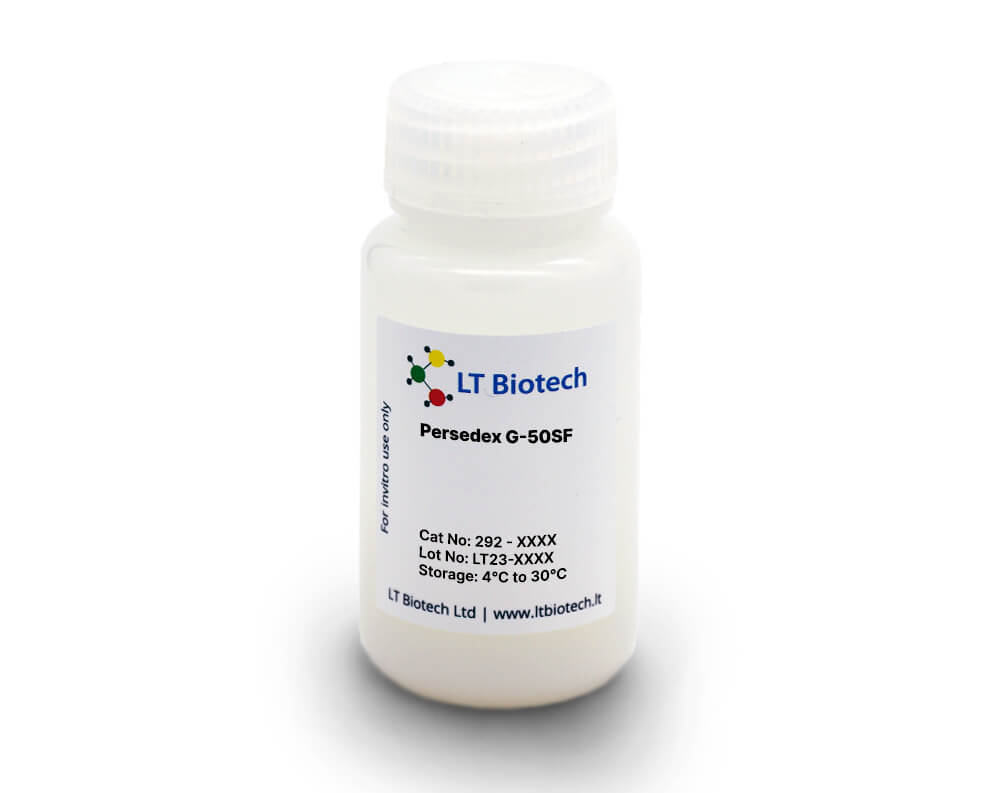
Persedex G-50SF
Resin parameters
Chemical resistance
Resin description
Persedex G-50SF is a cross-linked dextran gel filtration SEC resin with a particle size range of 10–40 µm and a separation range of 1.5–30 kDa. It separates molecules by differences in molecular weight. The Persedex G-50 series comes in three grades ordered by particle size, from the coarsest M through F to the finest SF; G-50SF is the finest. The resin is used for desalting biomolecules, buffer exchange, and the separation and purification of small molecular substances such as peptides.
Persedex G-50 scales up on two counts:
- A cross-linked dextran matrix with reliable rigidity.
- A range of pack sizes to suit different sample volumes, allowing linear scale-up.
Method of use
Chromatographic conditions
Buffer selection. Consider the stability of the sample in the buffer. Use a salt-containing buffer rather than ultrapure or pure water, to avoid non-specific adsorption.
Flow rate. Select a linear flow rate according to the column bed height, no higher than the recommended flow rate for this grade of 40 cm/h.
Sample pretreatment. Filter the sample through a 0.45 µm microporous membrane before loading to prevent the column from clogging.
Chromatography steps
- Equilibration. Use the buffer to fully equilibrate the column until the pH and conductivity are stable and consistent with the equilibration buffer. This step usually requires 1–2 column bed volumes (CV).
- Sample loading. The usual loading volume is 1–5% of the column volume. Do not use too high a sample concentration, to avoid overpressure and loss of resolution.
- Elution. Elute with buffer and collect the peaks at different positions, usually over 1–1.5 CV.
- Regeneration. Rinse the column with a high-salt buffer, such as 1M NaCl.
- Re-equilibration. Re-equilibrate the column with buffer.
Cleaning and regeneration
Contaminants such as lipids, endotoxins and proteins accumulate on the column as the number of uses increases. Regular cleaning-in-place (CIP) keeps the column in a stable working condition. Determine the frequency of CIP according to the degree of contamination. Where contamination is considerable, CIP after each use is recommended to ensure repeatability of results and to prolong the working life of the resin.
Recommended cleaning conditions by contaminant type:
- Strongly binding proteins: wash with 5 CV of 2M NaCl solution, or use a high-salt buffer at pH 3 or above, such as 1M NaAc solution.
- Strongly hydrophobic and precipitated proteins: wash with 5 CV of 0.2M NaOH solution, then wash out the alkali with 5–10 CV of ultrapure or pure water.
- Lipoproteins and lipids: wash with 5 CV of 70% ethanol or 30% isopropanol, then rinse with 5–10 CV of ultrapure or pure water.
Degas 70% ethanol or 30% isopropanol before use. Keep the flow rate at 30–60 cm/h during CIP. Reverse cleaning can be used where clogging is severe.
To reduce microbial load, treat the resin with 0.2M NaOH solution for 30–60 minutes.
Storage
Keep unopened resin in the original container at 4–30°C in a well-ventilated, dry and clean place. Do not freeze. Wash the used column with 2–3 CV of 20% ethanol solution and store at 2–8°C.
Destruction and recycling
Chromatography resin is difficult to degrade in nature, so incineration of waste resin is recommended. For resin that has been in contact with biologically active samples such as viruses and blood, follow local biosafety requirements before destroying or disposing of it.
Packing method
Detailed information on resin packaging is available on request. Please contact your local distributor.
Ordering information
- 579-00100 — 100 ml
- 579-00500 — 500 ml
- 579-01000 — 1 L
- 579-05000 — 5 L