
.svg)

.svg)


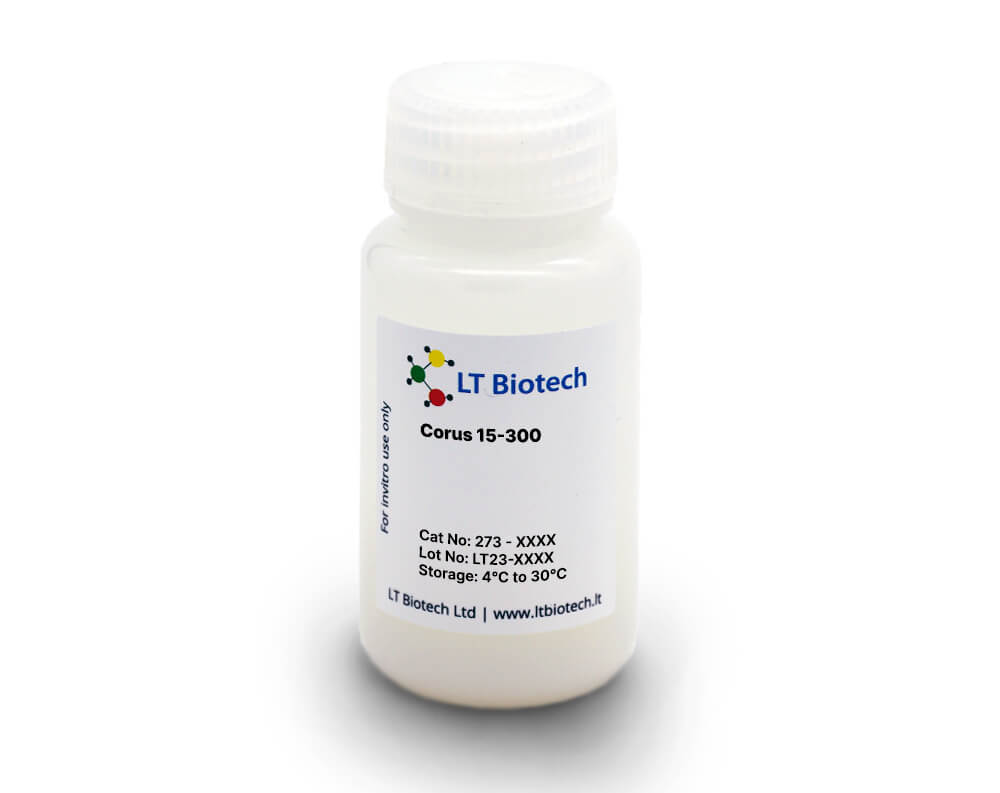
Corus 15-300
Resin parameters
Chemical resistance
Resin description
Corus 15-300 is a high-pressure chromatographic resin based on polystyrene-divinylbenzene. It has a large specific surface area, and excellent chemical and physical stability. Corus 15-300 has the advantages of high flow rate and high dynamic capacity, resistance to acid and alkali, and has a narrow pH operating range. The resin is used in reversed-phase chromatography (RPC) separation of small molecular compounds, peptides, low molecular weight proteins and other biomolecules.
Method of use
Column packing
Slurry concentration is the volume of the resting gel divided by the total volume after homogenisation. The best packing effect is obtained using a 0.5M NaCl slurry at a concentration of 70%.
- Calculate the column volume: V = Ac × L, where Ac = π × r². Ac is the cross-sectional area of the column, L is the height of the column, and r is the radius of the column.
- Agitate the medium to form a slurry and measure the required mass or volume. This should be about 1.2 CV to prevent shrinkage.
- Replace 20% ethanol with 0.5M NaCl solution and equilibrate overnight.
- Before packing, use 0.5M NaCl solution to adjust the slurry concentration to 65–70%. Pour the slurry into the column in a single pass, allow it to settle, and mark the height.
- Install the adapter and adjust the height so that the compression coefficient is 1.05–1.10. Start the pump and use a flow rate of 1.5–2 × the working flow rate to stabilise the column bed.
Cleaning
Packed columns should be cleaned with at least 5 CV of ultrapure or pure water.
Flow rate
After packing the column, equilibrate with the mobile phase for 3–4 CV. Control the flow rate at 1–5 cm/min until the conductivity and pH of the flow-through remain constant before loading the sample.
Sample loading
Solid samples can be prepared by dissolving them in equilibration buffer. Low-concentration sample solutions can be concentrated in advance; high-concentration sample solutions can be diluted with equilibration buffer. Filter the sample by centrifugation or membrane filtration to avoid clogging the column.
Estimate the sample load from the loading capacity of the resin and the concentration of the target molecule in the sample. Before loading, make the sample buffer as consistent as possible with the equilibration buffer. Reduce the sample load for the first run, then increase it according to the retention time and peak shape of the target molecules.
Elution
Use 2–10 CV of an aqueous solution such as methanol, ethanol, acetonitrile or acetone. Adjust the pH with acid, alkali or buffer, or both, to elute the target molecules.
Cleaning and regeneration
Contaminants such as lipids, endotoxins and proteins accumulate on the column as the number of uses increases. Regular cleaning-in-place (CIP) keeps the column in a stable working condition. Determine the frequency of CIP according to the degree of contamination. Where contamination is considerable, CIP after each use is recommended to ensure repeatability of results and to prolong the working life of the resin.
First wash with 3–4 CV of ethanol, acetone, alkali with ethanol or other solvents at the operating flow rate, then wash with 3–4 CV of equilibration buffer to re-equilibrate the column.
Storage
Keep unopened resin in the original container at 4–30°C in a well-ventilated, dry and clean place. Do not freeze. Wash the used column with 2–3 CV of 20–25% ethanol solution and store at 2–8°C.
Destruction and recycling
Chromatography resin is difficult to degrade in nature, so incineration of waste resin is recommended. For resin that has been in contact with biologically active samples such as viruses and blood, follow local biosafety requirements before destroying or disposing of it.
Packing method
Detailed information on resin packaging is available on request. Please contact your local distributor.
Ordering information
- 273-00025 — 25 ml
- 273-00100 — 100 ml
- 273-00500 — 500 ml
- 273-01000 — 1 L
- 273-05000 — 5 L
- 273-10000 — 10 L